Showing posts with label Vladimir Putin. Show all posts

Sunday, November 23, 2025

Quote of the Day (Martin Cruz Smith, on a World of ‘Money, Propaganda, and Terror’)

“It came back, Arkady knew, to three things: money, propaganda, and terror. They weren’t discrete entities but a triskelion, forever whirling around each other. This was the mindset of spies, the men whose formative years had been spent in the margins of the shadow world. The more rules you break, the more success you have. The game never pauses and never stops. There are no periods of war and peace, just active hostility and retrenchments. There are no threats other than those which can be talked up, or in many cases made up, the better to justify eliminating them. There are no social problems that would be solved if solving them would reduce people’s dependence on the state. There are no grand plans, no master strategies, just the lust for power, the insane addictive desire to accumulate more and more because too much is never enough.”— American mystery and suspense novelist Martin Cruz Smith (1942-2025), Independence Square: Arkady Renko in Ukraine (2023)

What Donald Trump has presented to Ukrainian President Volodymyr Zelenskyy shouldn’t be dignified with the phrase “peace plan.” Even “surrender plan” has the diplomatic scent of perfume about it. Believe it or not, I don’t even think “appeasement” does it.

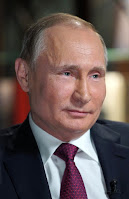
No, in its demands that Ukraine yield significant portions of its territory to Russia and cap the size of its security forces, along with an implied threat to curtail U.S. weapons deliveries if Zelenskyy doesn’t capitulate by Thanksgiving, the right word is "ultimatum"—something that Russian President Vladimir Putin (pictured) might make.

While reading this penultimate of 11 Arkady Renko mysteries by the late superb Martin Cruz Smith, I came across a succinct passage on Ukrainian history that I wish Trump could have read.

But what would have been the use? The President’s attention span is such that he’s lucky to digest a few bullets on a Powerpoint slide, let alone interconnected sentences.

Then I came across the quote above. Forget about Trump—I wish large portions of MAGA could read and ponder this. It explains so much about Putin, and, by the end, Trump himself (“There are no threats other than those which can be talked up, or in many cases made up”).

If the American President is not authoritarian, like the Russian leader, then he’s at least authoritarian-curious, and even more likely authoritarian-adjacent.

Thursday, May 29, 2025

Quote of the Day (John McCain, on Russia’s Leaders, ‘Corrupt With Power’)

“Russia's leaders, rich with oil wealth and corrupt with power, have rejected democratic ideals and the obligations of a responsible power. They invaded a small, democratic neighbor to gain more control over the world's oil supply, intimidate other neighbors, and further their ambitions of re-assembling the Russian empire. And the brave people of Georgia need our solidarity and our prayers.”—US Senator (R-AZ) and former POW John McCain (1936-2018), “Address Accepting the Presidential Nomination at the Republican National Convention in Saint Paul, MN,” Sept. 4, 2008, The American Presidency Project

For years, Donald Trump has acted weirdly and inexplicably towards Vladimir Putin, to say the least—from urging Russia in the 2016 Presidential campaign to release Hillary Clinton’s emails to claiming this year that Ukraine started its war with Russia. 

That behavior became even odder earlier this week, when he posted that the Russian dictator has “gone absolutely CRAZY” by escalating attacks on Ukraine amid peace negotiations.

Crazy? Hardly. That adjective, many would say, applies more to Trump.

No, despite the American President’s dictator-wanna aspirations, Putin has been unrelenting about his nationalist goals, pursuing them with a silence that Trump is temperamentally unable to maintain and with a cunning he can only envy.

Most of all, he has known how to appeal to Trump’s overweening ego, calling him a “genius” and feeding his misperception that Putin disregarded Barack Obama and Joe Biden because he didn’t “respect” them as he did their successor in the Oval Office.

So, over last weekend, Trump voiced frustration that Putin is “killing a lot of people.” Where has he been these last three years, since the invasion of Ukraine? Or the past decade? Or, to take McCain’s point, the last two decades?

You have to wonder, why is Trump squawking about Putin now? From the moment he became a serious contender for the GOP nomination a decade ago, he adopted a “see no evil, hear no evil, speak no evil” attitude on the former KGB operative.

Do you think the President is reading polls that show Americans don’t approve of that posture—and wonder if he is taking a tough enough stance against Putin?

Maybe, like Rip Van Winkle, Trump fell asleep for a generation, only to wake up to find the world utterly changed. Maybe his short-term memory is vanishing.

Long ago, that same phenomenon took hold of the MAGA faithful. How else to explain why, even after Putin’s actions unleashed the concerns of McCain (and the 2012 GOP nominee, Mitt Romney), delegates to the 2016 convention agreed, without the slightest fuss and following the urging of Trump representatives, to water down that year’s platform language about “providing lethal defensive weapons” to help Ukraine fight against pro-Russian separatists?

Whatever the case may be, Moscow can barely disguise its amusement over Trump’s incoherent rhetorical flailing. Kremlin spokesman Dmitry Peskov referred to “emotional overload,” while a female flunky trotted out for Putin-controlled television said Trump’s warning that the Russian strongman might be “playing with fire” would last “until tomorrow.”

Remarkably, the Russian government finds itself in accord with Wall Street about Trump’s mood and policy shiftsall that loud blustering followed by hasty retreats. The nickname most applicable, an acronym that made the President lash out yesterday at yet another reporter for asking a “nasty question,” was TACO—“Trump Always Chickens Out.”

(The image accompanying this postJohn McCain's official senatorial photo, taken Jan. 23, 2009derived from his Facebook page.)


Wednesday, December 18, 2024

Quote of the Day (Charles Simic, on the ‘Bloody Epic’ of a Dictator)

“I had a small, nonspeaking part
In a bloody epic. I was one of the
Bombed and fleeing humanity.
In the distance the great leader
Crowed like a rooster from a balcony,
Or was it a great actor
Impersonating the great leader?”—Pulitzer Prize-winning Serbian-American poet Charles Simic (1938-2023), “Cameo Appearance,” in The Voice at 3 a.m.: Selected Late and New Poems (2003)

As a child in World War II, Charles Simic was forced to evacuate with his family several times from their Belgrade home, part of the “bombed and fleeing humanity” of that conflict—or, as he put it elsewhere, “My travel agents were Hitler and Stalin.” He finally made it to America as a teenager.

This past week witnessed the fall of another strongman: Syria’s Bashar al-Assad, whose father, Hafez al-Assad, began the family tradition of bloody rule in 1971. That’s a long time for a country to endure such repression and violence, and now the evidence of this misrule is becoming starkly evident: mass graves uncovered, perhaps numbering hundreds of thousands of people tortured to death.

And there is another way in which the Syrians' plight resembles the Simic family's: over 14 million forcibly displaced since the nation's civil war began in 2011.

The fate of Assad should be kept in mind by entertainers with authoritarian aspirations: it may take a while, but a reckoning will be at hand, for yourself and/or your family.

(The image accompanying this post, showing Assad with Vladimir Putin in Moscow to discuss military operations in Syria, was taken Oct. 21, 2015—nine years before the Russian dictator, with blood on his own hands too thick for words, decided that the costs of helping the younger man remain in power was more than he could handle now.) 

Thursday, November 7, 2024

Quote of the Day (Anne Applebaum, on How Kleptocracies Spread From Russia)

“Since the 1990s, the kleptocratic model created in Russia has spread much further. From Angola to Zimbabwe, dictators with access to hidden sources of wealth are better able to resist demands for political change. They can hide their families and their property abroad. They can finance bribery and influence operations. The aura of secrecy they build is also part of what keeps them in power. Ordinary Russians, ordinary Chinese or ordinary Venezuelans are not allowed to know why their rulers, and their rulers’ friends and their families, are billionaires, because they’re not meant to have any influence or understanding or knowledge of politics at all. That lack of knowledge creates a sense of helplessness, apathy, even despair.”— Pulitzer-prize winning American historian Anne Applebaum, “Follow the Money,” The Financial Times, Aug. 31-Sept. 1, 2024

With Donald Trump’s election to a second term, the United States has officially joined—or, I should say, rejoined—the ranks of the dubious global fraternity of kleptocracies—i.e., governments with leaders who seek personal gain and status at the expense of those they govern.

In an interview last month with Jeffrey Rosen at the National Constitutional Center, Applebaum not only discussed how the kleptocratic model exemplified by Vladimir Putin (pictured) operates in autocracies across the world, but also how it figures in the case of Trump, whose “primary concern at all times is himself and his own finances and his own power.”

Even while President, Applebaum notes, the autocrat-curious politico maintained the practice he’d begun in his days as a New York real estate mogul of selling condos in Trump-branded or Trump-owned buildings to anonymous people, whose intentions—including whether they were out to bribe or influence White House officials—were unknown.

The potential for conflicts of interest was clear, a situation only worsened by how Trump flouted prior Presidential procedures for blind trusts. Though ostensibly turning over management of the Trump Organization to his two eldest sons after becoming President in 2017, he still received updates on the family-owned trust and remained its chief beneficiary.

Just as the Former and Future Guy made a farce of the notion of a “blind trust,” the Supreme Court did so with the belief that justice is blind. 

In a preview of its extraordinary deference in this past session in granting Trump broad immunity from prosecution for “official acts,” the Roberts Court dismissed in 2021 two cases involving his violations of the Constitution’s “emoluments clauses” for preventing Presidential corruption. (See Ciara Torres-Spelliscy’s excellent summary from that time for the Brennan Center for Justice.)

I have taken particular interest in Trump’s use of the U.S. government as a virtual slot machine for the Trump Organization because one instance of it occurred not far from my family’s ancestral homeland in County Clare, Ireland.

In September 2019, taxpayers footed a $15,000 bill for Secret Service lodging for Vice President Mike Pence’s trip to Ireland. The lucky beneficiary of this largesse? Trump’s Doonbeg resort, which he had already spent $41 million to buy, renovate and operate without returning a profit to that point. 

It was all part of a pattern in which Trump made $82 million from his three properties in Ireland and Scotland through often convoluted and unnecessary travel itineraries and exorbitant tacked-on charges, according to Rebecca Jacobs’ June 2023 report for the ethics watchdog organization Citizens for Responsibility and Ethics in Washington (CREW).

Even while in office, the Trump Organizations maintained ethically and legally questionable investments involving Trump International Hotel, New York’s Trump World Tower, Dubai’s Trump International Golf Club, trademarks in China, and royalties from The Apprentice and its spinoffs in multiple countries.

Then, while Trump planned his return to power, son-in-law Jared Kushner, while publicly withdrawing from campaign appearances, secured a $2 billion investment from a Saudi Arabian fund led by Crown Prince Mohammed bin Salman, as well as $157.5 million in management fees from foreign investors for work expected to be completed in 2024.

Let’s stop for a second on that last item. Mohammed bin Salman—you may remember him as “MBS,” the shadowy potentate credibly charged with ordering the October 2018 assassination of Saudi journalist Jamal Khashoggi.

Is it necessary to spell out the obvious implications of the Kushner deal for diplomacy and influence peddling?

The naturalist writer Frank Norris titled his 1901 novel of corruption by a massive railroad conglomerate The Octopus. With the resounding victory of MAGA forces this week, American voters have given carte blanche to the Trump Octopus.

Presidents' financial misdeeds are not as easy to understand as their infidelities, but they are more important to know if we hope to grasp how the long-term interests of the American people can be subverted. 

Despite Trump’s war against the group he calls “the enemy of the people,” the press owes it to the republic to continue and even amplify its reporting on the President-elect’s festering corruption—and Americans in turn owe it to themselves to pay attention and act accordingly.


Wednesday, April 3, 2024

This Day in Military History (Western Democracies Pledge Mutual Security With North American Treaty)

April 4, 1949—The countries who put their signature to the North Atlantic Treaty in Washington, DC, looked just like the Allied coalition that had recently won World War II in Europe—but with one notable exception: the Soviet Union, whose postwar threats to elected governments had alarmed its former partners.

Since the formation of this defensive pact, the North Atlantic Treaty Organization (NATO) has increased from its original 12 to 32 members. Its recent growth derives from the same factor that brought it into existence: a septuagenarian dictator who, in his quest to annex neighbors and subvert republics, inspires other nations to band together in mutual support.

Back in 1949, that authoritarian ruler was Joseph Stalin, who saw the chaos and devastation in the wake of WWII as an opportunity to expand Soviet influence, including through:

*reneging on its Yalta Conference promise of free elections in Poland;

*exploiting its continued military presence in Hungary to pressure non-Communist parties into submission;

*covertly backing an overthrow of the democratically elected government of Czechoslovakia by the nation’s Communist party;

*blockading Allied-controlled West Berlin in an unsuccessful attempt to incorporate the whole city into its orbit.

In 2024, the dictator is Vladimir Putin, whose revanchist nostalgia for the return of Russian influence has led him to invade Ukraine—a move that, in turn, led to a prompt application to join NATO by Finland and Sweden.

The West’s attempts to begin new eras of cooperation with Stalin and Putin quickly foundered as perceptions grew that these dictators were intent not just on cracking down on internal dissent but on posing a threat to Eastern Europe.

American, Britain, and French leaders had hoped to include the Soviets in a postwar Council of Foreign Ministers, according to a Truman Library oral history interview with John D. Hickerson, the Assistant Secretary of State generally credited with writing the text for what became the North Atlantic Treaty.

But, after 1947 conferences in Moscow and London that went nowhere because of Soviet intransigence, the three transatlantic partners determined to go their own way.

The genesis for the new system of cooperation came from British Foreign Secretary Ernest Bevin, but the indispensable forces were the two American Secretaries of State when the treaty was hammered out in 1948 and early 1949, George Marshall and Dean Acheson.

The most important element of the North American Treaty may be Article 5, in which the signatories agreed that "an armed attack against one or more of them… shall be considered an attack against them all" and that following such an attack, each Ally would take "such action as it deems necessary, including the use of armed force" in response.

The first time that mutual-aid pledge would be invoked came not in response to a move by the USSR, but after 9/11—and it did not involve the US coming to the aid of the organization’s European members, but them supporting us in the wake of the attack on the World Trade Center.

Hickerson’s oral history interview gives a strong sense of the improvisational nature of the discussions shaping the North Atlantic Treaty. 

The diplomats, he explained, were talking about “what we would do in the event of an attack, without considering anything beyond the political commitment to do that. And frankly in the back of our minds was the hope that that commitment itself would be enough to restrain any aggression.” 

It would not be until the following year, with the outbreak of the Korean War, before the “machinery” of NATO would be set up.

This brief history is worth keeping in mind in the present US. Presidential cycle, with one all-but-certain party nominee saying he would encourage Putin to do “whatever the hell they want” to any NATO member that falls behind on its defense spending guidelines.

That Presidential candidate’s complaint about failing to meet these guidelines echoes the chief  American opponent of the pact back in 1949, Robert Taft, who saw it as “arming Western Europe at American expense.”

But the deeply conservative, anti-communist Republican Senator from Ohio was under no illusions about Stalin’s intentions and never praised his “strength.”

Moreover, the national defense spending percentages on which today’s isolationists fixate are, as mentioned earlier, guidelines, not ironclad commitments.

The Cold War between the US and USSR was often conducted without nuance and sometimes risked catastrophe. But NATO created a defensive alliance based on collective security—an arrangement missing before WWII that would have eased the task of countering Nazi aggression.

That alliance resulted in 75 years of peace, encouraging international commerce—the kind of minimal-cost arrangement that one might have hoped a once and future businessman might have better appreciated.

(The photo accompanying this post shows President Harry Truman with the diplomats from the countries signing the North Atlantic Treaty.)

Friday, March 1, 2024

Quote of the Day (Jeffrey Lewis, on the Coming Military Challenge in Space)

“China, India, Russia, and the United States have all conducted antisatellite tests that created large amounts of debris. If they continue to conduct these tests, or if other countries follow suit, then the debris problem will continue to worsen, posing threats to both satellites and human crews in space. And antisatellite weapons are just the beginning. There are so many new actors in space. More than a dozen countries have the ability to launch satellites into orbit, including India, Iran, Japan, South Korea, and even North Korea. Add to that the private space launch companies owned by billionaires, like Elon Musk’s SpaceX and Jeff Bezos’s Blue Origin. New technologies, such as autonomous proximity operations, also allow for the development of small satellites that can rendezvous in orbit with other satellites—to inspect them, fix them, or even damage them. The orbital environment is changing rapidly. Increasingly we need rules, as well as the ability to understand our interests in the broad context of common interest among all spacefaring states to maintain the orbital environment. These rules must address military activity in space. Yet the international community was unable to agree on even a voluntary code of conduct.”— Arms control blogger and scholar Jeffrey Lewis, “2022: A Space Emergency,” The American Scholar, Spring 2022

Such is my curiosity that over the last few years, my propensity to buy reading matter, only to lay it aside for when I have more time, has grown apace. I must admit that, nearly two years ago, when I saw the “War and Space” cover headline for the Spring 2022 issue of The American Scholar, it all sounded like Flash Gordon stuff to me—or, maybe more appropriate, “Star Wars.”

I am sure that all too many Americans, still reeling from COVID, inflation, and the early days of Russia’s invasion of Ukraine, felt similarly.

Buy now, the Space Defense Force that Donald Trump pushed into being while in the White House is going to be tested in a major way by Vladimir Putin.

For reasons best known to himself, Rep. Mike Turner, R-Ohio, chair of the House Intelligence Committee, released a statement two weeks ago on a “serious national security threat” that some thought might be a nuclear weapon, while others believed the weapon might be nuclear-powered but not a nuclear warhead.

The next day, the White House said the Russian system under development was a space-based anti-satellite weapon. Its use would violate the 1967 Outer Space Treaty, which bans weapons of mass destruction in space.

Little of this should have come as such a shock because it was widely reported at the time, but the current prospects for nuclear terror, as Lewis notes, were laid two decades ago, when the administration of George W. Bush withdrew from the ABM Treaty, signed by Richard Nixon in 1972, which limited missile defenses.

Lewis’ article reinforces my conviction that a crisis is simply a problem worsened into potential catastrophe by officeholders through perpetual procrastination.

You may remember—or maybe you won’t—that the successful launch of Sputnik 1 in 1957 and the possibility that the Soviet Union was leapfrogging the US in the technological superiority behind military systems boosted momentum for the creation of the National Air and Space Administration and more spending for science education in the National Defense Education Act the following year.

We will see whether Putin’s statements since the Turner disclosure—a denial that Russia intends to deploy outer-space weapons, coupled with a confirmation that its “strategic nuclear forces are in a state of full readiness"—are enough either to boost science education again or to disenthrall Rep. Turner, his Capitol Hill colleagues in his party caucus, or the party leader who once told reporters he accepted the assurances of Putin rather than the word of his own intelligence agencies.

Thursday, February 15, 2024

Quote of the Day (Alexander Solzhenitsyn, on How Writers and Artists Can ‘Conquer Falsehood’)

“And the simple step of a simple courageous man is not to partake in falsehood, not to support false actions! Let THAT enter the world, let it even reign in the world – but not with my help. But writers and artists can achieve more: they can CONQUER FALSEHOOD! In the struggle with falsehood art always did win and it always does win! Openly, irrefutably for everyone! Falsehood can hold out against much in this world, but not against art.”—Russian novelist and dissident Alexander Solzhenitsyn (1918-2008), Nobel Lecture 1970

Fifty years ago this week, Alexander Solzhenitsyn was deported from the USSR for having written The Gulag Archipelago, a searing history and memoir of life in the Soviet Union’s prison camp system. His real “crime” was to expose the falsehood at the heart of Communist Party rule: that terror in the country began not with Joseph Stalin but with his predecessor, the founder of the USSR, V. I. Lenin.

Solzhenitsyn came to the United States but was never comfortable with the country that provided him with a refuge from harassment, arrest, and, potentially, even worse. Four years after the start of his exile, in a controversial commencement address at Harvard University, he surprised listeners and the wider world by attacking the West for its secularism, materialism, and lack of courage.

If you Google this speech, you will find many links praising it for its prophetic vision. I can’t help but regard much of it with dismay, though—not only for the points the great Russian dissident overlooked about the West but for an underlying outlook that became more apparent when he returned to his post-Communist homeland.

Solzhenitsyn could not see, for instance, that the legalistic culture and stress on individual rights in the West provided the basis for the human rights movement that created an alternative to totalitarianism and undermined Soviet legitimacy.

Moreover, after going home triumphantly to Russia 20 years later as a free man, with his citizenship restored, Solzhenitsyn started expressing more aggressively what Robert Coalson, in a 2014 essay for The Atlantic, called his “Greater Russian, Orthodox-driven nationalism.”

That outlook led the Nobel laureate to praise Vladimir Putin as he rose to power. In fact, Coalson notes, Solzhenitsyn’s 1990 essay “Rebuilding Russia,” though it urged the divestment of non-Slav republics, foreshadowed Putin’s plan to reunite Ukraine with Russia.

This week, still under the influence of The Gulag Archipelago’s act of profound moral witness, I bought an epic historical novel that Solzhenitsyn extensively revised while in exile, August 1914, part of his "Red Wheel" cycle on the end of Czarist Russia and the rise of the USSR. I wonder how much of it will reflect his great literary gifts and moral outrage—and how much of it will display the nationalistic blindness that led him to overlook Putin’s creeping authoritarianism.

William Harrison’s retrospective at the time of Solzhenitsyn’s death in the English publication The Guardian praised the Russian for his “principled and brave unmasking of the horrors of the Soviet regime,” while also lamenting his pan-Slavism, “the fantastical, backward-looking political idealism that led him to support Putin's project.”

“Like many of those disillusioned with western liberalism, in Russia and the west, he fancied that ‘Putin's path’ provided an alternative,” Harrison concluded. “The reality of this ‘alternative,’ involving, for example, the pilfering of resources by Kremlin-backed ‘businessmen’ and the silencing of the media by censorship and killing, is less than promising.”

Ironically, Solzhenitsyn failed to perceive that Putin would mix Russian nationalism with the dark arts of disinformation and deception he learned as a KGB foreign intelligence officer to create a homegrown 21st-century model of authoritarianism, maybe even more exportable and viral than the Communist variety. The obligation now resides in others once again to “conquer falsehood.”

Friday, August 25, 2023

Quote of the Day (Christo Grozev, Foretelling the End of Russia’s Major Coup Plotter)

“[Russian President Vladimir] Putin went on TV and called [Yevgeny] Prigozhin a traitor. Everyone knows what they do with 'traitors,' and Putin hasn't done that. He wants to see him dead. He can't do that yet. In six months, Prigozhin will either be dead, or there will be a second coup. I'm agnostic between the two, but I can't see neither of these happening."— Investigative journalist Christo Grozev, correctly predicting the fate of the late Wagner Group leader and coup plotter, quoted by Edward Luce, “Lunch With the FT: Christo Grozev,” The Financial Times, August 12-13, 2023

Now, I’d like to credit Grozev with the uncanny powers of Nostradamus, or what passes as such in the international intelligence community.

But I suspect that the journalist would be the first to tell you that it took no special soothsaying skill to know that Prigozhin would come to an untimely end. So many people, inside and outside Russia, who find themselves at odds with Vladimir Putin have suffered a similar fate, as itemized in Lauren Said-Moorhouse's CNN story today

The only real question was how Prigozhin would die. A plane crash was so convenient, and so poetic, in a sense. After all, his coup attempt of a few months ago never did really take flight, did it?


Thursday, June 29, 2023

Quote of the Day (George Orwell, on Totalitarianism and ‘The Continuous Alteration of the Past’)

“From the totalitarian point of view history is something to be created rather than learned. A totalitarian state is in effect a theocracy, and its ruling caste, in order to keep its position, has to be thought of as infallible. But since, in practice, no one is infallible, it is frequently necessary to rearrange past events in order to show that this or that mistake was not made, or that this or that imaginary triumph actually happened. Then again, every major change in policy demands a corresponding change of doctrine and a revelation of prominent historical figures. This kind of thing happens everywhere, but is clearly likelier to lead to outright falsification in societies where only one opinion is permissible at any given moment. Totalitarianism demands, in fact, the continuous alteration of the past, and in the long run probably demands a disbelief in the very existence of objective truth.”—English novelist and essayist Eric Blair, aka George Orwell (1903-1950), “Books v. Cigarettes,” originally published in 1946, later reprinted in Essays (Everyman Library, 2002)

George Orwell wrote these words with two totalitarian rulers in mind: Adolf Hitler and Joseph Stalin. Hitler’s dream of a thousand-year Reich crumbled at the end of WWII, and the Soviet Union that Stalin turned into a superpower collapsed from within more than 40 years later.

But Vladimir Putin has learned the lesson these two dictators taught about using fake history to control the present moment. He exploited fear and resentment over the loss of national power to manipulate his people.

Lucian Kim’s March 2022 article for the Wilson Center explored Putin’s “dangerous hobby”: a grasp of history “highly selective and distorted by politics” (a blueprint for control, I might add, that is increasingly envied, if not emulated, by Western proto-strongmen). Kim’s analysis of the Russian leader’s obsession with the wrong lessons of the past is best summed up with respect to Ukraine:

“If Russians are not allowed to condemn past crimes committed in their name, they will not be able to liberate themselves from the Soviet mindset. And as long as they are not free of the Soviet past, Russians will be unable to accept the paradox that the Soviet Union could be both liberator and occupier of half of Europe—and that they themselves were prisoners in their own country.”

(Jordan M. Poss’ blog post from May of last year contains another interesting reflection on “Orwell on History and ObjectiveTruth.”)

Friday, February 24, 2023

Quote of the Day (Liana Fix and Michael Kimmage, on the ‘Rules-Based Order’ Putin Left Long Before Invading Ukraine)

“[Vladimir] Putin projected a conciliatory air early in his presidency, although he may have harbored hatred of the West, contempt for the rules-based order, and an eagerness to dominate Ukraine all along. In any case, once he retook the presidency in 2012, Russia dropped out of the rules-based order. Putin derided the system as nothing more than camouflage for a domineering United States. Russia violently encroached on Ukraine's sovereignty by annexing Crimea, reinserted itself in the Middle East by supporting Assad in Syria's civil war, and erected networks of Russian military and security influence in Africa.”— Liana Fix and Michael Kimmage, “Putin’s Last Stand: The Promise and Peril of Russian Defeat,” Foreign Affairs, January/February 2023

Wednesday, April 20, 2022

Quote of the Day (Alexander Solzhenitsyn, on ‘Unlimited Power’)

“Unlimited power in the hands of limited people always leads to cruelty.”—Russian Nobel Literature laureate Alexander Solzhenitsyn (1918-2008), The Gulag Archipelago 1918–1956: An Experiment in Literary Investigation (1973)

It was one of the great ironies and tragedies of the life of Alexander Solzhenitsyn that the Russian novelist, who endured imprisonment, harassment, and exile at the hands of the Communist regime, was blind to the growing menace to his country posed by a former KGB operative.

Wrapping himself in the intense love of country and faith in God felt by Solzhenitsyn and so many of his countrymen—all the while ensuring that the material needs of the populace were met more than they had been in generations—Vladimir Putin consolidated absolute power by degrees. With an additional dollop of ego-stroking, he managed to fool even the great Russian writer and dissident into believing that he was merely restoring national greatness.

Too bad Solzhenitsyn could not have pondered again his own words about what happens when “unlimited power” is placed in the hands of people without the capacity to withstand temptation. But those of us in the West should not go away thinking it can’t happen here. It has, and may yet again.

Thursday, March 3, 2022

Quote of the Day (James Shirley, on ‘The Glories of Our Blood and State’)

“The glories of our blood and state
     Are shadows, not substantial things;
There is no armour against Fate;
     Death lays his icy hand on kings:
               Sceptre and Crown
               Must tumble down,
And in the dust be equal made
With the poor crooked scythe and spade.” — English poet-playwright James Shirley (1596–1666), The Contention of Ajax and Ulysses (1659)

The theme of these verses by Shirley—destined to see in his lifetime the death of the Tudor dynasty, the coming, going and revival of the Stuart dynasty, and the short-lived dictatorship of Oliver Cromwell—was encapsulated more succinctly nearly a century later in the great line from Thomas Gray’s “Elegy Written in a Country Churchyard”: “The paths of glory lead but to the grave.”

These days, as they attempt to bully smaller nearby nations, Russia’s Vladimir Putin and China’s Xi Jinping seem destined to learn this lesson all over again. But, even before the meet the same fate as any of their poor, powerless countrymen, they may well have to cope with another indignity: laughter at their expense.

Putin has already been satirized by Saturday Night Live’s Beck Bennett. To my knowledge, SNL hasn’t yet turned its hand towards dealing with Xi.

But I think the best manner of dealing with Putin and Xi is to put them together and dispatch them at the same time, much like when Charlie Chaplin and Jack Oakie (both pictured) played an earlier dictatorial duo, “Adenoid Hynke” and “Benzino Napolon,” in the 1940 film, The Great Dictator.


Saturday, February 26, 2022

Quote of the Day (Fiona Hill, on Putin’s Sense of Internal and External Threats)

“In truth, most American policymakers simply wish that Russia would just go away so they can refocus their attention on what really matters. For their Russian counterparts, however, the United States still represents the main opponent. That is because, as a populist leader, [Russian dictator Vladimir] Putin sees the United States not just as a geopolitical threat to Russia but also as a personal threat to himself. For Putin, foreign policy and domestic policy have fused. His attempt to retain Russia’s grip on the independent countries that were once part of the Soviet Union and to reassert Moscow’s influence in other global arenas is inseparable from his effort to consolidate and expand his authority at home.”—Fiona Hill, Brookings Institution fellow and former National Security Council Russian specialist, “The Kremlin’s Strange Victory: How Putin Exploits American Dysfunction and Fuels American Decline,” Foreign Affairs, November/December 2021

Saturday, January 8, 2022

Quote of the Day (Anne Applebaum, on the Business Links Among Dictators)

"Nowadays, autocracies are run not by one bad guy, but by sophisticated networks composed of kleptocratic financial structures, security services (military, police, paramilitary groups, surveillance), and professional propagandists. The members of these networks are connected not only within a given country, but among many countries. The corrupt, state-controlled companies in one dictatorship do business with corrupt, state-controlled companies in another. The police in one country can arm, equip, and train the police in another. The propagandists share resources—the troll farms that promote one dictator’s propaganda can also be used to promote the propaganda of another—and themes, pounding home the same messages about the weakness of democracy and the evil of America….

“Unlike military or political alliances from other times and places, the members of this group don’t operate like a bloc, but rather like an agglomeration of companies—call it Autocracy Inc. Their links are cemented not by ideals but by deals—deals designed to take the edge off Western economic boycotts, or to make them personally rich—which is why they can operate across geographical and historical lines.”—American journalist Anne Applebaum, “The Autocrats Are Winning,” The Atlantic, December 2021

Russia’s Vladimir Putin—featured prominently in Ms. Applebaum’s informative and disturbing cover story of last month’s issue of The Atlantic, as well as in the photo accompanying this post—might not lead a sprawling international bloc dedicated to one ideology, the way Soviet dictators for most of the 20th century did.

But he is certainly a charter member of and inspiration for what Ms. Applebaum calls “Autocracy Inc.” Combining the black arts of disinformation and dissent-crushing he learned while in the KGB with the realization that capitalism provides rich new opportunities for corruption that can sustain him in power, he has pioneered the most disturbing form of top-down control seen so far in the 21st century.

In judging the value of American politicians and pundits, it’s not a bad yardstick to see which ones have continued to hail Putin for his strength (as discussed in Jonathan Chait’s March 2021 piece for New York Magazine), even as his methods of corruption, harassment and murder have become all too brazen.

Tuesday, May 5, 2020

Quote of the Day (Michael Idov, on Cynicism and Dictatorships)


“One tends to imagine life in an autocratic regime as dominated by fear and oppression: armed men in the street, total surveillance, chanted slogans, and whispered secrets. It is probably a version of that picture that has been flitting lately through the nightmares of American liberals fretting about the damage a potential autocrat might do to an open society. But residents of a hybrid regime such as Russia’s — that is, an autocratic one that retains the façade of a democracy — know the Orwellian notion is needlessly romantic. Russian life, I soon found out, was marked less by fear than by cynicism: the all-pervasive idea that no institution is to be trusted, because no institution is bigger than the avarice of the person in charge. This cynicism, coupled with endless conspiracy theories about everything, was at its core defensive (it’s hard to be disappointed if you expect the worst). But it amounted to defeatism. And, interestingly, the higher up the food chain you moved, the more you encountered it.”— Michael Idov, “Russia: Life After Trust,” New York Magazine, Jan. 23, 2017

The image accompanying this post shows Russia’s Vladimir Putin—not only the dictator of his country’s own autocracy, but also a model for would-be strongmen elsewhere. This article was published three years ago, but it is no less relevant now--and probably more so.

Saturday, March 16, 2019

Quote of the Day (John Sipher, on Vladimir Putin and the World’s First ‘Intelligence State’)


“The history of the brutal Soviet security services lays bare the roots of Russia's current use of political arrests, subversion, disinformation, assassination, espionage and the weaponization of lies. None of those tactics is new to the Kremlin. In fact, those tactics made Soviet Russia the world's first ‘intelligence state,' and they also distinguished it from authoritarian states run by militaries. Today's Russia has become even more of an intelligence state after Mr. [Vladimir] Putin's almost 20-year tenure….[A] decade after the Soviet Union fell, Mr. Putin rose to power and recruited many of his former K.G.B. colleagues to help rebuild the state.  The result is a regime with the policies and philosophy of a supercharged secret police service, a regime that relies on intelligence operations to deal with foreign policy challenges and maintain control at home.”—Former CIA station chief John Sipher, “Putin’s Main Weapon: The ‘Intelligence State,’” The New York Times, Feb. 23, 2019