Showing posts with label Academy Awards. Show all posts

Monday, February 9, 2026

This Day in Film History (Birth of Ronald Colman, Sterling Star of Silent and Sound Eras)

Feb. 9, 1891— Ronald Colman, an Oscar-winning actor who personified courtliness from Hollywood’s silent to sound eras, was born in Richmond, England.

Probably because I was annoyed by what seemed like an unduly stiff performance as an amnesiac war casualty in Random Harvest (1942), I was put off for years by Colman. I changed my opinion after watching his world-weary diplomat in Frank Capra’s adaptation of the James Hilton novel Lost Horizon (1937).

But it was his depiction of brilliant, alcoholic, self-sacrificing lawyer Sydney Carton in the 1935 adaptation of Charles Dickens’ A Tale of Two Cities that finally convinced me that Colman was a sterling talent, well-deserving of his reputation as one of Hollywood’s best leading men of the 1930s and 1940s.

Understandably, the actor saw this as one of the best roles of his career. Not only did he agree to shave off his trademark mustache to play the part, but, with great good humor, he recited his climactic speech from the film whenever Jack Benny visited him on the comedian’s radio and TV shows.

After a half-century, I think I really should re-watch Random Harvest, which enjoys a reputation as one of the finest romantic melodramas of Hollywood’s golden age. 

Colman himself had been badly wounded in the Great War while serving in the London Scottish Regiment (a legendary unit in which actors Basil Rathbone, Herbert Marshall, and Claude Rains had their own harrowing experiences, as related in this 2015 post on the “Sister Celluloid” blog).

The war was as psychologically as physically devastating, as Colman recalled later:

“I won’t go into the war and all that it did to all of us. We went out. Strangers came back. It was the war that made an actor out of me. When I came back that was all I was good for: acting. I wasn’t my own man anymore.”

Undoubtedly, it was Colman’s identification with the traumatized veteran in Random Harvest that helped him overcome an often far-fetched script—and win an Oscar nomination.

The war did not end Colman’s travails. Determined to appear on the New York stage, he initially encountered a long period of unemployment, to such an extent that he was reduced to scrounging for food. (“Figuring out the best way to spend five cents in an automat was an art at which I became adept. Doughnuts were the main standby.”) At last he broke through.

Colman found film to be the real, where he made his mark, however, when director Henry King cast him opposite Lillian Gish in the 1923 silent The White Sister. The movie was so successful that the trio reunited for Romola the following year.

Unlike many silent-film idols, Colman had no trouble adapting to sound. In fact, the new technology enhanced his career because he could take advantage of his distinctive voice: rich, cultured, mellifluous, enhancing his image as an English gentleman.

“Colman only really hit one note with it, a sort of wistful oboe note, but that note was enough if the writing of the picture suited his restrained lyricism,” wrote Dan Callahan in an October 2025 post on his “Stolen Holiday” blog.

No matter what genre he tried—western, melodrama, detective film, romantic comedy—Colman’s gentlemanly persona was tinged with melancholy, a trait of his off-screen temperament. That sense was reinforced early in his career because of a disastrous first marriage.

Colman wed Thelma Raye in haste in 1920, a union he came to rue as, stricken with jealousy at his increasing success, the actress took to stalking him. Increasingly withdrawn under this pressure, Colman was relieved when she sued him for divorce 14 years later. Fortunately his second marriage, to Benita Hume, was longer (20 years, until his death) and far happier.

To the greatest extent possible, Colman tried to live with discretion, so the public knew little of his private circumstances. What it saw onscreen, it loved. 

In addition to the films I mentioned previously, I also enjoyed him in The Talk of the Town (1942), a comedy in which his straitlaced lawyer risks his nomination to the Supreme Court by aiding an escaped convict whose innocence he comes to believe in.

With his fourth Oscar nomination in 1947 for A Double Life, Colman finally won formal recognition from his peers by winning the coveted statuette, as a Shakespearean actor whose latest role—the jealousy-maddened Othello—begins to mirror his own life.

(A recent biographer of Colman, the prolific Carl Rollyson, has a astute analysis of the actor’s “graceful, literate masculinity” in this Spring 2024 article for Humanities, a journal of the National Endowment for the Humanities.)

Friday, November 14, 2025

Flashback, November 1960: ‘BUtterfield 8,’ The Film Hated by Its Stars and Author, Opens

 A common adage holds that nobody ever went broke underestimating the taste of the American public. Today’s case in point: BUtterfield 8, which MGM released 65 years ago this month.

It’s hard to find anyone today with much good to say about the film. When it came out, critics and even those most closely associated with the outcome of the movie felt just as strongly about the movie:

*Star Elizabeth Taylor took the role of promiscuous party girl Gloria Wandrous because she had to, in order to fulfill the last in a three-picture deal.

*Singer Eddie Fisher, who got his supporting role (his first movie acting credit) only at the insistence of his wife Taylor, never took another onscreen—perhaps out of embarrassment, perhaps because Hollywood regarded it as proof positive that he was best suited for his normal profession;

*Author John O'Hara could be forgiven for his usual cantankerous attitude this time, as he correctly believed that the Charles Schnee-John Michael Hayes screenplay had badly oversimplified his Depression-era novel.  Admirers like myself badly miss a cinematic equivalent of his panoramic view of class-ridden Manhattan in the Prohibition Era, as well as the bitter lament of his Irish-American alter ego, James Malloy, about being viewed as less than American by the WASP elite. (See my blog post from 14 years ago on the real-life scandal that O'Hara used as his springboard.)

With all the disgust these figures felt, American moviegoers reacted differently. BUtterfield 8 earned $10 million at the box office, which, on a budget of approximately $2 million, made it one of the biggest hits of 1960. And, in the new year, Hollywood gave Taylor her the first of two Oscars for a role in a motion picture that was little short of pornography.

The Production Code Administration, Hollywood’s censorship arm, had made it virtually impossible for more than two decades to bring O’Hara’s book to the screen. Although Hayes observed late in his life that in 1960 films didn’t encounter as many difficulties, that might have been in this case because the screenplay eliminated the novel’s references to abortion and lesbianism.

There was also the matter of how to describe Gloria’s occupation: was she a prostitute or not? Certainly in the case of the movie, many have assumed that she was, even though she ostensibly modeled dresses in restaurants and other upscale settings. 

But, particularly because of the opening scene, in which her married lover Weston Liggett left her money from the night before (to pay for the dress he tore in a drunken fit) and a joke by another lover that all the men she’s been with “meet once a year at Yankee Stadium,” the thought lingered among many that she was paid for her services.

(By the way, for the benefit of younger readers, the first two capital letters in “BUtterfield” are not a typo. They refer to how numbers were remembered in those days—thus, “BU” represents 28.)

Conventional wisdom holds that Taylor was awarded her Best Actress Oscar in sympathy for a life-threatening bout of pneumonia that resulted in an emergency tracheotomy. I won’t appraise the merits of the other nominees in the category. But it’s doubtful that they had to surmount as much as Taylor—a subpar screenplay and an extremely miscast co-star (Laurence Harvey).

The opening scene, unfolding with hardly a word for nearly 10 minutes, depends entirely on Taylor’s movements and expressions as she transitions from troubled sleep to anger at the departed Liggett. And her confession to her platonic male friend Steve of the sexual abuse she suffered as a child is searing.

Taylor reportedly did not get along well with director Daniel Mann. (One story goes that, when he handed her two eggs in their shells and told her to cook them in the next scene, Taylor—whose schooling on the MGM lot evidently did not include home economics—responded, “But what do I do with them?”)

Nevertheless, I like to think that, with her great sense of humor, Taylor would have guffawed at the notion that, even with a tawdry melodrama that brought such a sorry end to the studio she had called home for 17 years, she had achieved a career triumph in BUtterfield 8.

Friday, May 16, 2025

Flashback, May 1975: ‘Seven Beauties’ Scores With Pitch-Black Satire on the Death Camps

With the world premiere of Seven Beauties in France in May 1975, Lina Wertmüller not only maintained the buzz surrounding her since Love and Anarchy three years before, but reached what turned out to be her career zenith.  

No other filmmaker had created such a brand of biting, individually rendered satire since Preston Sturges’ run of Hollywood comedies in the early 1940s.

Then, like Sturges, Wertmüller made the mistake of releasing a movie that didn’t make money—and found her critical cachet as depleted as her box office grosses.

Even notoriously acerbic movie critic John Simon hailed her in a New York Magazine cover story as “The Most Important Film Director Since Ingmar Bergman." 

Such was the acclaim and attention that she became the first female to be nominated for a Best Director Oscar with this film, briefly reminding Hollywood that women had been at the forefront of industry back in the silent era.

Her iconoclastic views on class, sex, and politics in The Seduction of Mimi, Love and Anarchy, and Swept Away—all featuring Giancarlo Giannini as an antihero—set the stage for this latest triumph, at a time when loosened censorship made these topics a matter of incessant debate among cinephiles.

What made her work so compelling—and, at the same time, flummoxed many viewers—was Wertmuller’s refusal to fit neatly into an ideological box. Professedly a socialist, she gravitated more toward anarchism. (Pedro, a philosophical concentration camp inmate, echoes the director’s belief that “A new man in disorder is our only hope.”) Though a trailblazing female director, she evinced little interest in feminism.

The filmmaker’s creative methods were as unconventional as her subjects. The supercharged, slapstick energy of the films of her prime derives from her early training in the Italian commedia dell'arte form, characterized by extensive improvisation.

Most of the film’s scorn is directed at Giannini’s Pasqualino Frafuso, a small-time Neapolitan hood sarcastically nicknamed “Seven Beauties” for the group of homely sisters whose honor he continually boasts of protecting.

Flashbacks detail how his foolish machismo lead him to kill one sister’s pimp, fall into the hands of the police (right after boasting loudly that he’d never be taken alive), fake insanity to avoid jail, volunteer for service in Mussolini’s army when he fears he will go crazy with other lunatics, desert from the Eastern Front, and find himself in a German concentration camp. He is now face to face with the question: how far will he go to survive?

That turns out to be desperately far: first, when he decides to seduce the grotesque, pitiless female camp commandment, then when given charge of fellow inmates—including with responsibility for selecting who will live and who will die.

The lesson that Wertmuller drives home—that the horrors of Fascism become possible not just by political criminals who seize control of the state, but by the supine complicity of ordinary citizens—comes early in the film, when Pasqualino and fellow army escapee Francesco stumble upon Nazi soldiers perpetrating a massacre against helpless prisoners in an open field.

Carefully hiding while watching helplessly from a distance, Pasqualino and Francesco debate what they could have done. Francesco says that they are accomplices in the atrocity: “We didn't make a sound, didn't come out and spit in their faces.”

Nothing doing, Pasqualino counters: that would just be a “useless suicide.”

But Francesco persists: “No, it wouldn't have been useless because in the face of certain things you've got to say no, and instead I said yes to Mussolini, to duty, and to all that crap.”

As demonstrated in Maureen Orth’s October 1975 profile in Newsweek, Wertmuller indulged her penchant for non-professional actors by including the American journalist (originally on a brief leave of absence as her assistant) and her mother among the extras as a prostitute and her madam.

Like mentor Federico Fellini (for whom she worked on ), she sought unusual, sometimes grotesque, faces. Moreover, she often preferred visual to verbal instructions forgoing a translation of her remarks to the American actress Shirley Stoler, saying, “I don’t care if she understands what I say, I just want her to imitate what I do.”

Despite its considerable critical acclaim, Seven Beauties has not lacked detractors, then or now. Like Wertmuller’s prior films, it featured graphic violence (including rape, which has troubled many feminists who would otherwise champion her work).

Although its depiction of the Nazi death camps is grim, its tone veers as often into the satiric as the sorrowful. In the opening minutes, grainy black-and-white images of World War II contrast with a sardonic male voice-over intoning, “Oh, yeah” two dozen times (“The ones who vote for the right because they're fed up with strikes. Oh yeah. The ones who vote white in order not to get dirty. The ones who never get involved with politics. Oh yeah.”)

The repetition feels much like the “so it goes” mantra that Kurt Vonnegut used to comment on the senseless carnage of that conflict in Slaughterhouse Five.  The sequence is a necessary prelude to understand how Pasqualino will exhibit the amoral survival instincts of a cockroach.

Furthermore, though the Nazi victims onscreen include political dissidents and deserters, none are specifically identified as Jewish, even though that group was the major target of Nazi extermination schemes. That fact is all the more surprising given that Wertmuller based her screenplay on an Italian-Jewish death-camp survivor who, like Pasqualino, killed his sister’s pimp—and whom she even cast as an extra.

Seven Beauties opened in broader release around the world in the fourth quarter of 1975, giving it exposure for Oscar consideration. In the end, the film came away with four nominations (including for Wertmuller and Giannini) but no wins. (Even in the Best Foreign Film category, it lost to Black and White in Color.)

For a while, it seemed that Wertmuller’s white eyeglasses would become as synonymous with Italian cinema as Fellini’s Borsalino fedora. Hollywood even came calling, courtesy of a four-film contract she signed with Warner Bros. But after the failed English-language A Night Full of Rain (1978), the studio canceled the remaining three projects.

The filmmaker returned to Italy, making 16 more films for the big screen—each one progressively more strident and less available in America than the last. 

Yet the likes of Jane Campion, Sofia Coppola, Kathryn Bigelow, and Greta Gerwig owe her a debt for making manifest the possibilities inherent in a female director’s vision—and Hollywood recognized that contribution by awarding her an Honorary Award, at age 91, for her career in 2019, two years before her death.

With Eurocommunism in fashion in the year of the release of Seven Beauties, few could have predicted the end of Marxism as a viable force. But fewer still could have guessed that far-right nationalism would stage a comeback in Wertmuller’s Italy a half-century later, let alone that it would enter the United States.

That situation makes viewing Seven Beauties far more disturbing today than it was at the time. Its opening minutes of World War II footage immediately connect an ignorant, benighted, machismo-dominated populace to life in a dictatorship.

Thinking, a socialist tells Pasqualino while the two are awaiting prison, is “the most atrocious crime a citizen could commit.” In the present state of democracies worldwide, thinking is as dangerous as Wertmuller’s political prisoner suggests, but also as much of an absolute necessity.

Saturday, March 1, 2025

Quote of the Day (Demi Moore, on Her Oscar-Nominated Role in ‘The Substance’)

“Why it was easy for me to do this is because I don’t feel I am her. This is a woman who has no family — she’s dedicated her entire life to her career, and when that’s taken, what does she have? And so, in a way, I had enough separation from her, and at the same time, a deep, internal connection to the pain that she was experiencing, the rejection that she felt. I knew it would be challenging, but potentially a really important exploration of the issue.”—American actress Demi Moore, on her role in the film The Substance, quoted by Lulu Garcia-Navarro, “The Interview: Demi Moore Is Done With the Male Gaze,” The New York Times Magazine, Sept. 22, 2024

With recent Critics Choice, Golden Globe, and Screen Actors Guild awards, Demi Moore seems well-positioned to take home a Best Actress statuette at tomorrow night’s Oscar ceremony. It’s a far cry from her career from the Eighties through the early aughts, when her scant critical acclaim was signaled by the five “Razzies” “honoring” the worst in contemporary cinema in the prior year.

The Substance is by no stretch of the imagination cheerful, and, after seeing the movie a few weeks ago, I found a bit of trivia disclosed before the movie (36,000 gallons of fake blood for just one scene) a severe understatement of its grossness and goriness.

But give Moore props for taking on such a risky role—one that requires her, at age 62, not only to disrobe even more than she did, onscreen and on a Vanity Fair cover, three decades ago, but also to channel a career’s worth of frustration and rage over the male gaze.

The Substance itself has been far better received than another dystopian horror film that it resembles in several fascinating ways, Seconds. Moreover, the star of that 1966 sci-fi shocker, Rock Hudson, didn’t win anything like Ms. Moore’s plaudits. The relative reception of these two deeply downbeat dramas says much about the changing expectations of audiences and critics.

The resemblances between the two movies are multiple and, at times, uncanny, including:

*an aging middle-aged protagonist at a crossroads, profoundly dissatisfied and at a dead end in life;

*a mysterious stranger who tells the protagonist about the possibility of being a younger self;

*the stranger follows up on the stranger’s tip by going to a secretive organization that warns that, though the rewards of the new life are amazing, certain instructions must be followed—or else;

*the bodily transformation that follows is as bloody and disgusting as the big screen permits;

*despite the rewards reaped from the new life, the protagonist still feels empty inside—in fact, worse;

*the protagonist tries to end this experiment in the fountain of youth;

*that attempt is—well, no spoilers!

The greater success enjoyed by The Substance might have something to do with its specific application to Hollywood. Many actresses—and, I suspect, even some male matinee idols—surely identify with Moore’s “Elisabeth,” a former box-office star who loses her most recent gig as a TV fitness guru because of the crime of turning 50.

Comic relief, such as it is, comes from the caricature of the agist, sexist TV exec (played by Dennis Quaid) who fires Elisabeth and, after a much-hyped search, hires as her replacement her second, transformed self, “Sue” (played by Margaret Qualley).

No such opportunity for laughs exists in Seconds, and its put-upon central character, Arthur Hamilton, a Scarsdale banking executive who laments his lost youth and dream of an artistic life, hits squarely at mainstream suburban life in mid-Sixties America.

Hudson, believing he could not realistically play both Arthur and the younger self he becomes through plastic surgery, Tony Wilson, lobbied director John Frankenheimer to split the parts among himself and an older actor (who ended up being John Randolph).

Even so, Hudson regarded his part as complex and challenging enough that he could pivot away from the Douglas Sirk melodramas and Doris Day rom-coms that had boosted him to the upper echelon of Hollywood leading men.

The role was a career changer, all right—almost a career ender. Moviegoers stayed away from this film with such grim subject matter. It was even greeted with hostility by European critics at the Cannes Film Festival, who were more open to unusual subject content than their American counterparts.

It was bad enough that Hudson fell off his box-office perch and that he would have to resort to TV (McMillan and Wife) to revive his career. But, unlike Ms. Moore, he was unable to distance himself sufficiently from his character.

At one point, perhaps as a gay man, finding the role of a character filled with buried emotions to be too close to home, he went into an unplanned crying jag in one scene. Frankenheimer had to close the set to allow Hudson to regain his composure.

Several decades later, Seconds would be regarded as prophecy—a cult classic not just anticipating the counterculture that bloomed the following year, but also the false hope of spiritual and physical rejuvenation nourished by the baby boom generation (depicted so graphically in an actual rhinoplasty operation that the cameraman fainted).

Frankenheimer wryly observed that his paranoid thriller was "the only movie, really, that's ever gone from failure to classic without ever having been a success." But it remains so unrelentingly bleak that many viewers (including myself) have found the going so rough that we couldn't make it all the way through. 

In that sense, if not its box-office performance and Hollywood’s possible highest honor for Ms. Moore, The Substance shares much in common with this prior bit of disturbing cinematic fare.

Saturday, February 8, 2025

This Day in Film History (Jack Lemmon, ‘America’s Everyman,’ Born)

Feb. 8, 1925— Jack Lemmon came by his flair for the dramatic right from the start, when his flamboyant mother—"Tallulah Bankhead on a road show"—gave birth to her actor son while in an elevator in Newton, Mass.

His mother never had another child after that experience, he chuckled in later years.

Audiences saw themselves in Lemmon to such an extent that a documentary on his career was called “American’s Everyman.”

But it was his intelligence, intense preparation, improvisational skills, and ability to get along with directors with different working methods that made him a favorite with colleagues as well as audiences, leading to eight Academy Award nominations—and two victories—to go along with two Emmys, Kennedy Center honors, and a lifetime achievement award from the American Film Institute.

I remember when I read the news of his death back in 2001 and feeling stupefied that this actor I had watched since childhood would no longer be making any films. What impressed me especially about his career was how well he moved from primarily comic parts (Mister Roberts, Some Like It Hot) to dramatic ones (Save the Tiger, The China Syndrome). Among today’s actors, I think that only Tom Hanks has handled such a transition so adroitly.

Two films that I saw as pivotal in Lemmon’s career change came in the early Sixties.

With The Apartment (1960), Billy Wilder called on him to make several head-spinning changes from hilarity to near-tragedy, most notably when his drunken Chuck Baxter does the cha-cha as he tosses his jacket onto his bed—only to do a terrified double-take when he realizes that the co-worker he adores is passed out there after swallowing sleeping pills.

Two years later, in Days of Wine and Roses, the humor and charm that Lemmon endows PR man Joe Clay is critical to keeping the audience’s sympathy as he cajoles his wife into taking drinks so he won’t be alone—a decision with leads them on a downward spiral that threatens their marriage and lives.

The actor threw himself so thoroughly into the role that, when Clay experiences the DT’s while in a straitjacket, crew members had to shake the actor to snap him out of his hysterics.

In the 1970s, he made something of a specialty of the middle-aged man at bay—what critic Judith Crist termed a "harassed man — outflanked, outranked and outmaneuvered"—in films like The Out-of-Towners, The Prisoner of Second Avenue, The China Syndrome, and the film that won him his Best Actor Oscar, Save the Tiger.

Some more bits of trivia about Lemmon:

*While deeply affected by what he learned about alcoholism in Days of Wine and Roses, it took him another 20 years before he could quit drinking for good.

*Though he readily admitted, in this 1989 “Desert Island Disk” interview, to never learning to read music, he was an accomplished, self-taught pianist who demonstrated his talent in 10 of his 60 films, as noted in Fred Wasser’s 2011 NPR report.

*Wilder and Lemmon made seven films together, including the director’s last, Buddy Buddy (1981).

*He was often cast with Walter Matthau and even directed him in Kotch (1971).

Wednesday, November 20, 2024

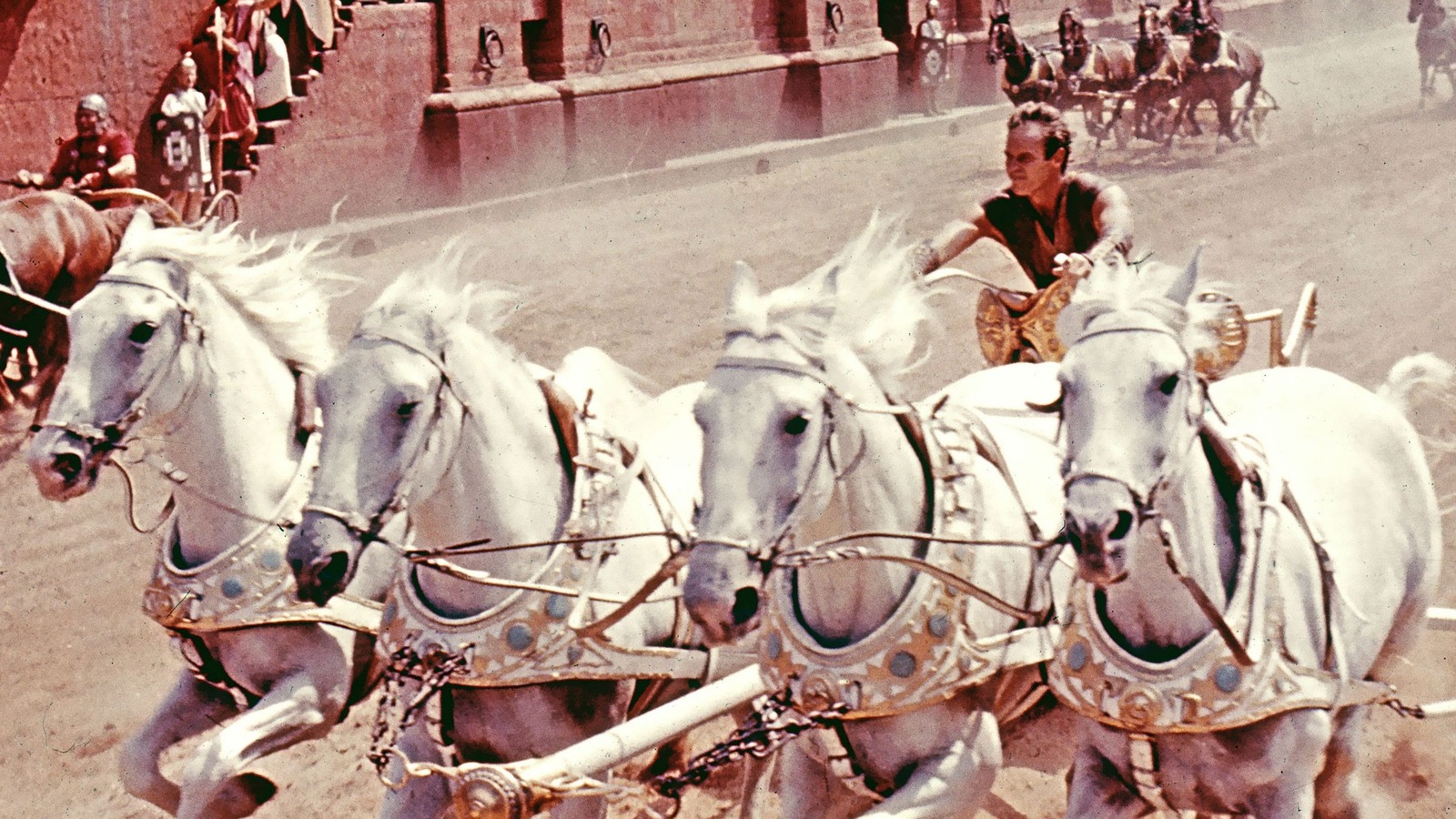
Flashback, November 1959: ‘Ben-Hur’ Remake Charges to Front of Nation’s Box Offices

Sixty-five years ago this week, struggling MGM bet that the market for cinematic biblical epics was not yet exhausted. The game paid off handsomely when the release of Ben-Hur—the sound adaptation of the best-selling novel of the 19th century—reaped box-office gold, saving the studio from bankruptcy.

In looking through my past blog posts, I was surprised to discover that, though I had written about much connected to this property—General Lew Wallace’s 1880 novel, a director whose one-reel 1907 short triggered a landmark copyright decision, and a 1925 budget-busting silent epic—I’d never written about the version that thousands have seen, in theaters and on television, for the past three generations.

This post, then, is my attempt to rectify this situation and to give this movie all the honor it deserves.

The 1959 remake became one of the most honored films in Hollywood history, netting Oscars for Best Picture, Best Director (William Wyler), and Best Actor (Charlton Heston). The 11 it netted in all set a record for the time that has only been equaled since then by Titanic in 1997 and The Return of the King in 2003.

It is also among the most influential movies in screen history. Most recently, Francis Ford Coppola listed it among the 20 films that inspired the epic he released a few months ago, Megalopolis.

Yet another director-producer’s debt to the film is more obvious. The first installment in “Star Wars” saga, The Phantom Menace, features a pod race that is a homage to the archetypal chariot race of Ben-Hur.

Even more so, the first trilogy in George Lucas’ bestselling series, focusing on Anakin Skywalker, bears strong similarities to Lew Wallace’s hero: another slave who makes a splash by competing in a great race, but never really feels entirely at home in the society that now embraces him, and is consumed by revenge for much of the action.

Ben-Hur also left its mark on the evolution of the film epic itself. Without ever stinting on pyrotechnics (it became the first film shot with Panavision lenses to win the Best Cinematography Oscar), it veered sharply from the sword-and-sandals movies associated with Cecil B. DeMille (The Ten Commandments), Howard Hawks (Land of the Pharoahs), and King Vidor (Solomon and Sheba).

Wyler delegated direction of the chariot race sequence to Andrew Marton and Yakima Canutt, while concentrating with his usual perfectionism on the actors’ performances. His creation of a more intimate, character-driven epic would release later releases such as Lawrence of Arabia, Doctor Zhivago, Young Winston, Reds, and, only a year later, Spartacus.

(In fact, Kirk Douglas only pursued the latter property when he lost out in the competition to play Ben-Hur to Heston, being offered instead the consolation prize of the titular hero’s friend-turned-enemy, Messala—a role that he considered nothing more than a second-rate villain.)

This desire to focus on characters rather than spectacle has led some viewers to regard the hour-and-a-half remaining after the chariot race to be anticlimactic. But this misunderstands the nature of the property.

The movie took its cue from the subtitle of the Wallace novel, “A Tale of the Christ,” tracking the miracle following Christ’s crucifixion that eventually frees Judah of the bitterness that has spurred his quest even as it deformed his life.

In their quest for character development, Wyler and producer Sam Zimbalist (who died of a heart attack in Rome just as the movie neared completion) employed six different screenwriters: Karl Tunberg, Gore Vidal, Christopher Fry, S. N. Behrman, Maxwell Anderson, and Ben Hecht.

Decades after the film’s release, Vidal caused a stir with his suggestion of a gay subtext in the Judah-Messala relationship. Audiences at the time were less likely to notice such elements than today, and in any case both Wyler and Heston denied them when asked about it in later years.

More likely, contemporary audiences would have responded to the Cold War resonance of the plot.

Judah’s refusal to renounce his Jewish heritage and pursue Roman glory with Messala triggers his family’s fall from wealth and influence, not unlike how rejection of informing consigned a host of Hollywood talent to blacklisting in the McCarthy Era.

At the same time, the presence of Rome as an authoritarian power imposing its will on a restless foreign people would have reminded many of the similar role played by the Soviet Union.

Monday, September 9, 2024

Quote of the Day (Lupita Nyong’o, on Aspirations)

“No matter where you’re from, your dreams are valid.”— Kenyan-Mexican actress Lupita Nyong’o, quoted by Kanika Lal, “Oscars: Lupita Nyong’o Earns Her First Academy Award for Best Supporting Actress (Video),” The Hollywood Reporter, Mar. 2, 2014

(The image of Lupita Nyong’o that accompanies this post was taken July 22, 2017, by Gage Skidmore.)

Thursday, March 28, 2024

This Day in Film History (Death of ‘Lawrence of Arabia’ Composer Maurice Jarre)

Mar. 29, 2009—Maurice Jarre, a French composer and conductor who netted three Oscars among his 150 movie soundtracks, died at age 84 of cancer at his villa in Malibu, Calif.

You might wonder why I picked a photo of Peter O’Toole to illustrate a brief account of someone else. Well, it’s because that picture instantly brings to mind the first of Jarre’s memorable Oscar-winning scores: Lawrence of Arabia.

Accomplished film composers have existed for nearly as long as there’s been a Hollywood, but except for John Williams, I don’t think that one has emerged as a name brand in his own right—and the latter’s fame was surely enhanced by his 14-year association with the Boston Pops.

But once you see that picture of O’Toole, more likely than not, the majestic theme of Lawrence of Arabia will resound in your head—as distinct a contribution to that epic’s grandeur as the spectacular cinematography of Freddie Young.

So indelible were the sounds created by Jarre that his soundtrack for the film was voted #3 on the American Film Institute’s 25 Greatest Film Scores of All Time, surpassed only by Williams’ Star Wars and Max Steiner’s Gone With the Wind.

Yet the soundtrack that Jarre produced for Lean’s next epic, Doctor Zhivago, produced an even more inescapable melody: “Lara’s Theme,” a hit international single.

Oscar honors came yet again for Jarre for his work on that 1965 film, then again 19 years later for what turned out to be Lean’s last big-screen epic: A Passage to India.

As Jarre’s agent and friend Richard Kraft noted in a 2009 appreciation for The Hollywood Reporter, Jarre came to the U.S. when pioneering symphonic-oriented film composers such as Max Steiner and Erich Wolfgang Korngold were passing from the scene, replaced by Elmer Bernstein, Alex North, Burt Bacharach, Henry Mancini, and Jerry Goldsmith interested in new sounds.

Although Jarre’s conservatory training leaned heavily on percussion, he shared the younger composers’ interest in different musical textures, using instruments that evoked the settings of his films, as seen in:

*The Man Who Would Be King, featuring sarangi and sarod, or Indian lutes;

*Ryan’s Daughter, with eight harps among the “lot of little experiments in the sound, music and concept” that Jarre mentioned in an August 1993 interview with Susan King of the Los Angeles Times;

*Witness, relying on synthesizers;

*The Dead Poets Society, with Celtic harp and flute layered over synthesizers.

Hired by producer Sam Spiegel, Jarre found Lawrence of Arabia a far more complex and high-stakes job than any he’d experienced in French theater and cinema. It was on a grand scale, requiring more than two hours of music; Lean was editing the second part of the film first, so Jarre would have to compose out of chronological order; and he had only six weeks to compose and conduct.

Making matters worse, as Sheila O’Malley noted in a perceptive 2007 blog post, Adrian Boult was engaged to record the soundtrack because British subsidies would not fund a foreign conductor, even though the first rehearsal made it plain that Boult didn’t know key aspects of what he was about to take on, such as keep an eye on the chronometer and an eye on the screen. (Boult ended up on the film credits, even though he didn’t record a note.)

Early on in researching this post, I wondered what Jarre’s personality was like—an inquiry triggered by Williams’ recent comment in an interview with Variety Magazine in which he discussed the older breed of film composers: “Alex North, David Raksin, Jerry Goldsmith and others — brilliant, beautiful talents. All unhappy.”

I’ve come to think that, while Jarre might have been a “brilliant, beautiful” talent, he was far from “unhappy”, with these traits among his most prominent:

*Perfectionism: Lean helped instill this characteristic, Jarre explained in commentary for a tribute concert for the director recorded with the Royal Philharmonic Orchestra.

*Loyal: Jarre worked on the last four films completed by Lean and was starting on a fifth, an adaptation of the Joseph Conrad novel Nostromo, before the project died with the director’s death from cancer.

*Convivial: At the time of the composer’s death, Bernard Miyet, then leader of French musicians’ guild SACEM, praised his friend’s “eternal good nature, a way of living and a simplicity that became legendary.” Jarre loved to regale listeners with anecdotes spotlighting the films and personalities he had known over the years, including how during an L.A. recording session, his entire orchestra stopped playing after spotting actress Sophia Loren in the technician’s booth.

Friday, March 8, 2024

Quote of the Day (Amy Poehler, on the ‘Barbie’ Oscar Controversy)

“When asked to comment, Margot Robbie and Greta Gerwig said they couldn’t hear ‘under a giant pile of money.’”— Actress and comedian Amy Poehler, on the Best Actress and Best Director snubs for Barbie, in her “Restless Leg Tour” with Tina Fey, quoted by Jason Zinoman, “Between Friends, an Endless Barrage of Jokes,” The New York Times, Feb. 10, 2024

Looks to me like Barbie has been driving all the way to the bank!

Monday, July 3, 2023

Movie Quote of the Day (‘The In-Laws,’ With Alan Arkin in Full-Blown Panic Mode)

[After a series of misadventures Dr. Sheldon Kornpett, along with his soon-to-be in-law, CIA operative Vince Ricardo, finds himself facing a firing squad ordered by a Central American dictator.]

Sheldon [played by Alan Arkin]: “There's no reason to shoot at me—I'm a dentist!”— The In-Laws (1979), screenplay by Andrew Bergman, directed by Arthur Hiller

The other night, hoping for some mental ease from the buzz about more bad air from the Canadian wildfires, I found while channel-surfing that The In-Laws was on the cable station Movies!

When I first saw it on its theatrical release in 1979, I was initially drawn to it by its FBI car chase filmed in my hometown of Englewood, NJ. But I was delighted to see that there was far more to the movie than this local trivia.

Although Peter Falk as the slow-witted CIA agent triggered many of the laughs, Alan Arkin, as his mild-mannered dentist in-law, sputtering incredulously at each insane turn of the plot, heightened the laughs in this uproarious, even inspired, farce.

I did not know as I was watching this fondly remembered film that within the past 24 hours, Arkin—a prolific, versatile, and deservedly honored actor if there ever was one—had passed away in San Marcos, Calif., at age 89.

I first encountered the actor’s work during a high school sociology teacher, when our teacher played the 15-minute 1963 short, “That’s Me,” in which Arkin played his first credited screen role: a Puerto Rican guitar player that a social worker attempts to help. 

It would also be the first of numerous movie roles in which Arkin—the son of Jewish emigrants from Russia and Germany—would play a variety of different ethnic or national characters—or, as The New York Times obit on the actor put it, “a man of a thousand accents, or close to it.”

The most prominent next one would be The Russians Are Coming the Russians Are Coming (1966). His role as a Soviet submariner mistaken for a spy after his boat accidentally wrecks aground in New England not only won him wide attention but the first of his four Oscar nominations. (He would finally win in 2004 for a heroin-snorting, obscenity-spewing grandfather in Little Miss Sunshine.)

But Arkin was hardly confined to comic roles. He also produced many screams among viewers as a psychopath who menaces a blind woman in Wait Until Dark, and, more touchingly, a deaf mute in the movie adaptation of Carson McCullers’ The Heart Is a Lonely Hunter.

Off the screen, Arkin flashed his other talents, for directing (including Little Murders, on film, and the original stage version of Neil Simon’s The Sunshine Boys), playwrighting (one-third of Power Plays, with the other parts composed by Elaine May), two memoirs and even children’s books.

Altogether, Arkin had 110 acting credits for film and TV. As a character actor skilled not only in accents but improvisation, he could disappear into almost any role.

In other words, it’s highly likely that, unless you were paying attention to the credits, he’s probably been in at least a few films where you didn’t recognize him at the time. Now’s as good a time as any to seek these out so you and I can better appreciate the legacy he left for audiences.

(For a very perceptive retrospective on Arkin’s filmography, I urge you to read my college classmate Frank Scheck’s Hollywood Reporter article, where he notes that the actor “made wryness and sarcasm seem the most natural and intelligent response to a world that increasingly makes little sense. We needed him now more than ever.”)

Tuesday, March 14, 2023

Quote of the Day (‘Grumplestiltskin’ Grant, Showing His Surly Side to Ashley Graham and a Worldwide Audience)

Ashley Graham: “What’s your favorite thing about coming to the Oscars?”

Hugh Grant: “Well, um, it’s fascinating. The whole of humanity is here. It’s vanity fair.”

Graham: “Oh, it’s all about Vanity Fair. It’s let loose and have a little fun. What are you most excited to see tonight?”

Grant: “To see?”

Graham: “Yeah. I know that you watch a few of the movies. Are you exited to see anyone win? Do you have your hopes up for anyone?”

Grant: “No one in particular.”

Graham: “Okay. What are you wearing tonight, then?”

Grant: “Just my suit.”

Graham: “Your suit? You didn’t make your suit! Who designed it?”

Grant: “I can’t remember…My tailor.”

Graham: “That’s okay. Shout-out to your tailor! So tell me, what does it feel like to be in Glass Onion? It was such an amazing film, I really loved it. I love a thriller! How fun is it to shoot something like that?”

Grant: “Well, I’m barely in it. I’m in for about three seconds.”

Graham: “But still, you showed up and you had fun, right?”

Grant: “Uh, almost.”—Hugh Grant and Ashley Graham quoted by Michael Ausiello, “Oscars: Hugh Grant Shuts Down Ashley Graham in Mesmerizingly Awkward Red Carpet Interview,” www.tvline.com, Mar. 12 2023

Movie fans who only know Hugh Grant as the bumbling but winning lead in rom-coms like Four Weddings and a Funeral, Notting Hill and Love, Actually had a chance to see him without a script at the Oscars on Sunday night. This recent spectacle will not exactly burnish his reputation as a charmer.

Former flame Elizabeth Hurley, who still remains on good terms with the English actor, revealed to talk-show host Andy Cohen eight years ago that Grant’s peevishness had earned him the nickname "Grumplestiltskin" among her friends. His dialogue above with supermodel Ashley Graham should tip you off how he acquired that surly sobriquet.

You will get no argument from me about the general inanity of the so-called "red carpet" (or, this year, "champagne-colored carpet") chatter before the industry’s main event of the year. Nor will you hear me disagree that what transpired between Grant and Graham was still better than Will Smith’s slap of Chris Rock in last year’s controversial telecast.

But, from the moment that Ms. Graham mistook Grant’s reference to William Makepeace Thackeray’s Victorian satire of human vainglory for an allusion to the glitzy magazine famous for its Oscar parties, it was all downhill. The actor’s lifted eyebrows at the end of their exchange said far more than his clipped answers about his contempt for the whole circus.

Reaction to this tense interview on social media was swift, and mostly against Grant.

Much the same division of sentiment followed after he acted as presenter with Four Weddings and a Funeral co-star Andie McDowell. Some called his description of how he looked without moisturizer funny; others thought it tasteless.

I voted for “tasteless.” In fact, when I first heard Grant’s description of his face, I thought I must have been mistaken, that he was resorting to the stuttery style of speaking that had endeared him to so many.

Clearly, he had ad-libbed while on stage, as you might have guessed from Andie McDowell’s surprised reaction to what was meant to be a compliment to her appearance.

Richard Gere was banned as a presenter for 20 years after ad-libbing at the 1993 ceremony, but at least he did it for a good cause: a protest against the Chinese government for its mistreatment of Tibet. What should the Academy do about Grant’s tacky, raunchy joke?

“The only thing an actor owes his public is not to bore them,” Humphrey Bogart reportedly said. Maybe.

But entertainers owe each other what all human beings owe the rest of humanity: courtesy. That attitude exudes grace and is more essential to what we call “class” than something ephemeral and maybe ill-gotten like money.

Over the weekend, it was missing from Grant’s repertoire. I guess we will find out soon, once he’s had some time to consider what he did and to craft an apology, if it was ever really part of his carefully crafted persona.

(The image accompanying this post, of Hugh Grant at a charity fundraiser held in South Bank, London, was taken Mar.15, 2011, by Julien Rath.)

Saturday, March 11, 2023

Quote of the Day (Budd Schulberg, on Gwyneth Paltrow’s Oscar Speech Omission)

“I watch the Awards shows year after year and I have noticed a trend. When Gwyneth Paltrow won for Shakespeare in Love, she thanked the producer and her agents. She thanked her hairdresser and every member of her family. She must have thanked 50 people. But she never mentioned the writer. She didn’t even mention Shakespeare. They don’t want to thank the people who created their characters and who put the words in their mouth. There can’t be anything without the writer.”— Oscar-winning screenwriter and novelist Budd Schulberg (1914-2009), quoted in “The Real Contender: A Conversation with ‘On the Waterfront’ Screenwriter Budd Schulberg,” Hudson Reporter, July 29, 2000

Budd Schulberg, with more than 80 years of experience in the film community as the son of a studio executive, screenwriter, and observer of the industry, was venting about the lack of respect so long accorded to scribes in Hollywood.

Their indignities have been legion—they have watched in frustration as:

*their terrific script goes into “turnaround,” or development hell; or as

*their script is given to one or more other writers for polishing (Turner and Hooch, the early Tom Hanks film that teamed him with an ugly dog, went through eight different writers!); or as

*their script gets turned by some combination of other writers, directors and producers into something radically different (or, in the words of William Holden’s hack in Sunset Boulevard about his last project, it “was about Okies in the Dust Bowl. You'd never know because when it reached the screen, the whole thing played on a torpedo boat”); or as

*they are banished from the set so they can’t object to the director's damage to their work; or as

*the angrier ones try to use whatever meager leverage they’ve accumulated to protect their scripts by becoming directors themselves, as with Preston Sturges and Billy Wilder; or finally, as Schulberg noted,

*actors forget to say thanks for writing the lines that helped them win the biggest professional honor of their careers.

But, if Schulberg had lived almost a decade longer, his outrage might have been, if anything, even more intense than what he conveyed in this interview.

After all, that producer that Gwyneth Paltrow thanked in her weepy speech on Oscar night almost a quarter century ago? It was Harvey Weinstein, a figure she later described as a “bully”—and now, of course, not just the poster boy of the #MeToo movement but also a felon convicted of rape and assault.

By the way, “the writer” Paltrow neglected to mention? It was actually two: Marc Norman and Sir Tom Stoppard—and that year they shared the Academy Award for Best Original Screenplay for Shakespeare in Love.

So let’s see tomorrow night who thanks the writers—and who, like Paltrow, for whatever reason, never gets around to it.

Wednesday, March 8, 2023

Quote of the Day (Cate Blanchett, on Roles for Mature Actresses)

“Men are boys for such a long time and really don't start getting the great roles until they're in their mid-thirties. But then they've got a long time to do them, whereas for women, it's all about playing younger and younger and younger. They start when they're 18 and go till they're 28, maybe 35 if they're lucky. I remember [veteran actress] Rosemary Harris saying to me that, in her sixties, she was coming into a whole swathe of work because she was one of the few women who hadn't had anything done, who actually looked her age, because when people try to find a 60-year-old now, there are none. I'm in it for the long haul.”—Two-time Oscar-winning actress Cate Blanchett quoted by Mark Salisbury, “Cate Blanchett: Women in Hollywood Icon 2006,” Premiere Magazine, October 2006

At age 53, Ms. Blanchett is closer to the 60-year-old mark that she noted in the above interview. But, with another Oscar nomination for Tar, she is indeed, as she vowed, “in it for the long haul.”

Just as remarkably in youth-oriented Hollywood, she will not be the only 50-plus nominee in the Best Actress category. She will be joined by Michelle Yeoh, age 60. It will be an interesting race between the two.