Showing posts with label ADDAMS FAMILY. Show all posts

Monday, October 24, 2022

TV Quote of the Day (‘The Addams Family,’ As Morticia Muses About Family Pets and Home Decor)

[An insurance salesman at the house discusses how to compensate the family for a loss.]

Gomez Addams [played by John Astin]: “We don't want money. What we want is another bear.”

Morticia Frump Addams [played by Carolyn Jones]: “What else could possibly go with our decor?”

Joe Digby [played by Eddie Quillan]: “The bear may be a little hard to come by. How about a lion?”

Morticia: “We already have one.”

Digby: “Stuffed?”

Morticia [eyeing the animal as it enters the living room]: “Well, he is after he's had his dinner.”—The Addams Family, Season 2, Episode 28, “The Addams Policy,” original air date Mar. 25, 1966, teleplay by Harry Winkler and Hannibal Coons, directed by Sidney Lanfield

Monday, August 29, 2022

TV Quote of the Day (‘The Addams Family,’ As Uncle Fester Offers To Teach Lurch About Women)

[The family decides to make over Lurch.]

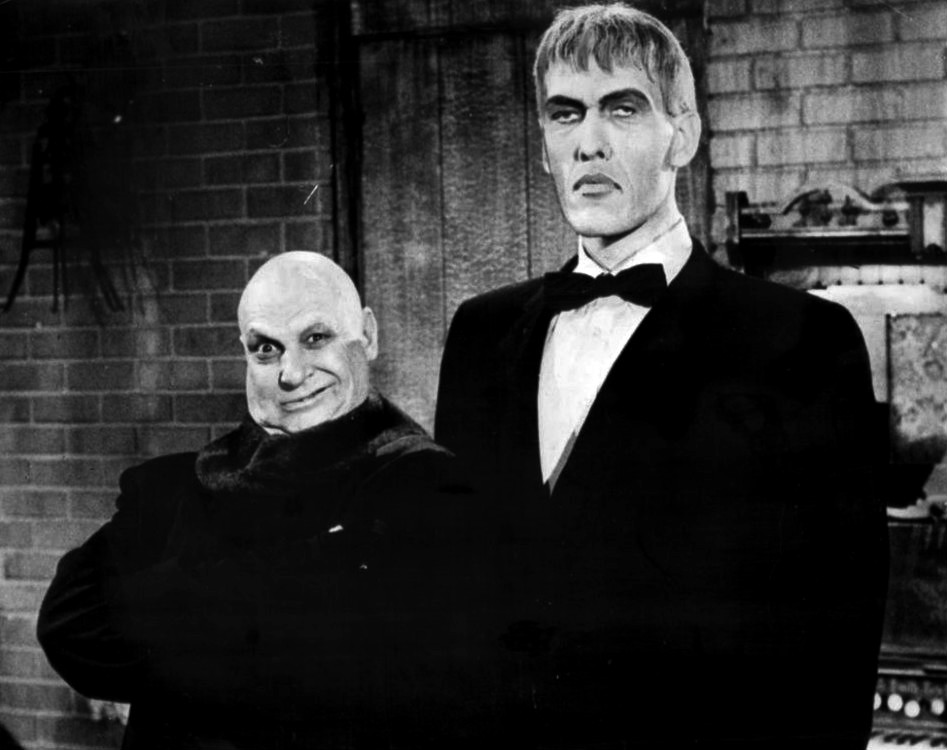
Uncle Fester [played by Jackie Coogan]: “And after a couple hours with me, why, he'll know all there is to know about women.”

Gomez Addams [played by John Astin]: “What do YOU know about women, Fester?”

Uncle Fester [a little affronted]: “Well, I had a mother, didn't I?”— The Addams Family, Season 2, Episode 29, “Lurch's Grand Romance,” original air date Apr. 1, 1966, teleplay by Gene Thompson and Arthur Weingarten, directed by Sidney Lanfield

Friday, March 25, 2022

TV Quote of the Day (‘The Addams Family,’ As Morticia Reveals a Logical, Legal Mind)

[Insurance agent Joe Digby has come to the Addams living room about a claim they filed to replace a stuffed bear that Uncle Fester accidentally set afire with a new flame-thrower. Digby quizzically eyes the pile of ashes on the floor.]

Joe Digby [played by Eddie Quillan]: “I don't want to quibble, but how do I know that was a bear?”

Morticia Frump Addams [played by played by Carolyn Jones]: “Well, let's use simple logic. Does it look like an antelope?”

Digby: “No.”

Morticia: “A zebra?”

Digby: “No.”

Morticia: “A giraffe?”

Digby: “No.”

[later]

Morticia: “An elephant?”

Digby: “No.”

Morticia: “A tiger?”

[much later]

Digby: “No.”

Morticia: “A camel?”

Digby: “No.”

Morticia: “A gorilla?”

Digby: “Well, uh... No! No!”

Morticia: “Well, then it must be a bear.”

Gomez Addams [played by John Astin]: “Querida, with your incisive mind, you should be on the Supreme Court!”

Morticia [considering it]: “I do love those black robes.” —The Addams Family, Season 2, Episode 28, “The Addams Policy,” original air date Mar. 25, 1966, teleplay by Harry Winkler and Hannibal Coons, directed by Sidney Lanfield

Would the Republican members of the Senate Judiciary Committee prefer Morticia to Biden Supreme Court nominee Ketanji Brown Jackson? Perhaps, if the matriarch of the creepy, kooky family announced a GOP affiliation.

At least her exercise in logic here is not as breathtaking—or as twisted—as what Senators Cruz, Graham, Blackburn, Cotton, Hawley et. al. displayed the last few days at Jackson’s confirmation hearings.

As noted by Domenico Montanaro of National Public Radio, much of their questioning took place with midterm messaging to their base in mind, as well as the airing of grievances on how Democrats treated the GOP’s most recent nominees for the Supreme Court, Brett Kavanaugh and Amy Coney Barrett.  

Monday, January 10, 2022

TV Quote of the Day (‘The Addams Family,’ on Uncle Fester’s Creepy, Kooky Exercise Regimen)

Morticia Frump Addams [played by Carolyn Jones]: [watching Uncle Fester exercise—if leaping and spinning in the living room can be labeled “exercise”—to Jack LaLanne on TV] “What's he doing?”

Gomez Addams [played by John Astin]: “He's either dancing to the ‘Late Late Show’ or exercising to the early early show.”—The Addams Family, Season 2, Episode 18, “Fester Goes on a Diet,” original air date Jan. 14, 1966, teleplay by Hannibal Coons and Harry Winkler, directed by Sidney Lanfield

Fester’s motivation for this new routine is getting in shape for a visiting pen pal from the Folies Bergere. For others, it’s the start of a new year. Whatever works, I guess…

Friday, July 2, 2021

TV Quote of the Day (‘The Addams Family,’ As Morticia Demonstrates Her Knowledge of American History)

Morticia Frump Addams [played by Carolyn Jones]: "'Tis better to have loved and lost than never to have loved at all.'"

Gomez Addams [played by John Astin]: “Lincoln?”

Morticia: “Jefferson.”— The Addams Family, Season 2, Episode 10, “Gomez, the Reluctant Lover,” original air date Nov. 19, 1965, teleplay by Charles R. Marion and Leo Rifkin, directed by Sidney Lanfield

What better intro to the Fourth of July weekend than this unexpected morsel of U.S. history?

I would love to see Morticia Addams on Who Wants to be a Millionaire. True, she might need an English major (especially one familiar with the Victorian poet Alfred, Lord Tennyson) as a lifeline. But it would be so much fun to watch this delicious matriarch of the offbeat Sixties sitcom hobble over to the podium in those tiny steps in that black form-fitting gown.

Her answers would be so loopy that fans would boo the real ones offered by the host as dreadfully uninspired. And, with the devoted but delightfully demented Gomez cheering her on in the audience, anything could happen. (How about Lurch as the next host, with Thing silently but visibly providing the answers?)

Monday, February 11, 2019

TV Quote of the Day (‘The Sopranos,’ in Which Tony Displays His Familiarity With Mysticism)


[Mobster Tony Soprano has returned to his sessions with psychiatrist Jennifer Melfi, who has brought the discussion around to existentialism and the meaning of “dread.”]

Dr. Jennifer Melfi [played by Lorraine Bracco]: "Carlos Castaneda said, “‘Live every moment as if it were your last dance on earth.’"

Tony Soprano [played by James Gandolfini] "Who the **** listens to prizefighters? Ali, maybe—he had a little wisdom."—The Sopranos, Season 2, Episode 6, “The Happy Wanderer,” teleplay by Frank Renzulli, directed by John Patterson

I had only seen about a half dozen or so episodes of The Sopranos during its original run, and for a long time after it left the air in 2007 I had no interest in revisiting it.

But with the recent upsurge of attention for the 20th anniversary of the groundbreaking HBO series—and especially with my brothers’ increased interest in the show—I became curious about what I had missed.

My memories of the show stemmed largely from its heavy violence and its focus on family dysfunction. When I started watching the second season on DVD, those impressions not only remained but intensified.

But what I hadn’t grasped the first time around was the show’s offbeat—sometimes laugh-out-lough—sense of humor. Much of that came from Miami Steve Van Zandt’s Silvio Dante, with his impersonations of Michael Corleone and his sputtering over cleaning up after cheese droppings on the floor while he’s in the midst of a high-stakes card game. Some of it came from Tony’s nephew Christopher and his preposterous desire to become a screenwriter.

Some of it came from Tony Soprano himself, and this particular exchange made me guffaw. In his aggressive befuddlement over popular culture, I hadn’t seen anything like it since the heyday of Carroll O’Connor’s Archie Bunker on All in the Family in the Seventies.

But much of the show’s humor stems from its overarching sense of the absurd, something I associate with a genre originating in a couple of Sixties sitcoms I watched as a kid: The Munsters and The Addams Family. In these shows, a figure who inspires fear tries to live like a regular guy in a neighborhood, only to see his interactions with “normal people” who enter his sphere producing only chaos and damage. It’s an inversion of the Nuclear Family so in vogue at the time.

You’d soon regret getting close to a paterfamilias on one of these shows. A backslap from Herman Munster guffawing at a joke could send you flying across the room or break your ribs. Guests are alarmed not only by Gomez Addams’ favorite hobby (blowing up toy trains) but by his pet (a lion named Kitty Cat).

As for Tony Soprano: Sure, he might agree to let you in on a friendly card game, but you’d have to be prepared to have him beat you to a pulp when you ended up thousands of dollars in debt and unable to pay up. 

Even then, you’d count yourself lucky to come out alive.

The Sopranos proved, as surely as those other shows did, that monsters could indeed live among us.

Wednesday, October 29, 2014

Flashback, Fall 1964: Creepy, Kooky Comedies Spook Networks


Every once in a while, several programs in a similar vein will clog the airwaves. Fifty years ago this autumn, the word “vein”—as in the body part that certain dark creatures desire—would have been used advisedly, as a trio of supernatural comedies premiered on the networks: Bewitched, The Addams Family and The Munsters. (Within a year, they would be joined by yet another fun fantasy of this ilk, I Dream of Jeannie.)

These three sitcoms aired on different networks, with different showrunners. But, lest you think that their simultaneous appearance (all within a week of each other, in September) was entirely coincidental, remember that on TV, little occurs by chance.

What better time to write about this group than the week preceding Halloween? Oddly enough, only a month into their runs 50 years ago, only one of the shows thought fit to have a Halloween episode: The Addams Family. 

You wonder if a young John Hughes absorbed its plot of a pair of robbers who invade a home (the one owned by the Addamses, in the midst of a Halloween party), only to be undone by a most unlikely source (in this case, not young Kevin of Home Alone, but, of all things, Thing).

Dominated by shows such as Ozzie and Harriet, Make Room for Daddy, and Leave It to Beaver, the 1950s were anything but a party. 

“It was a time when a woman's highest ambition was to be a good housewife, a time when men were judged primarily on their ability to provide financial support and domestic authority, a time when happily ever after was preferable to a real life with all its delights, a time when my own dream of glory was to be a conventional suburban teenager with a tacky nickname,” Susan Cheever recalled in an essay on perhaps the most influential of these patriarchal-themed sitcoms, Robert Young’s Father Knows Best, in Prime Times: Writers on Their Favorite TV Shows (2004). “The world seemed limited by the walls of the family ranch house. No one ever told the truth, even on television.”

By 1964, though, the rock ‘n’ roll era had opened up a chasm between youth and the adult world, with old values being questioned. 

Moreover, just the year before America was exposed to the likes of Samantha Stevens, Morticia Addams and Lily Munster, Betty Friedan had demonstrated in The Feminist Mystique that far more was happening behind the closed doors of the stay-at-home, suburban American housewife than anyone could ever imagine. 

The civil-rights movement was also about to effect a revolution not just at the ballot box, but also in communities and workplaces.

The result was that TV’s vision of suburbia—presided over by a paterfamilias with a rather indistinct occupation, with a stay-at-home mom, with nary a hint of sex between the two, and with blacks nowhere to be found except as domestics—was ready for subversion. And nothing undercuts the old order like comedy.

The nuclear family, of the Father Knows Best variety, was mercilessly parodied in this trio of horror comedies. In these sitcoms, Dad was depicted as strange (Gomez in The Addams Family), stupid (Darrin Stevens of Bewitched) or strange and stupid (Hermann Munster of The Munsters). 

It doesn’t matter if Dad is a lawyer (Gomez, supposedly), an ad man (Darrin) or a funeral-parlor employee (Hermann). Above all, he’s a bumbler.

Watching the Broadway revival of George S. Kaufman and Moss Hart’s Depression-era You Can’t Take It With You last month, I tried to think of what its scenario—a gallery of eccentrics presided over by an elderly male, a daffy mother, a father who blunders about a great deal, an ingénue daughter markedly different from everyone else by virtue of her normality, and a basement with all kinds of experimentation—reminded me of. Then it hit me: The Munsters.

Only the sitcom sent up the family in a way that Kaufman and Hart never dreamed of. 

In one episode, for instance, the Munsters were accidentally selected by a national magazine to appear on its front cover as the "Average American Family." Two magazine reporters arrive for an interview, unaware of what they’ll encounter at Mockingbird Lane!

But even from its opening credits in that first season, The Munsters was intent on laughing the Fifties American family out of existence. 

As the show’s musical theme played in the background, loving mom Lily Munster handed out lunch boxes to each family member leaving the house. The scene parodied a popular sitcom still going strong on rival network ABC: The Donna Reed Show.

Most of these sitcoms’ family members try to fit into the everyday world, but in straitlaced postwar America, they can’t help reverting to habit. “I don't mean to be disrespectful,” a clueless Darrin tells his mother-in-law on Bewitched, “but we wanna live normal lives.”

Endora will have none of it: “What is normal to you, young man, is to us [i.e., the world of witches and warlocks] asinine.”

The writers for Bewitched must have really loved Endora, for they gave her so many of the show’s best lines, including this gem: “Just because you married a human, Samantha, that's no reason to overdo this grubby little household role.” 

A little parsing will show how subversive that line is: Leave out the first half of that sentence and there is nothing that the next wave of feminism (kick-started in a major way with the formation of the National Organization for Women in 1966) would have disagreed with.

Over the last seven seasons, critics have hailed Mad Men for the manner in which it ironically chronicles the undermining of American male confidence in the 1960s. But guess what? Bewitched got there first 50 years ago, in an infinitely more sly way. Consider:

*The Drapers of Mad Men live in Ossining, NY, home of the great WASP suburban writer John Cheever; the Stevens reside in Westport, CT, another WASP outpost;

*Don Draper works for an ad agency boss, Roger Sterling, who contributes less and less to the firm as time goes on; Darrin Stephens’ boss, Larry Tate, substitutes greed for Roger’s drunken lechery;

*Both Darrin and Don are the envy of other men for their beautiful blond wives. But neither Samantha Stevens nor Betty Draper can preserve that internal household harmony so prized in Sixties suburbia—Betty, because of free-floating anxiety, and Samantha because of a restless desire to help her husband.

 I’ve only begun to scratch the surface on these comparisons. You really ought to see all the parallels drawn out by Kathleen Keating on the blog Hypable—it truly is extraordinary.

Of the three sitcoms, Bewitched, going eight seasons, endured the longest, four times the run of The Munsters and The Addams Family. One reason for the longevity is obvious: Elizabeth Montgomery. (Or, in the words of a friend who met her once: “Mike, she could have wiggled her nose at me anytime she liked!”)

But another reason for the show’s popularity might be its endless sense of invention, the way in which it took down one notion of society while setting up another. It poked merciless fun, for instance, at Mrs. Kravitz, the archetype of the nosy neighbor, while creating an entirely different set of characters such as Uncle Arthur, Doctor Bombay and forgetful old Aunt Clara.

Significantly, Bewitched closed out its run in 1972. The show came to a halt just when, it might be said, the Sixties itself—with its dream of an alternate society, less comedic than the supernatural one in Bewitched, The Addams Family and The Munsters—came to an end.

Tuesday, December 6, 2011

Movie Quote of the Day (“The Addams Family,” on Gomez and Morticia’s Wild Night)

Morticia (played by Anjelica Huston): “Gomez.”

Gomez (played by Raul Julia): “Querida?”

Morticia: “Last night you were unhinged. You were like some desperate, howling demon. You frightened me. Do it again!!!!” The Addams Family (1991), screenplay by Caroline Thompson and Larry Wilson, based on characters created by Charles Addams, directed by Barry Sonnenfeld