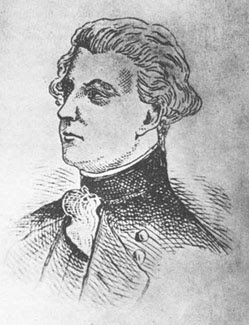
A trained
painter who, like the Marquis de Lafayette, left his native France in a burst
of youthful idealism to join the American colonies in their fight for freedom, L'Enfant
caught the attention of George Washington with his draftsmanship skills while
serving in the Continental Army Corps of Engineers. He not only endured the
brutal winter at Valley Forge but suffered a grievous leg wound at the Battle
of Savannah and spent six months as a prisoner of war after being captured at
the Battle of Charleston.
After the
war, L’Enfant worked on the insignia and diploma for the Society of Cincinnati
and the design for New York’s Federal Hall. In 1789, even before Congress had
formally approved a capital district for the nation, L’Enfant was lobbying
Washington with his proposal for creating it.
Only 11 months
after obtaining his prestigious architectural commission, L’Enfant was off the
project—depending on who you believe, having resigned or been fired. In a way,
the manner of his departure doesn’t matter, because, following continual
clashes with the three supervisory commissioners of the new federal District of
Columbia, he would have been gone in just a matter of time.
Perhaps
taking a cue from his adored commander in the war, Washington, L’Enfant had
neither requested nor been given a salary for his work in planning the
district. But, as the years went by and his income from other projects
dwindled, he felt the urgent need to press his claims.
It did not
help that when he had left, he had annoyed many with his egotism, his overbearing
ways, and his failure to adequately communicate his vision. He had ordered the
demolition of a property belonging to a prominent resident; delayed producing a
map for the sale of city lots; spoke and wrote English poorly; and, when he
walked away from the project in a huff, taken all the plans with him.
For his
last 15 years, the unmarried and childless L’Enfant lived as a charity case on
the estate of his benefactor, William Dudley Digges. Long before he was buried
in an unmarked grave on the plantation, he had haunted key figures in the city
he designed through rambling letters and appearances, wearing his blue
Continental Army uniform, in which he fruitlessly pressed his case for proper
remuneration for his work. (He wanted $95,000 for his architectural services;
Congress would go no higher than $3,800.)
The fulfillment
of L’Enfant’s vision for the city—and his honor for creating it—did not occur
until early in the 20th century. The centennial celebration of Washington’s
founding led the McMillan Commission—a panel of architects and planners
appointed by the U.S. Senate—to consider how to beautify a metropolis that had
fallen victim to decentralized, private land development.
The commission
members sought to adapt L’Enfant’s original scheme in the light of the “City
Beautiful” movement coming into being.
At the same
time, a parallel movement grew to remember L’Enfant in the fashion he craved
during life. His remains were exhumed, transported in in a casket draped with
the American flag to the U.S. Capitol (where he became the first foreign-born
man to lie in state) before being taken by military escort to Arlington National Cemetery. There he was buried overlooking the city he had created.
Some
aspects of L’Enfant’s plan, such as a waterfall flowing down Capitol Hill,
never came to fruition. But others eventually were adopted, including:
*the seat
of government on Capitol Hill;
*the mall
connecting Capitol Hill to what he called “The President’s House” and we call the
White House;
* a
four-quadrant grid, with north-south and east-west streets crossed by grand
diagonal avenues, creating public squares and beautiful buildings in what consisted
of hills, forests, marshes and plantations.


No comments:
Post a Comment