Showing posts with label The Eagles. Show all posts

Tuesday, June 11, 2019

Quote of the Day (Joe Walsh, on Running With Rock ‘Party Monsters’)


“Well, I never had to work in a factory, so that’s a blessing. The worst part [of being a rock 'n' roll star] is the distractions: money, women, partying. When you're young it's really easy to lose your perspective. I started believing I was who everybody thought I was, which was a crazy rock star. You know ‘Life’s Been Good,’ that whole story. It took me away from working at my craft. Me and a lot of the guys I ran with, we were just party monsters, and it was a real challenge to stay alive and end up on the other end of it.”—Joe Walsh, guitarist for the Eagles and former party animal, quoted in Andy Greene, “The Last Word: Joe Walsh,” Rolling Stone, Aug. 10, 2017

Tuesday, February 28, 2017

Flashback, February 1977: Eagles’ ‘New Kid in Town’ Hits Number 1


Forty years ago this week, The Eagles’ first single from the Hotel California LP, “New Kid in Town,” reached Number 1 on the U.S. singles chart. Perhaps anticipating a year when rock-and-roll music moguls would increasingly fixate on mega-selling releases, the group took a mordant view of flavors-of-the-month, both among the rock-buying public and faithless lovers. In the process, the single helped lift this ambitious album to a creative and commercial peak for this avatar of the Southern California sound of the Seventies.

Perhaps we should say at this point what this song is not about.  It does not deal with the anxieties of a sensitive teenager arriving at a new high school, a la James Dean in Rebel Without a Cause.

A better metaphor—but really only a starting point of the song—could be something out of The Eagles’ concept album from a few years before, Desperado: a young gun whose reputation precedes him, who ends up quickly exhausted from looking over his shoulder at the bar awaiting the next person to seize his mantle.

It’s easy to translate that to the rock ‘n’ roll environment in general and the Eagles’ situation in particular in 1976, when the album was recorded and released. One album after another had yielded hits—Eagles, Desperado, On the Border, and One of These Nights—but none seemed to satisfy the critics. In contrast, a new, raw force had appeared on the East Coast: Bruce Springsteen.

Though the group was quick to disclaim any animus toward “The Boss” from Asbury Park, N.J., they admitted to becoming jaded about what another musician on the Southern California scene, Joni Mitchell, called “the star-making machinery.” This was the year of the blockbuster in music: not just Hotel California, but Fleetwood Mac's Rumours and the Saturday Night Fever soundtrack.

“It’s about the fleeting, fickle nature of love and romance,” the group’s drummer and co-songwriter, Don Henley, remembered about "New Kid in Town" in liner notes for the collection, The Very Best of the Eagles. “It’s also about the fleeting nature of fame, especially in the music business. We were basically saying, ‘Look, we know we’re red hot right now but we also know that somebody’s going to come along and replace us — both in music and in love.”

 Especially because of the addition of guitarist Joe Walsh, The Eagles on Hotel California edged away from the more country-rock sound of their prior LPs, particularly with “Life in the Fast Lane,” “Victim of Love,” and the phantasmagoric title tune. But “New Kid in Town,” with its softer instrumentation and melancholy lyrics by Henley, Glenn Frey and J.D. Souther, harks back to their earlier work without being out of place in a collection revolving around personal, creative, and sociopolitical loss of innocence.

“New Kid in Town” won the Grammy for Best Arrangement for Voices. But, in listening to the piece over the years, I could understand those critics who felt that, for all their admitted skill in the studio, The Eagles’ sound had gotten pureed somewhere on the road to perfection.

In fact, the full power of the song didn’t hit me until I heard the version on the 2011 CD Natural History by Frey’s friend and frequent collaborator, J.D. Souther. Roy Orbison may have been the most powerful vocal influence on Souther, and that makes all the difference in comparing his and Frey’s lead vocal on the hit single. Souther’s was a more expressive instrument than his late friend’s, bringing out the underlying message of the song: that nothing lasts forever—not fame, not fortune, not creative fulfillment, not even love itself.

Tuesday, January 19, 2016

Quote of the Day (Don Henley, on Glenn Frey, Eagles’ ‘Spark Plug’)


“Glenn was the one who started it all. He was the spark plug, the man with the plan. He had an encyclopedic knowledge of popular music and a work ethic that wouldn't quit. He was funny, bullheaded, mercurial, generous, deeply talented and driven. … I'm not sure I believe in fate, but I know that crossing paths with Glenn Lewis Frey in 1970 changed my life forever, and it eventually had an impact on the lives of millions of other people all over the planet. It will be very strange going forward in a world without him in it. But, I will be grateful, every day, that he was in my life. Rest in peace, my brother. You did what you set out to do, and then some."— Eagles bandmate Don Henley, in a statement released in reaction to the death of Glenn Frey, quoted in “Don Henley Calls Glenn Frey His 'Brother' In Heartbreaking Statement,” The Huffington Post, Jan. 18, 2016

Rest in peace, Glenn Frey (Nov. 6, 1948 – Jan. 18, 2016)—and thanks for the music: "Take It Easy," "Peaceful Easy Feeling," "Already Gone," "Tequila Sunrise," "Lyin' Eyes," "New Kid in Town," and what many are feeling now, "Heartache Tonight."

Thursday, April 16, 2015

Song Lyric of the Day (The Eagles, on Fortune and ‘The Powers That Be’)


“Now I look at the years gone by
And wonder at the powers that be
I don’t know why fortune smiles on some
And lets the rest go free.”—“The Sad Cafe,” written by Don Henley, Glenn Frey, Joe Walsh, and J.D. Souther, performed by the Eagles from their The Long Run LP (1979)

Saturday, August 11, 2012

Song Lyric of the Day (The Beach Boys, on the Surfing Craze)


“Let's go surfin' now
Everybody's learning how
Come on and safari with me.”—“Surfin’ Safari,” written by Brian Wilson and Mike Love, performed by the Beach Boys, from their Surfin’ Safari LP (1962)

Though released as a single two months before, “Surfin’ Safari” by the Beach Boys entered the Billboard charts on this date in 1962, eventually peaking at #14. It would become the centerpiece of the group’s first album, released two months later.

“Surfin’ Safari” (labeled “Surf and Safari” at the time) was one of the songs featured on the demo tape that Murry Wilson, father of the three sons  that comprised the heart of the group, used to promote the young musicians to Nik Venet of Capital Records, who signed them almost immediately after hearing the demo in April 1962.

It was a fun (or, as the musicians would later put it, “fun, fun, fun”) record, brimming with influences such as the Four Freshmen and Chuck Berry. It’s also, indisputably, a song born of a time, place and mood unique in American life.

It’s hard to believe for a state with such a rocky economy these past several years, but Southern California in the early 1960s symbolized good times, in every sense. The defense and aerospace industries in the state were riding the wave of a postwar boom. Somehow, it seemed appropriate that, for the children of the white-collar workers at the heart of this boom, “catching a wave” came to have literal force, as a whole youth culture flocked around the state’s beaches.

Brian Wilson might have been the group’s principal songwriter and troubled genius (though not yet cracking under the effects of his abusive father), but it was younger brother Dennis Wilson who was the group’s only actual surfer. It was he who tipped off Brian and cousin Mike Love about the growing surf trend: “You guys ought to write a song about it,” he urged.

A month and a half ago, New York Times columnist David Brooks marveled over “The Power of the Particular”: “If your identity is formed by hard boundaries, if you come from a specific place, if you embody a distinct musical tradition, if your concerns are expressed through a specific paracosm, you are going to have more depth and definition than you are if you grew up in the far-flung networks of pluralism and eclecticism, surfing from one spot to the next, sampling one style then the next, your identity formed by soft boundaries, or none at all.”

The inspiration of this epiphany was the columnist’s astonishment over how Europeans could embrace so readily Bruce Springsteen, whose songs (particularly the early ones) are spiked with references to his home turf of the Jersey Shore. But the same applies just as much (perhaps even more so) to the Beach Boys.

Consider this: In “Surfin’ Safari,” the group summoned such California places as Huntington, Malibu, Rincon, and  Laguna. In another early group tribute to surfing, “Surfin’ USA,” the place-dropping was even more vigorous, with 11 different beaches in the state mentioned. It was all more than just a rock ‘n’ roll adaptation of the kind of “list song” that Cole Porter had made famous. No, this evoked an entire world—one that people all over, at that time, couldn’t wait to join.

A little over a decade later, the California Dream had already started to curdle, perhaps evoked nowhere more savagely and poignantly in The Eagles’ Hotel California song, “The Last Resort”: “They called it paradise/The place to be/They watched the hazy sun, sinking in the sea.”

The early 1960s were the Beach Boys’ sun-kissed moment—before Brian’s breakdown, before the band’s late ‘60s slide into an oldies group, before the death of the one true "beach" boy, Dennis in 1983. In 1962, with “Surfin’ Safari” and other tunes that Brian began to crank out (and soon tire of as formulaic), they were about to become America’s Boys of Endless Summer. None of the boys had any idea of the stress and storms waiting for themselves, their state, and their country in the next decade—and half-century.

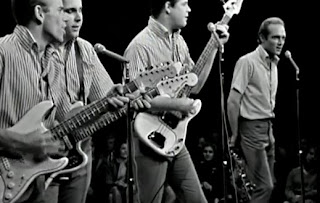
(The photograph shows the Beach Boys at their so-called “Lost Concert,” 1964, a performance believed lost for 35 years.)

Tuesday, July 5, 2011

Song Lyric of the Day (J.D. Souther, Weighing Sorrow and Hope)

“I don't know how you go on with your sorrows
Weighing you down like a stone
But then I don't know how I can sit here and give you advice
Dying for home.”—J.D. Souther, “Go Ahead and Rain,” from the Home by Dawn LP (1984)

A prior post of mine discussed my admiration for a past hit song of country rock singer-songwriter J.D. Souther, “You’re Only Lonely.” That exquisite song, along with 10 others from his marvelous career, has been collected in the musician’s current release, Natural History.


The album this might best be compared with is Jimmy Webb’s 1996 release Ten Easy Pieces, another re-recording of a famed singer-songwriter’s greatest hits (often composed for others), with spare instrumentation and beautiful restraint exercised by producer Fred Mollin. In this case, however, Souther’s voice, practically made for classic crooning, possesses a distinct advantage over that of the composer of “Wichita Lineman” and “MacArthur Park.”

It's wonderful to hear Souther revisit tunes made famous originally by The Eagles (“New Kid in Town,” “Best of My Love,” and especially “The Sad Café,” a long goodbye to the idealism of the Sixties). But for me, the real revelation was “Go Ahead and Rain.” Souther and Mollin did well to lead off the CD with this song that balances searing sorrow and tentative hope.

I expect I’ll be playing this CD repeatedly, and for a long, long time.

Monday, February 14, 2011

Video Classic of the Day: Souther’s “You’re Only Lonely”


Valentine’s Day brings all kind of reflections about love, but let’s not forget the unrequited kind. I don’t think that the agony of love’s absence has ever been evoked so movingly as in the 1979 hit “You’re Only Lonely” by J.D. Souther.


The singer-songwriter might be better known as one of the architects of the ‘70s Southern California sound with tunes covered by The Eagles, James Taylor and Linda Ronstadt (“Best of My Love,” “Heartache Tonight,” “Her Town Too,” and “Faithless Love”). But he may have reached the zenith of his career with this plaintive cry of the heart, which he sings in Japan in 1990 on this YouTube clip.


I’ve sometimes wondered why this song, unlike the others named above, hasn’t been covered by more artists. But then again, it’s impossible for me to conceive of anyone else performing this better.