Showing posts with label THE NATURAL. Show all posts

Tuesday, August 23, 2022

Quote of the Day (Edna Ferber, on an Adonis in a Dirty Baseball Uniform)

“Any man who can look handsome in a dirty baseball suit is an Adonis. There is something about the baggy pants, and the Micawber-shaped collar, and the skull-fitting cap, and the foot or so of tan, or blue, or pink undershirt sleeve sticking out at the arms, that just naturally kills a man's best points. Then too, a baseball suit requires so much in the matter of leg. Therefore, when I say that Rudie Schlachweiler was a dream even in his baseball uniform, with a dirty brown streak right up the side of his pants where he had slid for base, you may know that the girls camped on the grounds during the season.”—American novelist, short-story writer, and playwright Edna Ferber (1885-1968), “A Bush League Hero,” in Buttered Side Down: Stories (1912)

If the name “Edna Ferber” is recognized nowadays, it’s less because of her once-wildly-successful novels and plays than how often Hollywood saw them as hot properties worthy of adapting to the screen—works like Giant, Cimarron, Saratoga Trunk, Dinner at Eight, Show Boat, and the Pulitzer Prize-winning So Big. Many of these are regional works, ranging from Texas to Alaska.

That’s why I was astonished to find that Ferber had written a much less sprawling work—a short story—and even, God help me, a short story about baseball. I’d have understood it about her contemporary, Ring Lardner, who started out as a sportswriter, but Ferber is a different matter.

I still don’t know enough about Ferber to tell you whether she was a fan, but judging from this excerpt from her work, she sure noticed things (like that “Micawber-shaped collar”).

I suspect that the allure of an Adonis, even in a dirty business uniform, remains compelling to many a female fan more than a century after Ferber wrote these words. That would account for the matinee-idol status accorded, at least for a while, for Yankee shortstops Bucky Dent and Derek Jeter.

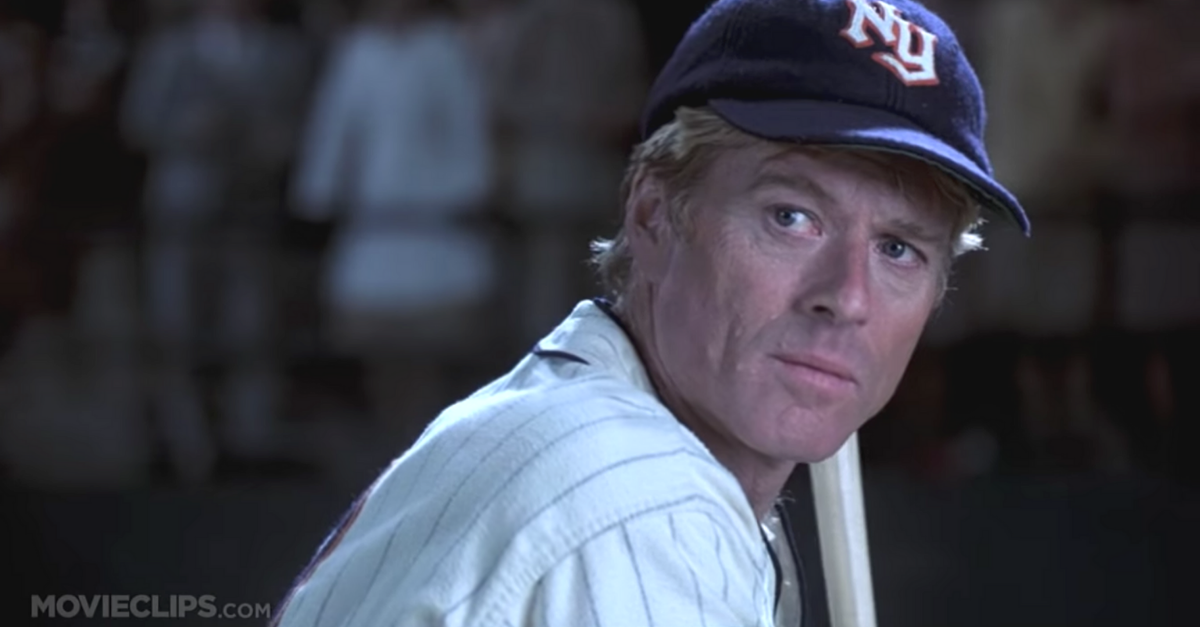
It’s even more the case for a movie baseball player: Robert Redford’s Roy Hobbs in The Natural (in the image accompanying this post)..

I couldn’t find a shot of Hobbs’ uniform beginning to seep with blood from a terrible past wound reopened, but I’m presenting the next best thing for my female readers: his face dirty, sweating and tense, as he awaits a pitch that can redeem a season and even his own life.

Saturday, September 30, 2017

Quote of the Day (Bernard Malamud, on the Awesome Power of ‘The Natural’)


“Wonderboy flashed in the sun. It caught the sphere where it was biggest. A noise like a twenty-one gun salute cracked the sky. There was a straining, ripping sound and a few drops of rain spattered to the ground. The ball screamed toward the pitcher and seemed suddenly to dive down at his feet. He grabbed it to throw to first and realized to his horror that he held only the cover. The rest of it, unraveling cotton thread as it rode, was headed into the outfield.”— Bernard Malamud, The Natural (1952)

This past summer marked the 65th anniversary of the first novel by Bernard Malamud. When it was turned into a vehicle for Robert Redford in 1984, The Natural was given a happy ending.

I’m normally a stickler for staying as close to original source material as possible, but I didn’t mind in this case. At the time, baseball had been hit with a series of drug scandals. No, not performance-enhancing drugs, but a performance-detracting one: cocaine, which afflicted several members of the Kansas City Royals in the early 1980s and, in 1985, burst out, in even more spectacular fashion, at the Pittsburgh Drug Trials, which ensnared such stars as Keith Hernandez, Tim Raines, and Dale Berra.

So, I was in an acquiescent mood in the 1980s when Malamud’s dark warning of the corruption of innocence was turned into the kind of optimistic, life-affirming film that Frank Capra once made. Since then, it has become not only one of my two favorite baseball films (vying with Bull Durham), but also one of my favorite movies, period.

I was surprised, then, as I began to write this post, to discover that, in nearly an entire decade of blogging, I had written only glancingly about The Natural before. One day, perhaps on the 35th anniversary of its release, I may well write about the movie at the length it deserves.

But the book itself weaves its own magic, and one of the ways it does so, as seen in the quote I used here, is in evoking the mythological aspects of baseball. 

“Wonderboy”— the bat of Roy Hobbs, desperate to make the most of perhaps his only shot at the big leagues—endows the improbable 35-year-old rookie with the same kind of astonishing power that Excalibur afforded King Arthur.  He has, to his team’s amazement, obeyed the offhand command of his manager Pop to “rip the cover off the ball.” Through one swing of the bat, he has changed the entire climate of the game—even the New York “Knights” miserable season to date—with his Thor-like presence.

I thought of Hobbs’ amazing highs and lows in the ensuing season as I followed the fortunes of Aaron Judge (pictured) this year. It’s appropriate that the New York Yankee rookie occupies right field, once the domain of Babe Ruth—perhaps as close to a mythological figure as baseball has ever produced. 

As of this writing, Judge has not only surpassed the major league rookie record for home runs, but also The Bambino’s mark for the most HRs in franchise history at home for a single season. Judge has even been heavily associated with a phrase evocative of the Thor-like Hobbs: “exit velocity.”

Slumping is another way that Judge resembles Hobbs. Malamud is very shrewd on the utter helplessness that the best baseball minds feel in the wake of a slugger’s doldrums, which can consume a contender as much as a power surge can lift them. Judge had his own epic meltdown after the All-Star Game, when Yankee fans such as myself worried that pitchers had discovered and exploited a fatal flaw at the plate.

More recently, Judge has righted himself, resuming something like his home run pace of the first half. It’s going to be interesting to see if he can keep carrying the team (like Hollywood’s Hobbs) or if he will falter in the end (like Malamud’s). Baseball prodigies, like Greek deities, sometimes prove all too humanly fallible in the end.

(Photo of Aaron Judge in a Yankee game against the Baltimore Orioles, taken Sept. 7, 2017, by Keith Allison from Hanover, Md.)

Saturday, April 26, 2014

(Quote of the Day (Bernard Malamud, on Writing as a Jewish American ‘For All Men’)


I’m an American, I’m a Jew, and I write for all men. A novelist has to, or he’s built himself a cage. I write about Jews, when I write about Jews, because they set my imagination going. I know something about their history, the quality of their experience and belief, and of their literature, though not as much as I would like. Like many writers I’m influenced especially by the Bible, both Testaments. I respond in particular to the East European immigrants of my father’s and mother’s generation; many of them were Jews of the Pale as described by the classic Yiddish writers. And of course I’ve been deeply moved by the Jews of the concentration camps, and the refugees wandering from nowhere to nowhere. I’m concerned about Israel….Sometimes I make characters Jewish because I think I will understand them better as people, not because I am out to prove anything. That’s a qualification. Still another is that I know that, as a writer, I’ve been influenced by Hawthorne, James, Mark Twain, Hemingway, more than I have been by Sholem Aleichem and I. L. Peretz, whom I read with pleasure. Of course I admire and have been moved by other writers, Dostoyevsky and Chekhov, for instance, but the point I’m making is that I was born in America and respond, in American life, to more than Jewish experience. I wrote for those who read.”— Bernard Malamud interviewed by Daniel Stern in “Bernard Malamud, The Art of Fiction No. 52,The Paris Review, Spring 1975

You can truly understand the vicissitudes of literary reputations when you consider the reviews of Adam Begley’s new biography of John Updike, which frequently have noted that the late man of letters could sure use a boost among critics these days. The fact that such a fate could befall the prolific and accomplished Updike—long a ubiquitous presence, and only dead five years—makes you appreciate the rather sorry posthumous fate of Bernard Malamud, with nowhere near his output and dead 28 years now. Several years ago, his daughter Jenna, a psychiatrist, came out with a biography in which she frankly admitted to the hope of bringing him back to where he was in the late Seventies: i.e., spoken as one of the "big three" postwar voices of Jewish America, along with Saul Bellow and Philip Roth.

Janna Malamud Smith’s 2006 bio, My Father is a Book, doesn’t seem to have done the trick, but the time might be right now for her father’s rising critical stock. Anniversaries, for instance, concentrate readers’ and publishers’ attention. Today, as it happens, marks the centennial of the birth of the novelist-short story writer in Brooklyn. Right on time come two volumes from the Library of America—Novels and Stories of the 1940s and 1950s and Novels and Stories of the 1960s—that, in effect, admit him to the American literary pantheon. Now, hopefully, more readers will approach him in the same spirit of astonished delight as Flannery O'Connor, who wrote a friend in 1958: "I have discovered a short-story writer who is better than any of them, including myself. Go to the library and get a book called The Magic Barrel by Bernard Malamud."

Longtime readers of this blog might recall my prior post on the novel that won Malamud the Pulitzer Prize, The Fixer. But really, I don’t think that comes close to exhausting all that might be written about his carefully calibrated, exquisite prose; his compassion for his suffering characters and suffering humanity as a whole; and his quiet sense of irony and humor.

Malamud’s quote above comes cocooned in all kinds of irony. In the interview from which it came, he spoke of how protégé Philip Roth needed to stop writing so obsessively about his troubled first wife. Roth indeed followed that advice that year: his My Life as a Man, a thinly veiled exorcism of that matrimonial disaster.

Yet you can also practically hear the note of exasperation in Malamud’s voice when he says: “the point I’m making is that I was born in America and respond, in American life, to more than Jewish experience.” The best reminder of that is an apprentice novel that, over the years, has become one of his best known: The Natural (1952).

For more than three decades, my admiration for Robert Redford’s Capraesque film adaptation has led me to avoid what I have long known to be Malamud’s far more somber take on baseball. Now, however, I may be in the mood for the original. 

At a basic psychological level, Malamud can probably tell much about why athletes such as Barry Bonds and Alex Rodriguez could misuse their many, pure gifts to spoil America’s pastime. More broadly, its dominant literary conceit—Roy Hobbs’ New York Knights as a counterpart to King Arthur’s Knights of the Round Table—can enable us understand the short-lived promise of the Camelot that held sway in the Kennedy White House within a decade of the novel’s publication—as well as why its collapse, amid treachery and tragedy, has proved so traumatic.

Short-story writer-critic Cynthia Ozick gave the correct response to her own question about whether Malamud was "an American Master": "Of course. He augmented it with fresh plasticity, he shaped our English into startling new configurations....He wrote about the plentitude and unity of the world."

Thursday, May 31, 2012

Quote of the Day (Daniel Barbarisi, on the Sick Yankees)


“A baseball team is a traveling germ factory. Twenty-five men living as a unit, sharing workout facilities and equipment, shaking hands with autograph-seeking fans, and pushing their bodies to exhaustion night after night—it's a recipe for illness. When one gets sick, sooner or later, they all do. And right now, the Yankees are sick.”—Daniel Barbarisi, “The Yanks Need Some Chicken Soup,” The Wall Street Journal, May 19, 2012

Easily the funniest scene in the Robert Redford baseball movie The Natural (1984) comes when a psychiatrist addresses the slumping New York Knights. “Losing is a disease…as contagious as polio,” he tells them dolefully, with scenes intercut of the hapless squad striking out, dropping easy fly balls, colliding with each other, etc. “Losing is a disease...as contagious as syphilis. Losing is a disease…...as contagious as bubonic plague...attacking one…but affecting all.”

Barbarisi’s article, appearing nearly two weeks ago now, came when the Bronx Bombers were at a physical low ebb, highlighted by the debilitating bronchial infection of Mark Teixeira (in the photo here). (Three years ago, that upraised hand was a mark of triumph; now, it appears more like a warning to stay away from him.) A physical illness was turning into something harder to shake, as the Yankee bats went to sleep and the team went on a losing streak.

The hapless Oakland A’s did wonders for the team’s morale—not to mention health—for awhile, including Teixeira’s. But a road stand at the Angels, where they lost two of three, are making many fans wonder all over again if this is longer lasting.

Some years ago, Bronx Bomber captain Derek Jeter noted that, while some teams have a single season of 162 games, you would think the Yankees have 162 seasons of one game each, based on the daily hysteria of the media. There have been other years when the team went through inexplicable cold spells, only to right themselves in the end. On the other hand, there’s also 2008, when they finished out of the money.

Here’s hoping that the team gets back to and stays on its winning ways, and that this is not just another manifestation of what Alex Rodriguez contracted after the 2009 World Series: The Curse of Kate Hudson. The team not only disregarded my perfectly reasonable suggestion that they vote her a full World Series share for how she helped turn the third baseman’s head (and performance) around, but Stray-Rod ditched her and took up with successive blondes (Cameron Diaz and Torrie Wilson) with nowhere near as good results.

Maybe a love doctor will cure what's ailing A-Rod and the Yanks. Otherwise, this latest slump could turn into the equivalent of the bubonic plague.