Showing posts with label Maureen Dowd. Show all posts

Friday, April 5, 2019

Quote of the Day (Danny DeVito, on the Joy of Playing The Penguin)


“It was a lot of fun. You got to put all the clothes on and the suit and the mask. It's like real commedia dell'arte. We all hide behind masks anyway. And you add something else onto that, which is like a beak, flippers, and you live in the sewer and you drool black crap out of your mouth.”—Actor Danny DeVito, on playing The Penguin in Batman Returns, quoted in Maureen Dowd, “The Fearless Ringmaster,” The New York Times, March 24, 2019

Thursday, January 28, 2016

Quote of the Day (Maureen Dowd, on ‘Sarahcuda’ Palin)


“With [Sarah] Palin and [Donald] Trump, a failed reality star and a successful one, gall is divided into two parts. There has been a lot of talk this campaign season about how women pols bring superior qualities to the table: collegiality and listening skills. But Sarahcuda shows that we are truly the equals of men, capable of narcissistic explosions, brazen hypocrisy and unapologetic greed. She had barely finished the endorsement Tuesday when she began using it to raise money for SarahPAC, so she can take her show on the road.”—Maureen Dowd, “Sarah Palin Saves Feminism,” The New York Times, Jan. 24, 2016

Sarah Palin threatens to put out of business Saturday Night Live as a source of electoral satire. After all, how can the SNL parody of her Donald Trump endorsement compete with her own self-parody?

“Just what is it with Sarah Palin?” a relative of mine, by no means a liberal, asked me the other day. What, indeed? After listening to her speech supporting Trump, can you, Faithful Reader, recall another public figure who ever sounded so incoherent without being drunk or high?

Michael Barbaro’s New York Times piece about this landmark in political dissuasion could barely restrain itself in recounting the former Vice-Presidential candidate’s multiple offenses to sense and sensibility. He picked out 10 of the “most memorable lines” from the speech, then, kind soul that he is, translated it for the benefit of readers. This passage is a particular favorite of mine:

“And you quit footing the bill for these nations who are oil-rich, we’re paying for some of their squirmishes that have been going on for centuries. Where they’re fighting each other and yelling ‘Allahu akbar,’ calling jihad on each other’s heads forever and ever. Like I’ve said before, let them duke it out and let Allah sort it out.”

It’s hard to know where to start with something like this. Already, “squirmishes,” in all its artlessness, shows signs of becoming a permanent part of political slang. (If Palin had a working cerebellum at this point, she might be squirming at the thought that she butchered a common-enough word like “skirmishes.”)

There once was a time, from one end of our sprawling country to another, when teachers instilled in their students how to build, step by step—words, phrases, clauses, sentences, paragraphs, all held together by consistency in pronouns, verbs and tone—structures of larger thought. That has gone sadly missing in the three sentences—or what purport to be three sentences—in Ms. Palin’s quote above. 

It is extremely doubtful whether any professional speechwriter would ever want to be credited with having written this grammatically loose, meandering address. The logical conclusion is that Ms. Palin herself winged it, right on the stump. No self-respecting politician improvises in this fashion, lest he or she risk merciless exposure, as Ms. Palin did in this case.

It is, in fact, a dreadful commentary on modern audiences that a speech like this elicited resounding cheers rather than appalled silence. Within my own memory, politicians once delivered coherent addresses. They might be cliché-ridden, they might be even masterfully evasive, but they attempted to present arguments and convince audiences of their value.

What “Sarahcuda” presented last week did not even meet this minimum standard. In fact, it doesn’t even match the level of the 30-second soundbite so derided by so many contemporary political commentators.

But leave aside questions of sound and sense. A woman whose principal national-security expertise derived from seeing Russia from her Alaska home executed, in the sphere of foreign policy, a triple-axel that would have astounded Olympic skaters.

Consider this: In September 2008, then-Governor Palin told a church audience that the “Iraq War is a task that is from God.” More than seven years later, she sounded like Sen. Rand Paul in demanding that the U.S. stop “footing the bill for these nations who are oil-rich.” In the interval between these statements, she never explained her reversal.

Nearly a decade ago, she did not criticize the President who put these soldiers in harm’s way, in a conflict started on faulty premises and pursued without forethought: George W. Bush. Now, shockingly, she blames Barack Obama—who has consistently sought to wind down the disastrous conflict inherited from his predecessor—for the post-traumatic stress disorder she sees at the heart of her son Track’s recent act of domestic violence that led to his arrest.

In that accusation against the President, Palin not only demonstrated that she fails at English and history, but also at logic. Track Palin’s tour of duty in Iraq began in 2008, before Barack Obama became President.  

As for the idea that Obama is “indifferent” to veterans such as Track: The long wait times for veterans' care that burst into public view last year were, according to this article from Mother Jones, known as far  back as 2005, but continued for the remaining four years of the Bush administration. Yet, even as veterans’ problems began to pile high in the second term of George W. Bush, the administration stuck to its plans to cut funding for their  health care, according to this 2007 piece from the Washington Times.

In 2008, Sarah Palin proved to be scandalously uninformed and unprepared to assume the Presidency. The nation dodged a budget when she and the man who named her to the ticket, John McCain, did not win the election. This year, however, reveals a scandal of a different kind: the continuing adulation she still receives from an oblivious portion of the American public. In 1997, William Kristol and David  Brooks wrote an essay in The Weekly Standard calling for "National Greatness Conservatism." Nearly two decades later, Sarah Palin can lay fair claim to leading another, increasingly more sizable, wing of the movement: Clueless Conservatism.

Sunday, April 27, 2014

Quote of the Day (Peggy Noonan, on the Inspiring Imperfection of Saints)


“There is a misunderstanding regarding sainthood itself, and it is that saints are perfect. Saints aren’t perfect, they’re human. A saint is recognized for heroic virtue in the service of Christ, but saints have flaws, failings and eccentricities. It is because they are not perfect that they are inspiring. They remind you what you could become.”—Peggy Noonan, “‘Santo Subito!’ They Chanted,” The Wall Street Journal, April 27, 2014

This weekend’s column by Peggy Noonan reads like an indirect response to Maureen Dowd’s takedown in The New York Times of Pope John Paul II’s simultaneous canonization along with Pope John XXIII. Dowd's commentary—notably, criticizing the late pontiff for not cracking down on the sexual abuse scandal—was predictable, as was the torrent of comments from online readers weighing in on MoDo’s side. (Opinions ran about 20 to 1 against John Paul before I gave up reading.)

Noonan—herself a scathing critic of the Church’s response to the scandal—makes the two necessary and appropriate arguments regarding John Paul’s response to this. First, that the Communists and Nazis he had struggled against all his life used false allegations of sexual misconduct to undermine opponents, including priests (such happened in the early 1980s, when the Soviets and their lackey Polish regime when they tried that line of attack, unsuccessfully, against Lech Walesa). That left him inclined to discounts any scattered reports he may have initially about priestly misconduct. Second, that, had he been fully apprised of the widespread and widening nature of the abuse crisis by his bishops (who, so often, had their own reasons to downplay the threat), he would not have tolerated the damage to children, who meant so much to him.

Noonan does offer a useful catalogue of how history will recall John Paul:

“He was a crucial actor in defeating the Soviet Union, an expansionist, atheistic, totalitarian state that for 70 years bedeviled mankind. After he was shot and almost killed in 1981, he made a point to go to the would-be assassin’s prison cell to assure him that he was personally forgiven, and that God loved him. He wrote and spoke in a new way of the true nature and meaning of the Catholic faith from its beginnings to its missions to its meaning in the world. As Francis would, he stood for the powerless, from the unborn to the unwell to the aged.”

Even this, however, does not go far enough. The essential place to start, I think, is with Jonathan Kwitny’s biography Man of the Century. The hyperbolic title is unfortunate, given the author’s far more nuanced argument for John Paul’s greatness. While fully acknowledging the late pontiff’s faults, in a depth far surpassing even Dowd’s, he nevertheless points to John Paul’s crucial role in bringing down Communism. It was not, as so many American conservatives have claimed, primarily owing to Ronald Reagan or even Margaret Thatcher that the specter of Communism vanished from Eastern Europe, but because of John Paul, his fellow Poles, and other (more often than not, Catholic) subject peoples behind the Iron Curtain.

The magnitude of that achievement, the product of John Paul's stubborn faith as well as his political dexterity, cannot, as Dowd tries to do, be underestimated. East Bloc Communism fell without a shot being fired. No less an authority than Mikhail Gorbachev has noted that this would not have occurred without John Paul. Just how extraordinary that is can be seen in comparison to the contemporaneous crackdown in Tiananmen Square or Vladimir Putin’s maneuvers in the Ukraine today.

In providing essential leadership in the peaceful movement of mass numbers of people from oppression to liberty, John Paul’s achievement ranks with that of Martin Luther King Jr. and Mahatma Gandhi. In short, if for this alone, he fully merits being called the Church’s apostle of freedom through nonviolence.

Saturday, March 16, 2013

Quote of the Day (Maureen Dowd, on Digital Platforms and Content)


“Digital platforms are worthless without content. They’re shiny sacks with bells and whistles, but without content, they’re empty sacks.

“It is not about pixels versus print. It is not about how you’re reading. It is about what you’re reading.”—Maureen Dowd, “As Time Goes By,” The New York Times, March 10, 2013

Sunday, August 5, 2012

Bonus Quote of the Day (Arthur Gelb, on Monroe’s Dizzying Walk)


“When she walked, it was as though she had a hundred body parts that moved separately in different directions. I mean, you didn’t know what body part to follow.”—Former New  York Times managing editor Arthur Gelb, quoted in Maureen Dowd, “The Love Goddess Who Keeps Right on Seducing,” The New York Times, August 5, 2012

A half-century to the day that she died, Marilyn Monroe remains an object of fascination, in a way that others who have died younger (such as Jean Harlow, a full decade younger than Monroe at the time of her death) have not. Gelb (who cops to making, and following through on, a boorish, drunken bet that he could touch the star’s “flawless porcelain back” at Sardi’s) has put his finger on one element, her overpowering sexuality. (Billy Wilder also captured that walk in her memorable introduction in Some Like It Hot—a movement so astonishing it leads Jack Lemmon’s cross-dressing, mob-dodging musician to gasp that it’s “like jello on springs”).

She was the ultimate woman who makes guys act endlessly stupid just by her sheer presence.

But only part of the fascination owes to her raw physical appeal.  Much of the  continued interest relate to her vulnerability, the lingering questions of Kennedy involvement in her last desperate days, and her attempt to break out of the image that she herself had so adeptly created.

Goodbye, Norma Jean. It’ll be a long time—if ever—before we see your like again.

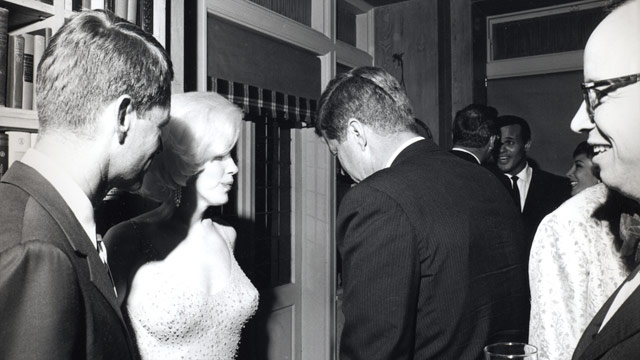
(Photograph of Monroe in her famous dress-with Jack and Bobby Kennedy and Arthur Schlesinger Jr., , on the occasion of the President’s 45th birthday party celebration in New York’s Madison Square Garden, in 1962 —by Cecil W. Stoughton, official White House photographer.)

Monday, January 26, 2009

Quote of the Day (Maureen Dowd, on New York Senator-Designate Kirsten Gillibrand)

“The 42-year-old Gillibrand, who has been in the House for only two years, is known as opportunistic and sharp- elbowed. Tracy Flick is her nickname among colleagues in the New York delegation, many of whom were M.I.A. at her Albany announcement.

Fellow Democrats were warning Harry Reid on Friday that he was going to have his hands full with the new senator because she’s ‘a pain.’”—Maureen Dowd, ““Which Governor is Wackier?” The New York Times, January 24, 2009

(I have my issues with a larger trend that Caroline Kennedy came to epitomize: the “branding” of American political dynasties—not just the Kennedys, but also the Clintons, the Bushes, the Gores—who capitalize on family connections and fame to elbow aside others in a democracy.

Nevertheless, for all her inarticulateness—a weakness that, the overwhelming majority of the press failed to note, sometimes afflicted her uncles Bobby and Ted—Kennedy struck me as basically a class act. She certainly did not deserve the leaking and trashing to which she was subject by the minions of Gov. David Paterson.

What a way for Gillibrand to make her entrance onto the big political stage: to be likened to the budding high-school politician played by Reese Witherspoon in the great comedy Election. One term in Congress, peddling positions that would make the NRA smile, and now she’s ready to assume the seat once occupied by Bobby Kennedy, one of the past century’s most prominent victims of assassination. What was Gov. Paterson thinking?

I have to wonder if this fiasco would have occurred if Paterson still had by his side Charles O’Byrne, the ex-priest-turned-political insider. O’Byrne had become close to Caroline Kennedy while he was in Columbia Law School with one of her cousins. A decade later, while still a Jesuit, he officiated at the wedding of John F. Kennedy Jr. as well as at his memorial service.

Disclosure of his failure to taxes for four several years earlier in this decade, during a period of clinical depression around the time he left the priesthood, forced O’Byrne to resign as Paterson’s chief aide. At one stroke, his departure seems to have left Paterson—a genial man with generally good policy instincts—without a shrewd political enforcer.

At very least, O’Byrne would not have resorted to trashing his old friend after her withdrawal—he would have found a face-saving way for her to pull out. He might even have been able to intervene earlier in the process, persuading Kennedy not to jump into the fray lest she she become covered with muck.

Instead, Paterson has now managed to tick off the Clintons, the Cuomos, AND the Kennedys over this affair. It’s hard to see how a one-term upstate Congresswoman who sounds even less appealing than Sarah Palin can help him.)