
Showing posts with label German Literature. Show all posts
Showing posts with label German Literature. Show all posts
Wednesday, July 30, 2025
Quote of the Day (Hermann Hesse, on ‘People With Courage and Character’)


Wednesday, August 28, 2024
Quote of the Day (Johann Wolfgang von Goethe, on Nature and Art)

And yet, before we know it, both are one;
I too have learned: Their enmity is none,
Since each compels me, and in equal part.”— German man of letters Johann Wolfgang von Goethe (1749-1832), “Nature and Art” (c. 1800; published 1807), translated from the German by Michael Hamburger, in Selected Works (Everyman’s Library, 2000)
Johann Wolfgang von Goethe—born 275 years ago today in Frankfurt, Germany—was to German literature what William Shakespeare was to England’s and Alexander Pushkin to Russia’s—a titanic figure who decisively influenced its language and literary standing around the world.
But, because of his attitude to nature and art, he was so much more. I think that Goethe might have been the last of the Enlightenment figures who were able to make their marks in multiple fields.
Had he confined his endeavors to literature, Goethe still would have been acclaimed for his versatility in multiple genres: the novel (The Sorrows of Young Werther, a bestseller in 1774), travelogues (Italian Journey), drama (Faust), and assorted poems eventually set to music.
Like Thomas Jefferson—born only six years before—Goethe trained in the law before dabbling in science (he formulated the concept of morphology, a kind of forerunner to Darwin’s theory of evolution) and practicing statecraft (as an aide to Duke Carl August, who later became Grand Duke of Saxe-Weimar-Eisenach).
I mentioned that he was an Enlightenment figure, but in another sense, he harked back to the Renaissance who could excel at multiple areas of endeavor. Besides the above activities, Goethe was also a skilled painter and, well into middle age, an enthusiastic athlete.
(For more on Goethe as Renaissance man, see this August 2020 post from the Sarkologist blog.)
Ralph Waldo Emerson, using Goethe as a representative of “The Writer” type in his seven lectures on Representative Men (1850), saw him as someone who “in conversation, in calamity…finds new materials”
Such was his capacity,
that the magazines of the world’s ancient or modern wealth, which arts and
intercourse and skepticism could command,—he wanted them all. Had there been
twice so much, he could have used it as well. Geologist, mechanic, merchant, chemist,
king, radical, painter, composer,—all worked for him, and a thousand men seemed
to look through his eyes. He learned as readily as other men breathe. Of all
the men of this time, not one has seemed so much at home in it as he. He was
not afraid to live.
Thursday, April 4, 2024
Quote of the Day (Thomas Mann, on Space, Time, and Forgetfulness)

Wednesday, December 21, 2022
Quote of the Day (Thomas Mann, on Christmas Season in 19th Century Germany)

Saturday, June 11, 2022
Quote of the Day (Johann Wolfgang von Goethe, on Trusting Yourself)

Seeing that quote, outside of its theatrical context,
one might regard it with the same optimism and innocence as Ralph Waldo Emerson’s
“Trust thyself: every heart vibrates to that iron string.” (And, indeed, in his
essay collection Representative Men, the American admired the German man
of letters so much as to offer him as an example of “The Writer.”) What could
be wrong with that?
Well, wait. In Goethe’s tragedy Faust, the line
is said by Mephistopheles—yes, the Devil himself. He may be more gentlemanly
and witty than what one might expect, but he remains wheedling, calmly appealing
to Faust’s belief in his own reason and scholar’s overweening vanity.
Self-confidence lies at the heart of the modern
self-help movement. Yet it is crucial to remember that, unchecked by any outside
restraint, that quality can lead to self-delusion, a refusal to recognize
reality, and a willingness to use others for one’s own ends.
Wednesday, October 20, 2021
Quote of the Day (Thomas Mann, on ‘The Artist's Highest Joy’)

Tuesday, June 1, 2021
Bonus Quote of the Day (Thomas Mann, on a ‘Luminous’ Munich on the First Day of June)

This quote was too beautiful not to highlight on this
day.
Wednesday, August 28, 2019
Quote of the Day (Heinrich Heine, on How ‘Dark Times are Rumbling Toward Us’)

“Wild, dark times are rumbling toward us, and the
prophet who wishes to write a new apocalypse will have to invent entirely new
beasts, and beasts so terrible that the ancient animal symbols of St. John will
seem like cooing doves and cupids in comparison.”—German poet Heinrich Heine
(1797-1856), Lutetia; or, Paris. From
the Augsberg Gazette, 12, VII (1842)
Monday, July 22, 2019
Quote of the Day (Thomas Mann, on a Wine Bottle--Beautiful Outside, Awful Inside)
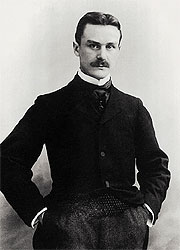
“[T]he firm of Engelbert Krull paid unusual attention
to the outside of their bottles, those final adornments that arc technically
known as the coiffure. The compressed corks were secured with silver wire and
gilt cords fastened with purplish-red wax; there was, moreover, an impressive
round seal — such as one sees on ecclesiastical bulls, and old state documents
— suspended from a gold cord; the necks of the battles were liberally wrapped
in gleaming silver foil, and their swelling bellies bore a flaring label with
gold flourishes round the edges. This label had been designed for the firm my
godfather Schimmelpreester and bore a number of coat of arms and stars, my
father’s monogram, the brand name, Loreley
extra cuvee, all in gold letters, and a female figure, arrayed only in bangles
and necklaces, sitting with legs crossed on top of a rock, her arm raised in
the act of combing her flowing hair. Unfortunately it appears that the quality
of the wine was not entirely commensurate with the splendour of its coiffure.
‘Krull,’ I have heard my godfather Schimmelpreester say to my father, ‘with all
due respect to you, your champagne ought to be forbidden by law. Last week I
let myself be talked into drinking half a bottle, and my system hasn’t recovered
from the shock yet. What sort of vinegar goes into that brew? And do you use
petroleum or fusel oil to doctor it with? The stuff’s simply poison. Look out
for the police!’”—German novelist and Nobel Literature laureate Thomas Mann
(1875-1955), Confessions of Felix Krull, Confidence Man, translated by Denver Lindley (1955),
Saturday, March 9, 2019
Quote of the Day (Thomas Mann, on the Exclusivity of Stories)
 “Not every story happens to everyone.”—German Nobel
Prize-winning novelist, short-story writer, and essayist Thomas Mann
(1875-1955), in his introduction to The Magic Mountain (1924)
“Not every story happens to everyone.”—German Nobel
Prize-winning novelist, short-story writer, and essayist Thomas Mann
(1875-1955), in his introduction to The Magic Mountain (1924)
Thursday, November 15, 2018
Quote of the Day (Thomas Mann, on Europe on Edge, 100 Years Ago)

“It was a spring afternoon in that year of grace
19-, when Europe sat upon the anxious seat beneath a menace that hung over its
head for months.” — German novelist and Nobel Literature laureate Thomas Mann
(1875-1955), Death in Venice (1911)
It might be more appropriate for today’s “menace”—nationalism/fascism
revived—to appear while we wait for the cold of winter to arrive…
Thursday, October 19, 2017
Quote of the Day (Thomas Mann, on Why Speech is ‘Civilization Itself’)
 “Speech is civilization itself. The word, even the
most contradictory word, preserves contact — it is silence which isolates.”—
German
novelist and Nobel Literature laureate Thomas Mann (1875-1955), The Magic Mountain (1924)
“Speech is civilization itself. The word, even the
most contradictory word, preserves contact — it is silence which isolates.”—
German
novelist and Nobel Literature laureate Thomas Mann (1875-1955), The Magic Mountain (1924)
Subscribe to:
Posts (Atom)


