Showing posts with label Gary Cooper. Show all posts

Friday, May 19, 2023

This Day in Baseball History (Gehrig’s Columbia Clout Starts Lou Lore)

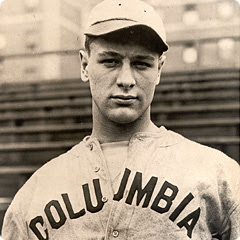
May 19, 1923—Not yet in Yankee pinstripes, Columbia University sophomore sensation Lou Gehrig gave evidence of the power that would make him one of the greatest baseball players of all time with a home run that became the stuff of legend.

Fans of the future Hall of Famer and the screen idol who played him nearly two decades later, Gary Cooper, will recall the scene from the popular 1942 film The Pride of the Yankees that focused on this moment. 

It’s a real-life version of the bust-the-fixtures highlights that occur so often in The Natural, except that in this case it didn’t occur in a fictional major-league ballpark but on Columbia’s real-life South Field, where it was reported to be the longest homer hit there to that time.

But did Gehrig’s blast really knock out a window in the School of Journalism? What got me interested in this question was Leslie Zukor’s article in the new Spring/Summer issue of Columbia Magazine.

Contemporary accounts, Zukor indicated, varied in where they said the homer landed. My old newspaper, The Columbia Daily Spectator, pointed to “in front of [the School of] Journalism.” Similarly, The New York Times reported that the ball came down “in the small campus surrounding the School of Journalism building.” The Hartford Daily Courant, which covered Columbia’s opponent that day, Wesleyan University, claimed that “the sphere went over the center field stands and hit the School of Journalism building.”

What do we have here? A Bunyanesque blast that flew 400 feet and destroyed the psyche of Wesleyan pitcher Joseph Layton “Layt” Moore that day. But it doesn’t seem to have destroyed any windows. So where did this notion come from?

Maybe eyewitnesses simply misremembered the end point of the home run, or maybe, from so far away, they took their best guess about where it should have gone. But, if tracing the legend to a single source or sources is difficult, it’s easier to cite what gave the story “legs”: The Pride of the Yankees.

In that box-office smash, the reporter who will become Gehrig’s great advocate and friend (Walter Brennan’s “Sam Blake”) is talking to the phenom’s football coach (Gehrig was on a football rather than baseball scholarship to the school) when the sound of breaking glass interrupts their talk at the same time it puts an exclamation point on it.

In a way, that scene is typical of so much about the film and its tendency towards sharpening and shining up actuality. 

A major truth of Gehrig’s career is at the core of this scene: he was already an athlete of raw but astonishing skill just waiting to be discovered by the wider baseball world. He did indeed give observers something to talk about that day: not just his plate productivity—that homer, a single and two walks—but his three-hit throttling on the mound. (The same thing had happened a month earlier, in a game against Ivy League rival Cornell, when Gehrig hit--you guessed it--"a towering and legendary home run, possibly the longest in Hoy Field’s history," according to Jeff Stein's 2015 article in the Ithaca Voice.)

But it’s far more questionable whether Gehrig busted the window at Columbia's School of Journalism. And he didn’t need a sportswriter to boost his status: Yankee superscout Paul Krichell (who would go on to alert the team to, among others, Phil Rizzuto and Whitey Ford) had discovered him over a month before at a game against Rutgers, and by the time of the Wesleyan game had persuaded Gehrig to sign with the Bronx Bombers. As a matter of fact, there wasn’t a “Sam Blake” (the closest equivalent in Gehrig’s life was probably sportswriter Fred Lieb).

There’s another aspect of this scene that is not so immediately apparent: this astounding feat occurs, in effect, off the field. 

Before being cast, Cooper had no interest in baseball, and he had to undergo intense training by coach and former player Lefty O’Doul in the art of hitting. The star’s lack of ease with the bat probably contributed to the odd fact that, in a movie of roughly 2 hours and 10 minutes about a tremendous baseball player, less than 10 minutes feature any action on the diamond.

Even the follow-up to the Columbia sequence (Gehrig disappointing his mother’s wish that he graduate with an engineering degree by signing with the Yankees) misattributes his motivation: it wasn’t to pay for her medical care, but his father’s.

Nobody should be surprised by such departures from history: Hollywood has always been uninterested in fidelity to fact, and Pride of the Yankees producer Samuel Goldwyn had no interest in a film about baseball (or even the subject of Gehrig) until he was told about "The Iron Horse's" “Luckiest Man on the Face of the Earth” speech on the day held in his honor in 1939.

As sportswriter Paul Gallico (who wrote the “story” for the Oscar-nominated film) wrote to Gehrig’s widow Eleanor during filming: “No matter what I know, we are going to catch hell from the sports writers so we might as well face it. None of the boys will ever understand what we were up against in trying to make baseball fit into a Sam Goldwyn movie.” (Not even the screenplay, co-written by fellow Columbia alum Herman Mankiewicz, seems to have improved its commitment to reality.)

In short, much of the early going in the movie consists of facts changed for no particular reason; characters or situations sandpapered from rough reality (Gehrig's possessive mother didn't have an ambivalent relationship to her daughter-in-law but a positively warlike one); or concern about a global reality that hangs over the portrayal of its driven subject (Gehrig's success was a demonstration to a world at war that America was a place where virtue and hard work was rewarded).

In the end, it didn’t matter. Whatever offenses against the truth occur in the first half of the film, from the moment that Lou and Eleanor notice the first distressing signs of the ALS that will end his livelihood and even his life, all of that is forgotten and forgiven.  

The poignant interplay between Cooper and Teresa Wright as Eleanor in the closing scenes underscores a larger truth that the testimony of his teammates and subsequent biographical research confirmed: that with the love and support of his vivacious wife, this shy, often insecure superstar faced a mystifying disease with an undaunted courage that inspired millions around the world, all the way down to the present day—including many with no real interest in what may have happened on his Ivy League campus 100 years ago today.

As for me: Gehrig ranks, together with Jackie Robinson, as my favorite baseball player. This blog post I wrote 14 years ago, on the 70th anniversary of the end of his extraordinary 2,300-consecutive game streak, goes a long way to explain why, I hope.  

But ultimately, the novelist Thomas Wolfe put it far more poetically than I ever could: the Yankee great, he wrote in You Can’t Go Home Again, embodied “the faultless velvet of the diamond.”

Tuesday, January 16, 2018

Quote of the Day (Gary Cooper, on Kissing in Westerns)


“In Westerns you were permitted to kiss your horse but never your girl.”—Oscar-winning actor Gary Cooper (1901-1961), as told to George Scullin in “Well, It Was This Way," Saturday Evening Post, March 17, 1958

Tuesday, November 24, 2015

This Day in Literary History (O’Hara’s ’10 North Frederick’ Published)


November 24, 1955—Random House, yielding to the desire of bestselling author John O’Hara to get a decent critical shake for his latest novel, released Ten North Frederick on Thanksgiving. The ploy, aimed squarely at the daily reviewers of The New York Times, worked: the book earned such a favorable review from critic Charles Poore that the publisher released most of O’Hara’s books on the holiday for the remaining 15 years of his life.

It shouldn’t have mattered—since A Rage to Live six years before, O’Hara had been earning enough from his books to live in the affluent style he chronicled in his fiction—but critics had increasingly given him the backs of their hands, and it stung.

Critic Dwight Macdonald referred to The New York Times’ two regular daily reviewers, Poore and Orville Prescott, as “the lead-dust twins,” but at least as far as O’Hara was concerned, significant differences existed between the two. Prescott had lambasted A Rage to Live for its “sensationalism,” primarily for being “only the story of a woman for whom there is a common but unprintable word.” Poore did not like all of O’Hara’s work (he later had serious reservations about Ourselves to Know), but he never regarded him as anything other than a serious novelist who deserved at least a respectful hearing.

The thin-skinned O’Hara obviously wanted to avoid being  reviewed by Prescott—and eventually, he figured out a way to circumvent him. At the time, the Times critics alternated the days of their reviews, a practice to which the Good Gray Lady adhered religiously. This meant that Prescott did not review on Thursdays.

Publishing on Thanksgiving, then, might have seemed to ordinary bibliophiles a reminder to get hold of another O’Hara title for Christmas. For the novelist, however, it meant stealing a critical march on someone who had done him dirt in print.

Ten North Frederick went through 58 international printings between its original publication and 1970—no surprise. But it also netted unusual critical acclaim for an O’Hara work, culminating in a National Book Award the following year—a recognition so unusual that the legendarily cantankerous author choked up at the end of his acceptance speech.

In nearly 40 years of reading and re-reading O’Hara, this novel remains a particular favorite of mine—even though, as I noted in a prior post, his most enduring legacy is as a master of the short story. Yet the 60th anniversary of its publication—and my viewing, after all this time, of its 1958 fine film adaptation starring Gary Cooper and Geraldine Fitzgerald (both in the image accompanying this post)—has made me reflect anew on why it works so well for me.

For the first time in a novel since the book that first brought him notice, Appointment in Samarra, O’Hara returned to Gibbsville, a fictionalized version of his eastern Pennsylvania birthplace, Pottsville. And, though it is longer and less fiercely concentrated than that earlier work, it deals with similar themes: society’s image of an individual vs. his self-image, free will vs. determinism. That can be seen, very subtly, even in its first paragraph, as a new widow prepares herself for the crowd coming to pay respects at the funeral of her husband:

“Edith Chapin was alone in her sewing room on the third floor of the house at Number 10 in Frederick Street. The room was warm, the day was cold and unbrightened by the sun. The shutters in the bay-window were closed, but the slats in the shutters were open, and Edith Chapin could, when it pleased her, go to the bay-window and look down on her yard and the two-story garage that had been a stable, and above and beyond the gilded figure of a trotting horse on the weather vane she could see roof upon roof upon third story upon third story of the houses on the rising hill. She would know the names of nearly all of the people who lived in them, she knew the names of the owners. She had spent her lifetime in the town, and it was easy to know who everyone was and where everyone lived. It was especially easy for Edith because she had always had a reputation for shyness, and it was not expected of her to make a fuss over people. She could notice them and study them, if it pleased her, without any further social effort on her part than simple politeness called for. It had always been that way.”

Notice the wealth of information suggested by these seven sentences:

*A great length of time is evoked—first by “the two-story garage that had been a stable,” symbolizing the seismic social change wrought by the automobile, second by the note that Edith “had spent her lifetime in town.” The rest of the novel will consider the entire lifetime of her husband, Joe, an eminent lawyer who, by virtue of inherited wealth, is the most prominent man in town.

*Edith gazes down on “the houses on the rising hill.” Her affluence is implied not just by topography but by her manner of beholding those in her orbit; they are beneath her. At the same time, she knows “the names of nearly all of the people who lived in them [and] the names of the owners.” Quietly, O’Hara has distinguished between landlords and tenants (“the people who lived in them”), another clue to the issues of class that obsess him. It might be said that O’Hara, with his insatiable curiosity about people, knew all about houses and their inhabitants. But he sometimes transformed what he knew for fictional purposes. In this case, he took the real-life home that most resembles the Chapins’—a house on George Street in Pottsville, owned by his mentor at a local newspaper—and made it into a far grander home on the written page, according to biographer Frank MacShane. One other thought about the matter of observation here: Technically, there is no passage in the book when O’Hara, as third-passage narrator, enters the consciousness of Joe Chapin. But through the entire experience of everybody gathered at the house for the funeral,  the reader learns as much about him as it is possible to do about a human being with all his inevitable secrets and need for privacy.

*The fact that Edith has lived all her life in town speaks volumes about her narrow horizons. But, except for education at Yale, Joe’s is no broader.

* Edith can look out the window “when it pleased her,” and she can notice and study the townspeople “if it pleased her.” The near-exact repetition of that phrase was not a mistake on O’Hara’s part. Pleasure is a highly contingent matter for Edith. Just as important, it’s a silent assertion of her will—an instinct in stark contrast to her largely passive, though decent and kind-hearted, husband.

*The weather—“cold and unbrightened by the sun”—summons not just a dismal day or time of year, but also, we will learn by the book’s end, the frigid marriage of Joe and Edith. Later,  O’Hara will peg this character unmistakably, without the screen of symbolism: “Protestantism for her religion, extravagance nowhere in her character, and discontent never far from her contemplation.”

*“Edith…always had a reputation for shyness, and it was not expected of her to make a fuss over people.” Much of the rest of the novel will unpeel an onion—the reputation of Joe Chapin as a success—versus the reality—a failure as a family man and in the one ambition he seeks to satisfy in midlife. Similarly, Edith’s reputation for “shyness” will be revealed as a sham. She is not a wallflower, but a withholder of affection. As for what is “expected,” that comes to hamstring her husband. Well into middle age, he does exactly what first his parents, then society, thinks he will do. He has never had to take risks—even small ones, let alone large ones—with the result that his inner resources are lacking. When, at age 50, he finally does decide to seek what he wants—the U.S. Presidency—he cannot grasp how preposterous the notion is, without the slightest political experience. It’s inevitable that, in the preliminary step toward this, running for lieutenant governor of the state, he will be cheated out of a $100,000 donation to the Republican Party by local boss Mike Slattery—who, by his comparatively lower-class upbringing, has far fewer compunctions about seizing what he wants.

There is something else to be noticed about the sentences in this first paragraph: they are long, leisurely even, in the manner of someone about to relate a story about three generations—not just Joe Chapin but also his parents and children.  But O’Hara also knew how such sentences could set up the reader for a short, devastating one, the kind that comes at the end of this long opening section about the funeral, when the mourners begin to quarrel over who will direct a subscription for the memorial they plan in his honor: “Joseph B. Chapin was finally dead. They had started fighting over him.”

Hypocrisy and cruelty run rampant in this kind of social order. Only love—even the furtive, helpless romance between Joe and a friend of his adult daughter’s—provides a grace note in a life discovered, tragically late, to have been empty at its core.

In a very real sense, O’Hara was laying down a marker for himself with Ten North Frederick. In the first two decades of his career writing fiction, his ability to write fast had been undercut by heavy drinking. Then, in the course of a year and a half in the 1950s, his life changed dramatically because of a near-fatal stomach ulcer, the death of his beloved second wife, the resulting primary responsibility for his nine-year-old daughter, and remarriage, on his 50th birthday.

The change in O’Hara was signaled by his pouring an entire bottle of scotch down the drain. After that, he never had another drink. All the energy he had once wasted on pub crawling now went into one of the most astonishingly prolific periods ever exhibited by a major American novelist.

The critical reputation of O’Hara has been dogged by the perception that he never wrote another novel as good as his rookie effort, Appointment in Samarra. A different but equally sizable group of people disliked his unsparing treatment of how characters interact, including through sex.

It’s a sign of the skill and complexity of O’Hara’s tough-minded realism in Ten North Frederick that he provided an answer of sorts through the otherwise not very sympathetic Judge Lloyd Williams: “Well I don’t give a damn what you think or anyone else. Nothing personal. I just see what I see and I don’t shut my eyes to it.”

Tuesday, July 24, 2012

Movie Quote of the Day (“High Noon,” on ‘How Much You Can Ask a Man’)


Deputy Sheriff Herb Baker (played by James Millican): “Time's gettin' pretty short.”

Marshall Will Kane (played by Gary Cooper): “It sure is.”

Herb: “When are the other boys gonna get here? We gotta make plans.”

Kane: “The other boys? There aren't any other boys, Herb. It's just you and me.”

Herb: [nervously smiles and chuckles] “You're jokin'.”

Kane: “No, I couldn't get anybody.”

Herb: “I don't believe it. This town ain't that low.”

Kane: “I couldn't get anybody.”

Herb: “Then it's just you and me.”

Kane: “I guess so.”

Herb: “You and me against Miller and all the rest of them?”

Kane: “That's right. Do you want out, Herb?”

Herb: “Well, it isn't that I want out, no. You see. Look, I'll tell ya the truth. I didn't figure on anything like this, Will.”

Kane: “Neither did I.”

Herb: “I volunteered. You know I did. You didn't have to come to me. I was ready. Sure, I'm ready now - but this is different, Will. This ain't like what you said it was gonna be. This is just plain committing suicide and for what? Why me? I'm no lawman. I just live here. I got nothin' personal against nobody. I got no stake in this.”

Kane: “I guess not.”

Herb: “There's a limit how much you can ask a man. I got a wife and kids. What about my kids?”

Kane: “Go on home to your kids, Herb.”—High Noon (1952), directed by Fred Zinnemann, screenplay by Carl Foreman from the magazine story “The Tin Star,” by John W. Cunningham

That most taut of classic westerns, High Noon, premiered on this date 60 years ago, in a place far removed from the film’s Hadleyville, New Mexico: New York City. Or maybe the remoteness only related to physical details: dusty vs. concrete streets, open frontier spaces vs. crowded urban squares. Because in the ways that people behaved--the desire to look away when something heinous was about to occur--not much separated Gotham from the film's precarious outpost of civilization on the frontier.

The pleasures of this film are manifold. My earlier post on Gary Cooper only began to hint at its riches, as did a fine piece by blogger Matt Barry that placed it in a trio of great “psychological westerns” along with The Ox-Bow Incident and Shane

The movie is, of course, superbly scripted, directed and acted. But what drew so many to the film at the time, and continues to do so, is the identification that so many people feel with the agonizing dilemma faced by Marshal Will Kane: the high cost of doing the right thing. In that sense, the movie shares a common theme with a later Fred Zinnemann classic as totally unlike it as you can get in terms of setting, dialogue and narrative pace: the Oscar-winning biopic about Saint Thomas More, A Man for All Seasons (1966).

Director Howard Hawks and John Wayne, aghast at the silly notion that a lawman would take on a gang of toughs alone, answered in 1959 with Rio Bravo. (Wayne, making no bones about his quarrel with High Noon's mostly liberal filmmakers, went so far as to call it "defeatist" and "un-American.") But a lawman taking on thugs with a hopeless alcoholic, a broken-down old man, and a callow youth doesn’t equalize the odds appreciably compared with the solitary man who will do his duty even when nobody else will.

What Zinnemann and screenwriter Carl Foreman realized so brilliantly here was the unexpected adaptability of cinema’s oldest genre in presenting a distant mirror of their own age of anxiety. Few suspected that this cinema form—even one employed by such masters as Hawks and John Ford—could, amid its venerable conventions, offer as many opportunities to comment on one’s own time and place as Italy presented in the plays of William Shakespeare.

The subject whose name could not be openly broached—particularly for Foreman, about to fall victim to Hollywood’s blacklist—was McCarthyism. Far too many people in America in 1952 would not directly confront the bullying U.S. Senator from Wisconsin—including a genuine war hero, Dwight Eisenhower, who was persuaded to delete from a speech his defense of one of Joseph McCarthy’s targets, General George C. Marshall.

“The awful thing about life is this: Everybody has their reasons,” goes the great line from Jean Renoir’s The Rules of the Game. Everybody certainly has their reasons for not helping Will Kane: pacifism and fear of widowhood (his fianceé Amy), unwillingness to take part in another man’s quarrel, ambition (young Deputy Marshal Harvey Pell), disgust with the town (Kane’s former lover, the Mexican Helen Ramirez), cowardice, and, as in Herb Baker’s case, family ties. 

Kane’s reasons for avoiding the showdown with the Miller Gang are better than anyone else’s—he’s about to get married, his time as sheriff is up, and Miller is out to get him for putting him in prison—but he can’t turn away. His credo reflects the monosyllabic persona created over two decades in film by Cooper, but it might also be the most eloquent line in the whole movie: “I've got to, that's the whole thing.”

In films and TV series after High Noon, Hollywood would use the Western to draw parallels between 19th and 20th century America, in such areas as racism (Ford’s Sergeant Rutledge and John Huston's flawed but stirring The Unforgiven), misadventures abroad (The Wild Bunch), capitalism (McCabe and Mrs. Miller) and anti-Semitism (The “Look to the Stars” episodes of Bonanza, in which the Cartwrights aid the promising young Jewish science student—and future Nobel laureate--Albert Michelson). 

High Noon started it all with the question implicitly posed by Herb Baker: How much can you ask a man? In a small Western town desperately unsure about maintaining its hard-won stability, as with a 20th and 21st century superpower concerned about the survival of the democratic values it proclaims, the answer is: Near everything.

Friday, December 2, 2011

Movie Quote of the Day (Gary Cooper, Unnerved by Barbara Stanwyck)

Professor Bertram Potts (played by Gary Cooper): “Make no mistake, I shall regret the absence of your keen mind. Unfortunately, it is inseparable from an extremely disturbing body.”—Ball of Fire (1941), written by Charles Brackett and Billy Wilder, based on an original story by Wilder and Thomas Monroe, directed by Howard Hawks

Today marks the 70
th anniversary of the release of Ball of Fire, which came toward the end of Hollywood’s magnificent screwball-comedy era. Five days later, Pearl Harbor would be bombed, and once Hollywood was done with its propaganda products and home-front dramas, it began to explore in earnest a genre it only began to touch this year, in The Maltese Falcon: film noir that reflected a newfound understanding of man’s darkest impulses. The world would never look so bright again.
 
Ball of Fire would be the last film that
Billy Wilder, chafing under the restrictions placed on his work by the men behind the camera, would make only as a screenwriter. The following year, The Major and the Minor began his nearly 40-year career as a director. In the meantime, he convinced the studio to allow him to observe the work of Howard Hawks, whose films he greatly admired.

For all the fast-and-furious action that Hawks packed into this two-hour film about a “nightclub singer” holing up with a group of linguistic professors to avoid police questioning about her mobster boyfriend, the film really can be seen as one long wink to the audience. 

Even the quote marks in that prior sentence represent a raised eyebrow. Barbara Stanwyck’s “nightclub singer” is a stripper, one of two she would play in her long, illustrious career (the other being Lady of Burlesque, based on a mystery by Gypsy Rose Lee, whose pretensions as an intellectual exotic dancer were mocked by lyricist Lorenz Hart in the musical Pal Joey.)

The more knowing members of the audience would also catch on to the film's central satiric premise,  seven professors studying slang centered around one brassy female with an especially vivid sense of it--Snow White and the Seven Dwarfs, if you will. 

And Hollywood insiders were probably beside themselves guffawing over box-office champion Gary Cooper--so laconic that Art Buchwald, in one of his funniest early columns, used the actor’s characteristic “nopes” and “yups” to respond to Coop’s own questions--as the chief linguistics professor. (How Cooper got around the formal, polysyllabic but hilarious lines above, addressed to Stanwyck, can only be imagined.)

And how can you not find a place in your heart for a stripper named Sugarpuss O’Shea?

The queen of film bloggers, Self-Styled Siren, has a characteristically astute analysis of what made this film so worthwhile
here
.

Friday, May 13, 2011

Quote of the Day (Frank Capra, on Gary Cooper)

“Every line in his face spelled honesty. So innate was his integrity he could be cast in phony parts, but never look phony himself.

“Tall, gaunt as Lincoln, cast in the frontier mold of Daniel Boone, Sam Houston, Kit Carson, this silent Montana cowpuncher embodied the true-blue virtues that won the West: durability, honesty, and native intelligence.”—Frank Capra, The Name Above the Title: An Autobiography (1971)
TV viewers of the April 1961 Academy Awards might have been surprised to see James Stewart take long strides to the stage to pick up an honorary Oscar being awarded that night to his friend Gary Cooper. That surprise probably turned to mass confusion, even consternation, as Stewart became emotional as he spoke of Coop.

Before long, front pages of newspapers around the world provided the answer to the mystery: the prostate and colon cancer that doctors thought they had successfully treated had metastized in the veteran star. The following month--on this day 50 years ago--the embodiment of the slow, laconic, but sure American Everyman had died.

In choosing an image to accompany this post, I thought at first of choosing a photo of the young Cooper, one that would make it understandable why he became one of Hollywood’s romantic leads, a 6-ft.-3-inch man that the always dependably salty Carole Lombard christened “Studs.”

But the more I considered it, there really was only one image for me. Much as I liked them, it wasn’t from one of the two films in which director Capra so shrewdly maximized Cooper’s considerable appeal, Mr. Deeds Goes to Town and Meet Joe Doe. It wasn’t even from one of the fine romantic comedies he made with Howard Hawks (Ball of Fire) or Billy Wilder (Love in the Afternoon).

No, it was from the genre in which Cooper (whose real first and middle names were Frank James, ironically echoing that of the brother of one of the West’s most notorious outlaws) first made his mark in the talkies, in The Virginian (1929): the western. In fact, it was from one of the truly great westerns of them all: High Noon (1952).

Some people have claimed that the intensity written all over Cooper’s face, in a performance that won him his second Academy Award, resulted not from his assimilation of the mounting tension his character, Marshal Will Kane, faces, but from the actor’s private medical struggle of the time (he was having an ulcer). Don’t you believe them.

There was a reason why Fred Zinnemann cast him: like every other director who ever worked with him, he knew that Cooper could convey volumes without saying a word. And so it was here, in a magnificent performance that returned the actor to the top of Hollywood’s A list, after a dry spell at the start of the 1950s.

By the time of the scene in this still, Cooper is showing that the task facing Kane--to stop a dangerous outlaw and his men before they reach town on the noon train in 90 minutes (reflecting the running time of the film)--has unexpectedly transformed from elemental to monumental. One by one, every able-bodied man in town has come up with an excuse not to help him form a posse to stop the outlaws.

Now, facing them alone, with even his Quaker bride-to-be indicating her disapproval, he’s being called on to summon not only every bit of experience and strength he ever learned in law enforcement, but also reserves within that he’s never known. And all of this still might not be enough. He’s weary and worried, but, as the Capra quote indicates, he is a Cooper stuff, with a common-man's greatness that Americans take to heart.

In other words, the burden on him might be huge and grossly unfair, but he will shoulder it. Like the fictional code created by his good friend, novelist Ernest Hemingway, he embodies the very definition of courage as "grace under pressure."

Cooper’s performance is what makes High Noon one of the most psychologically taut, and deeply satisfying, examples of the western genre created by Hollywood almost as soon as the frontier itself closed down. By film's end, Will Kane has become as toweringly mythic as the heroes to whom Capra likened Coop (yes, he does kill the villains), yet still, recognizably, a man (he flings down his badge in disgust with the town he was willing to save, but who, he now knows, would never do likewise for him).