
Showing posts with label Dr. Martin Luther King Jr.. Show all posts
Showing posts with label Dr. Martin Luther King Jr.. Show all posts
Monday, January 19, 2026
Quote of the Day (Dr. Martin Luther King Jr., on Non-Violence and Oppressors)


Monday, September 2, 2024
Quote of the Day (Martin Luther King Jr., on Truths Forgotten About the Labor Movement)

Martin Luther King’s leadership of the civil-rights movement hardly stopped with his successful campaigns against segregation and for voting rights. He recognized that a living wage was just as essential for African-Americans.
Nobody should forget that he reminded his audience at the AFL-CIO and the
larger American public that unions, by raising wages, had created a mass market
for industry in the postwar era.
His belief in the necessity of unions was so powerful
that he was in Memphis to support striking sanitation workers when he was
assassinated in April 1968.
One person today who has forgotten the “simple truths” that King identified 63 years ago—as well as that he lost his life while advocating for justice for striking workers—is Donald Trump.
Then again,
as a leader who sought to create coalitions for change through non-divisive
rhetoric, Dr. King would have been appalled by Trump’s demagogic references these last
few weeks to “black jobs.”
Even that doesn’t constitute a truly bizarre, unforced
error by the GOP Presidential nominee. Instead, try his endorsement of firing striking workers in his recent X interview with Elon Musk—a mistake all the greater
considering that union member votes may be more up for grabs than at any time
since Labor Day was declared a federal holiday 140 years ago.
The GOP nominee’s observation unleashed widespread
condemnation from union leaders. A typical denunciation— that Trump’s remarks constituted “economic terrorism”—came from Teamster head Sean O’Brien,
who had addressed the Republican Convention only the month before.
The electronic Trump-Musk dialogue also prompted the United Auto Workers to file unfair labor practice charges against the GOP presidential nominee and the X impresario, alleging interference with workers who may
want to exercise their right to join a union.
Even before the conversation between the tetchy
ex-President and the tech billionaire, Trump had compiled a problematic
labor-relations record dating back to his days in New York real estate,
including a $1.4 million settlement for underpaying undocumented Polish workers who demolished the Bonwit Teller department store to make way for
Trump Tower.
Without the Wagner Act of 1935—the so-called “Magna Carta” of organized labor—Trump would never have been called to account for that violation.
Now, his loose remarks to Musk blatantly undercut another central
tenet of this landmark legislation: that “no person shall be denied employment
because of membership in or affiliation with a labor union."
That same legislation had previously benefited my father
and maternal grandfather.
As Irish immigrants, their entry into the American
middle class was eased by the benefits of union membership. When their way of
life was threatened, it came via layoffs from bosses every bit as contemptuous
(if not crude) as Trump.
If they were alive today, I’m sure they would have
scoffed not just at Trump’s remarks but also his larger pretensions to being a
working-class hero.
This Labor Day weekend, even with high-profile union
victories in the last year involving the United Auto Workers and the Hollywood
actors’ and writers’ strikes, it’s easy to forget that the position of most
American workers remains tenuous.
But, if this country is serious about addressing
income inequality and worker safety—and yes, as Dr. King noted, ensuring an
adequate market able to pay for the products of American industry—then it will
stop undercutting labor unions.
Sunday, July 14, 2024
Quote of the Day (Dr. Martin Luther King Jr., on ‘The Ultimate Weakness of Violence’)

Monday, January 15, 2024
Quote of the Day (Martin Luther King Jr., on Courage in the Face of Disaster)

Monday, August 28, 2023
Quote of the Day (Taylor Branch, on MLK and the March on Washington)

Sunday, April 16, 2023
Spiritual Quote of the Day (Dr. Martin Luther King Jr., Reproving the Contemporary Church as ‘An Archdefender of the Status Quo’)

“But the judgment of God is upon the church as never
before. If today's church does not recapture the sacrificial spirit of the
early church, it will lose its authenticity, forfeit the loyalty of millions,
and be dismissed as an irrelevant social club with no meaning for the twentieth
century. Every day I meet young people whose disappointment with the church has
turned into outright disgust.”—Civil-rights leader and Nobel Peace Prize
laureate Dr. Martin Luther King Jr. (1929-1968), “Letter from Birmingham Jail,” Apr. 16, 1963
Sixty years ago today, Dr. Martin Luther King Jr.,
jailed for participating in a nonviolent civil rights protest in Birmingham,
Ala., read a statement in a local newspaper from eight fellow clergymen, taking
him to task for “unwise and untimely” direct action rather than pursuing justice
through the courts. Veering between profound disappointment and righteous
anger, the civil-rights leader began to scribble his response—at first in the
margins of the original article itself, then in paper provided by a black jail
trusty, even on toilet paper.
After the scraps were smuggled out by aides and
reassembled in a nearby hotel into 20 typed pages, the resulting “Letter from
Birmingham Jail” proved as startling in content as in composition. It
transcended its origin as an open letter to the seven Protestant ministers and
one rabbi to become a seminal document of the civil-rights movement.
Many passages have become among the most famous in
King’s entire eloquent output, including:
* “History is the long and tragic story
of the fact that privileged groups seldom give up their privileges voluntarily”;
* “Shallow understanding from people of good will is
more frustrating than absolute misunderstanding from people of ill will”; and especially
* “We are caught in an inescapable network of
mutuality, tied in a single garment of destiny. Whatever affects one directly
affects all indirectly.”
The letter is filled with allusions to religious
figures, providing a common frame of reference with the ministers who
criticized him and laying the groundwork for a powerful rhetorical answer to
them: Jesus, St. Paul, Martin Buber, and Paul Tillich.
Most pointedly, he cited St. Thomas Aquinas to prove
that “An unjust law is a human law that is not rooted in eternal and natural
law”—part of his justification for the necessity of civil disobedience against segregation.
Read even in the context of its own time, King’s
letter demonstrates an aspect of his career that often is forgotten
today: his radicalism, even when it came to criticizing Southern white
moderates, such as the eight clergymen who sympathized with his goals but
disagreed with his tactics.
At the same time, it points to his understanding of
the need for broad-based activism beyond simply voting rights and de jure
segregation. In our time, that concern has been given the unfortunate,
academic-sounding coinage “intersectionality.”
But King, with his typical pungency, expressed the
matter more memorably: “I am cognizant of the interrelatedness of all
communities and states….Injustice anywhere is a threat to justice everywhere.”
In the last years of his short life, King took a
stance that, again, many activists—including longtime allies—regarded as a
bridge too far by assailing the Vietnam War. He took his fateful trip to
Memphis in 1968 to aid a sanitation workers’ strike that had been sparked by
low wages and appalling working conditions. (In early February two black
employees, forbidden by city policy from taking refuge from storms by standing
on porches and forced to take refuge in the barrel of their garbage truck, died
when the vehicle malfunctioned.)
Today, he would protest inadequate health care,
environmental injustice, and gun laws that rip apart people of all races, ethnicities,
and classes—all operating under the conviction, like the demonstrators sitting
down at segregated lunch counters in his time, that they would be “standing up
for the best in the American dream and the most sacred values in our
Judeo-Christian heritage.”
(Asking whether an “email, tweeted press release or
lengthy text message from Birmingham Jail [would] carry the same gravitas,” Vanecia Carr’s thoughtful January 2022 blog post considers “The Power of a Paper
Letter.”)
Monday, January 16, 2023
Quote of the Day (Martin Luther King Jr., on When ‘A Man Dies’)
Monday, January 17, 2022
Quote of the Day (Martin Luther King Jr., on God’s Laws ‘Planted in the Fiber of the Universe’)

Monday, January 20, 2020
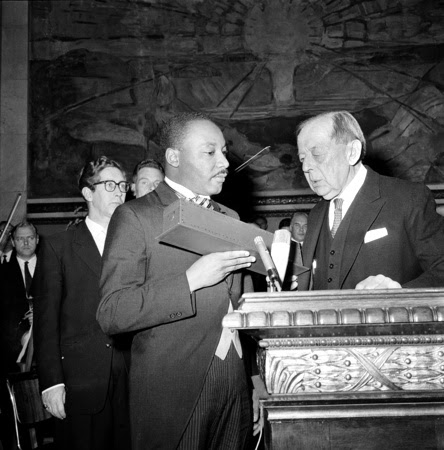
Quote of the Day (Dr. Martin Luther King Jr., on God’s Love ‘Seeking to Preserve and Create Community’)

“Agape [i.e., God-originated love] is not a weak, passive love. It is love in action. Agape is love seeking to preserve and create
community…. The Holy Spirit is the continuing community creating reality that
moves through history. He who works
against community is working against the whole of creation…. In the final
analysis, agape means a recognition of the fact that all life is interrelated….
Whether we call it an unconscious process, an impersonal Brahman, or a Personal
Being of matchless power and infinite love, there is a creative force in this
universe that works to bring the disconnected aspects of reality into a
harmonious whole.”— American civil-rights leader and Nobel Peace Prize
laureate Dr. Martin Luther King Jr. (1929-1968), Stride Toward Freedom: The Montgomery Story (1958)
(The image accompanying this post shows Dr. King receiving the Nobel Peace Prize in 1964.)
Monday, January 21, 2019
Quote of the Day (Martin Luther King Jr., on ‘The Good Neighbor’)

“The good neighbor looks beyond the external
accidents and discerns those inner qualities that make all men human and,
therefore, brothers.”—American civil-rights leader and Nobel Peace Prize
laureate Dr. Martin Luther King Jr. (1929-1968), Strength to Love (1963)
Tuesday, October 30, 2018
Quote of the Day (Martin Luther King, Jr., on the ‘Shackles of Prejudice’)

“There is little hope for us until we become
toughminded enough to break loose from the shackles of prejudice, half-truths,
and downright ignorance...A nation or a civilization that continues to produce
softminded men purchases its own spiritual death on an installment
plan.”—American civil-rights activist and Nobel Peace Prize laureate Dr. Martin
Luther King, Jr. (1929-1968), Strength to Love (1963)
In memory of the 11 Pittsburgh synagogue massacre
victims…Never again…
Wednesday, April 4, 2018
Quote of the Day (James Baldwin, on MLK and Malcolm X)
 “I don’t think that any black person can speak of
Malcolm [X] and Martin [Luther King Jr.] without wishing that they were here.
It is not possible for me to speak of them without a sense of loss and grief
and rage; and with the sense, furthermore, of having been forced to undergo an
unforgivable indignity, both personal and vast. Our children need them, which
is, indeed, the reason that they are not here: and now we, the blacks, must
make certain that our children never forget them. For the American republic has
always done everything in its power to destroy our children’s heroes, with the
clear (and sometimes clearly stated) intention of destroying our children’s
hope. This endeavor has doomed the American nation: mark my words.”—African-American
novelist-essayist James Baldwin (1924-1987), “Malcolm and Martin,” in No Name in the Street (1972)
“I don’t think that any black person can speak of
Malcolm [X] and Martin [Luther King Jr.] without wishing that they were here.
It is not possible for me to speak of them without a sense of loss and grief
and rage; and with the sense, furthermore, of having been forced to undergo an
unforgivable indignity, both personal and vast. Our children need them, which
is, indeed, the reason that they are not here: and now we, the blacks, must
make certain that our children never forget them. For the American republic has
always done everything in its power to destroy our children’s heroes, with the
clear (and sometimes clearly stated) intention of destroying our children’s
hope. This endeavor has doomed the American nation: mark my words.”—African-American
novelist-essayist James Baldwin (1924-1987), “Malcolm and Martin,” in No Name in the Street (1972)
(I took the image accompanying this post over four
years ago, while visiting the memorial to Dr. Martin Luther King Jr. in
Washington, DC.)
Subscribe to:
Posts (Atom)


