Showing posts with label Communism. Show all posts

Saturday, January 27, 2024

This Day in Russian History (Lenin Final Rites Strengthen Stalin’s Hold on Power)

Jan. 27, 1924—The Moscow funeral of V.I. Lenin, who seven years before had led a small cadre of revolutionaries to seize power over a Russian population of 158,000,000, took on all the characteristics of a secular sanctification, with the city of Petrograd renamed in his honor and even a special mausoleum containing his carefully preserved body erected in a mere three days.

Braving temperatures 35 degrees below zero Fahrenheit, lines of mourners more than a mile long waited patiently to segue past his coffin.

Already signaling the credulous reporting he would display in downplaying the Soviet terror famine of the early 1930s, The New York Times’ Walter Duranty reported that the Lenin-related pageantry would lay “the foundation of a revival campaign to infuse new energy, enthusiasm, unity, and discipline in the Communist party.”

While acknowledging an attack by Lenin’s emerging successor, Joseph Stalin, on his rival, Leon Trotsky, the day of Lenin’s death, Duranty brushed it off, seeing potential for harmony in the offing:

“The best-informed people here are confident that Trotsky, Radek, and other insurgents will join hands with the ‘machine’ leaders, Stalin, Zinoviev, Kamenev, and Bukharin, over Lenin’s grave. If Trotsky gives no sign to the latter, they may make the first step toward reconciliation.”

No such “reconciliation” took place. Unity would be achieved by fear and capitulation.

This was more than the kind of mass grief that followed, for instance, the assassinations of Abraham Lincoln and John F. Kennedy in the United States. 

This was a form of mass indoctrination, a means of smothering internal dissent about the meaning of Lenin’s life and the Soviet regime he had agitated, plotted, and fought to bring into being, and the beginning of what became a familiar sight for decades: 

The entombment of the Communist leader, performed against the express wishes of his family and several key Party leaders, reflected the wishes of Stalin, who—mindful of the traditional Russian Orthodox Church belief that a divine body would not deteriorate—used the last rites to position himself as Lenin’s successor and to help fashion his own “cult of personality.”

Somehow, architect Aleksei Shchusev managed to build this temporary mausoleum within the three days that Stalin allotted. Then he was asked to revise his plans twice more, with each revision producing a more grandiose structure.

What ordinary Russians couldn’t perceive over several decades was the sleight of hand needed to manufacture all this reverence. A phrase from The Wizard of Oz comes to mind: “Pay no attention to that man behind the curtain.”

David Remnick’s Lenin’s Tomb, published after the collapse of the USSR, noted that control room staffers supervised the optimal temperature and degradation of Lenin's corpse, and that beneath the mausoleum there was also a workout room for the guards, in which the reporter imagined "some pimply kid from Chelyabinsk doing squat thrusts."

In addition to successfully wrapping Stalin in Lenin’s mantle, the creation of Lenin as a revolutionary icon later served the purpose of Stalin’s opponents. The ceremony at Red Square substituted a revolutionary form of devotion for a religious one, with Lenin joining Karl Mark as the crucial icon.

With Stalin’s unmasking as a paranoid director of a police state a few years after his death in 1953, Lenin became the great “what-if” alternative for Communists who couldn’t abide any questioning of the legitimacy of the U.S.S.R.—or, according to Lenin biographer Christopher Read, “a ‘good’ Lenin, a democrat blown off course by Russian backwardness and the exigencies of the [Soviet] Civil War, as opposed to a ‘bad’ Stalin.”

Starting in spring 1922, three strokes had progressively undermined the Soviet leader’s health and, more important for the state he hoped to direct, limited his day-to-day control of Party affairs.

With his physical strength waning but his anxiety mounting, he sought to stave off a split between two of his closest associates, Stalin and Leon Trotsky, that might divide the Soviet leadership while he was alive and spark a succession struggle after his death.

Yet, though he chastised both men for behavioral traits that gave rise to tension in the ranks, he viewed Stalin—to whom he had often turned to implement his directives—as s figure who should be blocked from assuming ultimate authority in the state.

As Lenin grew feebler, he had attempted to curb Stalin’s increased accumulation of power by issuing in late December 1922 a “testament” to the Communist Party’s Central Committee. As General Secretary of the committee, he noted, Stalin now possessed “unlimited authority concentrated in his hands, and I am not sure whether he will always be capable of using that authority with sufficient caution.”

A couple of weeks later, after Stalin had insulted Lenin’s wife, the ailing leader went further in an addendum to his report, observing that the younger man’s rudeness was intolerable in a party leader, and that the committee should “think about a way of removing Stalin from that post” and appoint somebody “more tolerant, more loyal, more polite, and more considerate to the comrades, less capricious, etc.”

When Stalin’s death came in 1953, he joined his old chief in the mausoleum. But his period as an object of devotion was much shorter. 

After Nikita Khrushchev’s 1956 “secret speech” to the Congress of the Communist Party of the Soviet Union denouncing his crimes, it was only a matter of time—five years, to be exact—before he was removed from Lenin’s tomb and re-buried in a far humbler resting place.

But the cult of Lenin remained intact for decades more. “Lenin Lived, Lenin Lives, Lenin Will Live” became a longtime mantra of Soviet society, and even beyond, as the ubiquitous image of the international Communist movement at parades. Amid regimes that placed a premium on censorship, his works continued to be produced in mass quantity, year after dreary year.

There was far less distance than one might suspect between the current dictator of the sprawling Russian land mass named Vladimir and the one a century ago. (Lenin’s initials, V.I., stood for “Vladimir Ilich.” His surname was adopted as a pseudonym to evade the Czar’s secret police.)

Russia’s first kleptocratic ruler and the world’s first Marxist dictator embraced the same means to power: ruthless force that crushed opponents. 

Indeed, Vladimir Putin learned about the dark arts of poisoning, targeted assassinations, even striking at critics in foreign lands as a former lieutenant colonel of the KGB, a descendant agency of the Cheka, or Soviet state security police, set up by Lenin and under the direction of Felix Dzerzhinsky.

For a deeper, contemporary consideration of Lenin’s legacy—not just in the Soviet Union well into the glasnost era, but even among American right-wingers like Steve Bannon who emulate the Communist’s style of disruption if not his ideology—Cathy Young’s recent article from The Bulwark is well worth reading.

Tuesday, December 7, 2021

Quote of the Day (Timothy Snyder, on Globalization, Totalitarianism, and History)

“Both fascism and communism were responses to globalization: to the real and perceived inequalities it created, and the apparent helplessness of the democracies in addressing them. Fascists rejected reason in the name of will, denying objective truth in favor of a glorious myth articulated by leaders who claimed to give voice to the people. They put a face on globalization, arguing that its complex challenges were the result of a conspiracy against the nation. Communists ruled for longer, for nearly seven decades in the Soviet Union, and more than four decades in much of Eastern Europe. They proposed rule by a disciplined party elite with a monopoly on reason that would guide society toward a certain future according to supposedly fixed laws of history….

“Americans today are no wiser than the Europeans who saw democracy yield to fascism, Nazism, or communism in the 20th century. Our one advantage is that we might learn from their experience. Now is a good time to do so.”—Yale historian Timothy Snyder, On Tyranny: Twenty Lessons fromthe Twentieth Century (2017)

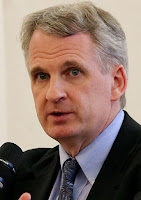
The accompanying photo of Timothy Snyder was taken Mar. 31, 2016, by Frauemacht.

Saturday, September 29, 2018

Quote of the Day (Lech Walesa, on ‘Polish Aspirations to Freedom’)


“I think that all nations of the world have the right to life in dignity. I believe that, sooner or later, the rights of individuals, of families, and of entire communities will be respected in every corner of the world. Respect for civic and human rights in Poland and for our national identity is in the best interest of all Europe. For, in the interest of Europe is a peaceful Poland, and the Polish aspirations to freedom will never be stifled. The dialogue in Poland is the only way to achieving internal peace and that is why it is also an indispensable element of peace in Europe.”—Former Polish President, union leader, and democracy icon Lech Walesa, “Nobel Peace Prize Address,” Dec. 11, 1983

Lech Walesa was born 75 years ago today in Popowo, Poland. The arc of his career—first leading the exhilarating battle for freedom in Eastern Europe, then increasingly marginalized in this region as it embraces the worst form of nationalism—is familiar but dismaying.

In 1980, Walesa sparked a series of strikes that won for Solidarity the right to represent workers. The free world cheered again as he endured house arrest and systematic harassment during Polish General Jaruzelski's imposition of martial law. Late in the decade, he proceeded from triumph to triumph, as Solidarity negotiated the right to free elections in Poland. A decade after the Gdansk strike, he became the first freely elected President of Poland. 

Unfortunately, Walesa was less adroit as President than as dissident and union leader. His alienation of former allies and inability to ensure a stable post-communist economy ensured a narrow defeat at the polls in his 1995 re-election bid—ironically enough, to a former communist functionary.

In the wake of that defeat, many believed that the freedoms Walesa had helped secure would survive in his homeland. But, while there has been no going back to Poland’s communist past, the nation has taken another problematic political turn, with the ruling nationalist Law and Justice Party supplanting liberal news anchors and talk-show hosts on state media with more congenial right-wing voices. At the same time, the new leadership also packed the Constitutional Court with five justices of their own liking and, particularly heinously, adopted a law (since modified) restricting public debate on the Holocaust.

Under the new regime, Walesa’s once-bright star has dimmed. He’s been forced to deny accusations that he served as a communist informer in the 1970s before he rose up the union ladder. More recently, he was pointedly excluded from any speaking role at recent anniversary celebrations of Solidarity. 

Poland is “now being destroyed,” Walesa explained to Bloomberg in discussing why, in his mid-70s, he felt compelled to step back into the political arena to monitor his country’s elections. His case illustrates how voters the world over, riven by socioeconomic discontent, might turn away from the liberal free-trade regime that preserved European collective security after WWII.

Friday, September 9, 2016

This Day in Chinese History (Death of Chairman Mao, Propagandist-Tyrant)


Sept. 9, 1976—Chinese Communist Party Chairman Mao Zedong, who cultivated a cult of personality that led many to overlook the dismal economic record and millions of deaths under his leadership, died at 82.

The physical decline of Chairman Mao was, in its way, of a piece with his crimes: the evidence scattered, but lying about in such profusion that an unbiased, reasonably attentive person could have surmised that something was amiss. He had not been seen in public since 1971, and the consensus of China watchers was that he had suffered from a neuromuscular disease, probably Parkinson’s.

In fact, his deterioration had been even more rapid than supposed. China’s leader had been diagnosed with Lou Gehrig’s Disease in 1974. His condition, dire enough with that diagnosis alone, was even worse because of a longtime addiction to cigarettes that left him vulnerable to bronchitis, pneumonia, emphysema and congestive heart failure, his personal physician Li Zhi-Sui finally revealed in The Private Life of Chairman Mao (1994).

Similarly, the strong-arm tactics of the Chinese leader were not impossible to divine, as in one of the principal maxims in Quotations from Chairman Mao (aka The Little Red Book): “Political power grows out of the barrel of a gun.” But many in the West were so excited at the wholesale transformation of the world’s most populous country after the 1949 revolution that they paid little attention to the strong signals of human-rights abuses.

In 1955, to quell any notion of revolt against a regime still only in existence a half-dozen years, Communist China formed what were known euphemistically as “re-education through labor” camps meant to house “counter-revolutionaries.” In time, they would house not only dissidents but also petty criminals, drug addicts and prostitutes—about 400,000 people in more than 300 facilities by 2007, according to an NPR report. Only two years ago did the current post-Mao overlords close what had become symbols of detention without trial and other legal abuses.

Even that did not begin to describe the extent of human-rights violations under the Maoist regime. Before he even seized power from Chiang Kai-shek, Mao had indicated his general indifference to human life on his so-called “Long March,” the 368-day, 7,000-mile retreat of Chinese Communist forces away from Chiang in 1935. As I mentioned in a prior post, less than 5% of his original 86,000 men survived the trip. If he remained unmoved at the thought of losing so many supporters, is it any wonder that he would be less so by opponents?

The estimates may vary concerning those who lost their lives because of Mao’s rule, but the arithmetic is unswervingly grim. Hong Kong-based historian Frank Dikotter, when allowed access to government archives, estimated that at least 45 million people were worked, starved or beaten to death in the laughably named “Great Leap Forward,” the nation’s attempt to catch up with Western economies from 1958 to 1962 through collectivization. In the “Cultural Revolution” of 1966, another two million may have lost their lives at the hands of students mobilized into Red Guard units who attempted to purge China of institutions and individuals regarded as insufficiently revolutionary.

The new understanding about Mao may have been best expressed by Australian man of letters Clive James, who has written:

“In China Mao Zedong went to war against the evil landlords and the imperialist spies. Neither group actually existed. The death toll of his countrymen exceeded the totals achieved by Hitler and Stalin combined. They all died for nothing. Dying innocent, they have their eternal dignity, but there are no profundities to be plumbed in their collective extinction except the adamantine fact of human evil.”


Wednesday, December 21, 2011

Quote of the Day (Vaclav Havel, on the ‘Contaminated Moral Environment’ of Communism)

“We live in a contaminated moral environment. We fell morally ill because we became used to saying something different from what we thought. We learned not to believe in anything, to ignore one another, to care only about ourselves. Concepts such as love, friendship, compassion, humility or forgiveness lost their depth and dimension, and for many of us they represented only psychological peculiarities, or they resembled gone-astray greetings from ancient times, a little ridiculous in the era of computers and spaceships. Only a few of us were able to cry out loudly that the powers that be should not be all-powerful and that the special farms, which produced ecologically pure and top-quality food just for them, should send their produce to schools, children's homes and hospitals if our agriculture was unable to offer them to all.” Vaclav Havel, “New Year’s Address to the Nation” after his election as President of Czechoslavakia, January 1, 1990

The life and career of playwright-dissident-statesman Vaclav Havel (1936-2011), who died over the weekend, was a standing rebuke not just to totalitarianism but also to the habits of mind to which even politicians in a democracy can slip when spin becomes, by ever-so-artful degrees, lying. He showed that, while words alone might not be sufficient in political discourse, they are an indispensable starting point in framing arguments and, as he put it, "living within the truth."

We are about to find out not only if that example will not only prove an enduring object lesson to the countries involved in the "Arab Spring," but whether the parties that followed his path toward freedom behind the Iron Curtain will have the backbone to tell their constituents the hard choices that await them in the worst economic crisis since the end of the Cold  War.

Vaclav's crucial recognition--that in politics (especially in politics) moral considerations still need to be brought to bear--is analyzed in a fine post by the blogger “Archbishop Cranmer.” (No, not the archbishop executed in the 16th century, but the contemporary British blogger using the name as a pseudonym.)

Sunday, December 4, 2011

This Day in Film History (Beatty’s “Reds,” Cinema Swan Song to the Left, Opens)

December 4, 1981—Warren Beatty’s Reds, a labor of love four years in the gestation, opened the day after its premiere. A throwback to epic films of the 1960s, this movie about Ten Days That Shook the World author John Reed and wife Louise Bryant also represented a veiled commentary on the New Left that marched for civil rights and against the Vietnam War before losing energy and followers.

Recently, a post by fellow blogger “Real Delia” included Reds among its “Five Political Films Worth Seeing.” I had always thought of it as an historical film, because it is set in the late Progressive Era in the U.S. and the Russian Revolution, when John Reed and fellow radicals pressed for labor rights at home and looked (mistakenly, it turned out) to the Bolsheviks as a harbinger of a better world.

But Delia is right the film is political, and especially so in its second half, the portion that, to many reviewers, is most problematic. It’s not just that the differences between the Communist Party of America and the Communist Labor Party of America become hard to follow (something that Bryant herself, as audience stand-in, acknowledges in dialogue with Reed), but that the triumphal energy that lifted the first half of the movie begins to ooze out.

But that is the nature of the real-life material that Beatty and co-screenwriter Trevor Griffiths were dealing with, as well as part and parcel of their commentary on the nature of politics. For a longtime liberal activist such as Beatty so heavily committed to the political process that he turned down The Godfather, The Sting, and The Way We Were so he could stump for George McGovern for President this represented a brutally frank acknowledgement of the price to be paid in private life for total devotion to a cause. (Even the conservative Ronald Reagan, offered a preview of the film before its opening by Beatty, joked that he wished the movie had a happier ending.)

Because the narrative is a love story set against the backdrop of revolutionary Russia, Reds has been likened to Doctor Zhivago. But it might be more useful to compare it to an earlier David Lean movie, Lawrence of Arabia, another epic that traces a hero’s movement, in the realm of international politics, from revolution to dissolution to disillusion.

And that brings me back to my opening point: the parallels between John Reed’s 1910s and the 1960s are impossible to ignore.

Often, novelists and screenwriters will offer the past as a mirror on the present. For instance, one novelist friend of mine, discussing why he set one of his books in 1860s New York, noted that with its racial and ethnic tensions, that decade had more in common with the 1990s than the latter era had with the 1960s.

Average film fans, particularly baby boomers, would have been highly unlikely to know anything about Reed and Bryant (played by Diane Keaton, at the peak of her career). But they would have found tremendous resemblances between the era of these radicals and the tumultuous age then, with Ronald Reagan ensconced in the White House, assuredly at an end:

* Progressives, led by the likes of Theodore Roosevelt, Woodrow Wilson, and Robert LaFollette, had their counterparts in mainstream liberals in control of the White House 50 years later: John F. Kennedy and Lyndon Johnson.

* In the 1910s, a Democrat (Wilson) led the nation into a foreign war (WWI); in the 1960s, another (LBJ) did the same, with Vietnam.

* In the 1910s, suffragettes pressed for the right to vote; in the 1960s, feminists moved a broader agenda centered around the workplace and privacy issues.

* In the 1910s, the Old Left, epitomized by Reed and his colleagues, saw Russia as the wave of the future; in the 1960s, many on the New Left glimpsed it in Fidel Castro, Chairman Mao, or even both.

* Reed, Bryant and their friends centered around Greenwich Village believed in birth control, free love and an end to other restrictive social relations between men and women; the 1960s witnessed legislation permitting greater access to birth control and abortion, the rise of the gay-rights movement, and an at-times difficult renegotiation (even on the Left) between the sexes over relations at home and in the workplace.

* Louise Bryant and fellow bohemians in Greenwich Village often clashed with male partners over issues of independence and personal autonomy; the same happened in Hollywood and the music community (perhaps most memorably in the songs of Joni Mitchell and Carly Simon, long rumored a past Beatty conquest).

In both eras, the range of the changes envisioned by American radicals was breathtaking and the new world they glimpsed made them giddy. “What a time it was,“ Reed, dying in a substandard Soviet hospital, tells Bryant in the film. But, as the saltiest of Reds’ two dozen “witnesses” (surviving contemporaries of Reed and Bryant, offering commentary on the film’s events), novelist Henry Miller, noted, changing the world is well-nigh impossible: Even Christ was crucified.

In short, the 1960s, as described by singer Judy Collins in her memoir Sweet Judy Blue Eyes, sounds like a ringer for the bohemian culture of Reed and Bryant: “It was a time of tremendous hope and tremendous naivete,” one that also involved “undeniable destructiveness as the war raged and the young trashed their bodies and their lives with the drugs many of us thought were so cool.”


One character in the film notes that Reed’s commitment to Communism has become like a religion. The second half of the movie depicting a collapse over minor differences into fratricidal “sects” would have seemed painfully familiar to New Left members recalling how Students for a Democratic Society, the Black Panthers, and other organizations in the 1960s had splintered into self-destructive, even murderous factions. Likewise, the recreational substances used by the two generations--alcohol for the Greenwich Village radicals, drugs for the 1960s New Left--would, in time, exact a heavy toll.

Like Lawrence of Arabia, Reds is so crowded with people and events that, for all their bravura filmmaking, context and complexities become lost. One longs for the kind of program notes included in playbills for Tom Stoppard plays, offering further background on events. In particular, I wish that Reds had included a pre-closing credits epilogue that would have offered the following capsule summaries of some major characters after Reed’s death:

* Eugene O’Neill (played by Jack Nicholson), Bryant’s cynical ex-lover and fellow lapsed Catholic, became the only American playwright ever to win the Nobel Prize for Literature. His last play to premiere on Broadway, The Iceman Cometh, featured a dozen boozy derelicts in a Bowery dive in 1912, including Larry Slade, whose sees his radical days as all a useless “pipe dream.”

* Max Eastman (played by Edward Herrmann), editor of The Masses, became, like anarchist Emma Goldman, convinced that the Russian Revolution bore the seeds of totalitarianism. By the time he died in 1969, he was inveighing against Communism in William Buckley’s National Review.

* Louis Fraina (played by Paul Sorvino), Reed’s friend-turned-enemy, broke with the American Communist Party in 1922, though he remained a Marxist. Teaching at Antioch College in the 1940s under the name “Lewis Corey,” he was once interrupted in class by several Communists with the taunt, “What did you do with the money?”--a reference to $4,200 that the ACP had accused him of embezzling during his time in the party. He died in 1953 under threat of deportation by the U.S. government for his radical past.

* Gregory Zinoviev (played by novelist Jerzy Kosinski), the party apparatchik who epitomizes Bolshevik fanaticism, fell victim to the terror he once advocated, executed in 1936 in one of Stalin’s early “show trials.”

* Louise Bryant led possibly the saddest of the lives of the Old Left bohemians in Reds. Continuing her journalistic career for a short time after Reed’s death (one scoop was an early interview with Benito Mussolini), she married her third husband, William C. Bullitt--a staffer in the Wilson administration she had once excoriated--in 1924. With this future Ambassador to Russia under FDR, she was able to have the child she did not have with Reed. But his discovery of her affair with sculptor Gwen Le Gallienne led him to deny access to their daughter in their subsequent bitter divorce. Stricken with Dercum's disease, a condition characterized by painful fatty tumors and/or fatty deposits, she lost her beauty and took refuge in alcohol, dying in 1936.

As imperfect as it was in suggesting the nature of these tangled lives, however, Reds was, as Griffiths put it, "the most important movie about politics ever to come out of the Hollywood studio system.” Or, as Norman Mailer put it in a 1991 Vanity Fair profile of the actor-hyphenate: "Who else in America had dared to produce and direct a film so monumental in scope and so avowedly sympathetic to the early aspects of Communism?"


Several months after its release, Reds was nominated for 12 Oscars, with Beatty himself receiving four--the only person to that point to receive four nominations for a single film in two different years (he  had pulled off the same feat three years earlier with Heaven Can Wait, the commercial film he did as a favor to convince Paramount to back Reds).

Beatty walked home with the Best Director Oscar, but Academy voters awarded Best Picture to a small-budget, optimistic film that was the direct antithesis of the downbeat blockbuster about the Old Left: Chariots of Fire. The denial of the ultimate prize meant that Beatty’s dream project, which cost nearly $36 million, would barely make a profit.

The film’s underachievement at the box office also meant that Reds would represent the last gasp of the “New Hollywood” or the “American New Wave” that arguably began with Beatty’s own Bonnie and Clyde in 1967. Films that challenged the status quo with a new aesthetic and more challenging subject matter were already yielding to the summer blockbuster phenomenon that had begun in earnest with Steven Spielberg’s Jaws in 1975.

Saturday, September 13, 2008

Quote of the Day (Richard Wright, on the Communist Party)

"It was not courage that made me oppose the (Communist) party. I simply did not know any better. It was inconceivable to me, though bred in the lap of Southern hate, that a man could not have his say. I had spent a third of my life traveling from the place of my birth to the North just to talk freely, to escape the pressure of fear. And now I was facing fear again, though I had no notion that I was slowly adding fagots to a flame that would soon blaze over my head with all the violence of the assault I had sustained when I had naively thought I could learn the optical trade in Mississippi."—African-American fiction writer and memoirist Richard Wright (1908-1960), Black Boy (American Hunger) (1944)

(This past September 4 marked the centennial of the birth of African-American novelist-memoirist Wright. I don't know how I overlooked it, nor, even more surprisingly, why major media—including newspapers, libraries and bookstores—did. His 1953 novel, The Outsider, might stand as a useful label for his entire life—the agony that blew him around the world like a leaf, searching vainly for a place where he could reconcile race, personal aspiration, intellectual openness, and security.

For more than 60 years, many, of not most, of the students assigned Wright's 1945 memo
ir Black Boy have been under the impression that it was the story as he intended to write it. They do not know that they have been reading only half of what he intended. In 1977, Harper and Row came out with the missing second half of the book, American Hunger. Finally, in 1991, in its edition of Wright's works, the Library of America put the two halves together, and it's this version that I've been marveling at for the last several days.

The memoir begins with four-year-old Wright accidentally burning his family's home in Natchez, Miss., and for the rest of the book Wright found himself singed by the world.

It was Wright's tragedy to be piercingly honest, at times agonizingly doubtful about his ability, and, in the end, deeply alienated from virtually every environment in which he found himself. He even started off with the odds against him, on a plantation in Natchez, Miss.—in the heart of the sharecropper system that was reducing the African-American population to a stage not very well advanced beyond the stage they had escaped.

In his great elegy "In Memory of W.B. Yeats," W.H. Auden addressed the great (by then deceased) poet with, "Mad Ireland hurt you into poetry." In Wright's case, mad, racist America hurt him into Communism. The results were not as happy as in Yeats' case.

The attempt to "learn the optical trade" that Wright briefly mentions in the passage above was disrupted by two co-workers when they realized he intended to better himself. Their harassment ended with Wright looking elsewhere.

Eventually, Wright found himself part of the John Reed Communist Party chapter in Chicago. In the end, he tired of mysterious party hacks who appeared out of nowhere to enforce intellectual conformity. It was this half of the manuscript of
American Hunger, describing his savage disillusionment with Communism (including a climactic public assault by two white Communists at a party, with two black Communists looking on without lifting a hand) that Wright agreed to delete in order to make it more acceptable to the Book of the Month Club.

The amputation of this second half of the memoir led Wright to complain in his journal about Communist political pressure on the Book-of-the-Month Club. Indeed, his case seems more than a little reminiscent of how T.S. Eliot, in his editorial capacity at Faber & Faber, came to reject George Orwell's
Animal Farm. Both editorial decisions were made in 1944, before the onset of the Cold War, when the U.S.S.R. was still the indispensable ally of the Americans and the British against Nazi Germany.

Much of this section of the memoir appeared in an essay Wright had published in The Atlantic Monthly called "I Tried To Be a Communist." In 1950, Wright, along with Alfred Koestler, Andre Gide, Stephen Spender, and other left-wing intellectuals, contributed to an anthology called The God That Failed, about their breaks with Communism.

Wright's memoir ends with him sitting at his typewriter, alone, unsure what will happen as he flings his words out into the world. That sense of isolation informed the rest of his life. He could not become a Communist, but he withdrew from organizations such as the Congress for Cultural Freedom that he suspected were CIA-funded. He moved to France, hoping to find acceptance there as an African-American, but came to feel increasing misgivings about that nation's treatment of its Algerian colony. He died in 1960, worn out from a lifetime of contention, paying the price for his independent streak.

His ideological trajectory illustrates bloggers' simultaneous craving for community and need for the independence that ensures their work will have lasting value. The latter will often only come through the alienation that left Wright hungry for company and acceptance
.)