Showing posts with label Cities. Show all posts

Tuesday, September 26, 2023

Quote of the Day (Vivian Gornick, on the Healing Power of a Walk Through the City)

“As I saw myself moving ever farther toward the social margin, nothing healed me of a sore and angry heart like a walk through the city. To see in the street the fifty different ways people struggle to remain human—the variety and inventiveness of survival techniques—was to feel the pressure relieved, the overflow draining off. I felt in my nerve endings the common refusal to go under.”—American critic, journalist, essayist, and memoirist Vivian Gornick, The Odd Woman and the City: A Memoir (2015)

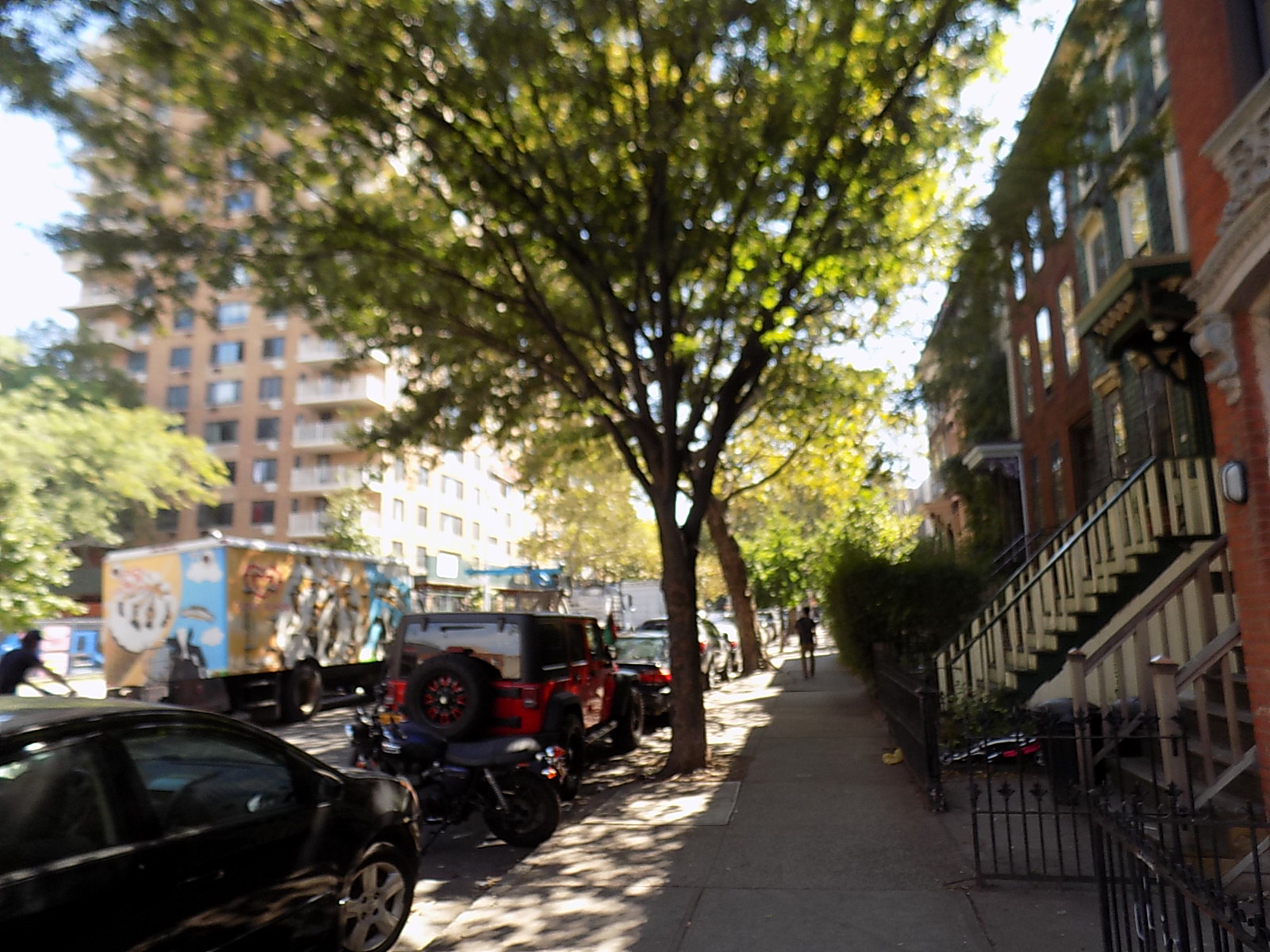
This week seven years ago, I took the picture accompanying this post while walking through the Clinton Hill neighborhood of Brooklyn—a section of the New York borough filled with tree-lined streets and brownstones. At least for me, it held some of the restorative powers that Ms. Gornick praises.

Thursday, July 8, 2021

Quote of the Day (Niccolo Machiavelli, on Cities and Freedom)

“Cities have never expanded either in dominion or in riches if they have not been in freedom.”— Italian political philosopher Niccolo Machiavelli (1469-1527), Discourses on Livy (1517)

Wednesday, November 20, 2019

Quote of the Day (Edward Hoagland, on City Walking)


“[I]f you ask people who have some choice in the matter why they live in a particular neighborhood, one answer they will give is that they ‘like to walk.’ Walking is a universal form of exercise, not age—oriented or bound to any national heritage, and costs and implies nothing except maybe a tolerant heart. Like other sports, it calls for a good eye as well as cheerful legs—those chunky gluteus muscles that are the butt of mankind’s oldest jokes—because the rhythm of walking is in the sights and one’s response as much as simply in how one steps.” —American essayist-novelist Edward Hoagland, "City Walking," New York Times Book Review, June 1, 1975, collected in Heart's Desire: The Best of Edward Hoagland: Essays from Twenty Years (1988)

Thursday, March 28, 2019

Quote of the Day (Kevin Baker, on the First Baseball Parks, in the Cities)


“The first major-league parks, back in the nineteenth century, were little more than sandlots with rows of precarious wooden bleachers—one step up from those vacant, rock-strewn lots in Chelsea. Eventually they were ringed, frontier-style, with a stockade fence so the owners could monopolize what was going on inside—charge for admission and food sales; shake down or expel gamblers who dogged the game; expand the fan base to the growing middle class, to children, and even women. These changes were akin to Vegas going family—or to the incandescent cities of fire that rose along the sands of Coney Island during the same period, replacing the site of louche entertainments with the very first official amusement parks.”— Novelist, historian, and diehard baseball fan Kevin Baker, “At the Park,” Creative Nonfiction 34 (Anatomy of Baseball), 2008

It’s opening day. Play ball!

(The source of the image accompanying this post, by the way, is The Boston Public Library. The photo, dating from 1893, shows South End Grounds in Boston, where the Boston Red Stockings, Beaneaters, and Braves played from 1871 to 1914. Today, the site—at the intersection of Walpole Street, railroad tracks, and Columbus Avenue—is a parking lot between Northeastern University's Columbus Parking Garage and Ruggles Station of the Orange Line of the MBTA.)
Saturday, July 23, 2016

Quote of the Day (Richard Brookhiser, on City Newsstands)


“Why would anyone want to use a newsstand? The pleasure of service counts for something. Thousands at your bidding do not speed, but this man behind his counter will, if you give him a dollar. Newsstands made a show of plenitude. Their wares were on display, from broadsheet seriousness to tabloid shout. Newsstands made you feel on top of things, even when you were in motion. Hurrying to an appointment, plunging into a subway, you could tell at a glance, even if you did not spring for a paper, what the headlines were. Just as promoters of plays used to cover the board walls around construction sites with one, two, three, ten, 20 posters, to satisfy the eye on the move, so a scattering of newsstands along your daily commute served the same function.” — Richard Brookhiser, on city newsstands, in “Black and White and Read: All Over,” National Review, June 13, 2016

(Photo of Richard Brookhiser discussing his book James Madison at the Miller Center in Charlottesville, Virginia, December 9, 2011)

Wednesday, May 4, 2016

Quote of the Day (Jane Jacobs, on How Cities Regenerate)


“Dull, inert cities, it is true, do contain the seeds of their own destruction and little else. But lively, diverse, intense cities contain the seeds of their own regeneration, with energy enough to carry over for problems and needs outside themselves.”— Jane Jacobs, The Death and Life of Great American Cities (1961)

Urban writer and activist Jane Jacobs was born on this day 100 years ago in Scranton, Penn. She had no training as a professional planner—a lack that proved to be fortunate, as it also freed her from professional dogmas. Her vision was empirical—what she could see with her own eyes. This was the kind of woman who saw that one of the keys to safe cities was the notion of “eyes on the street.”

If nothing else, New Yorkers particularly owe her a debt of gratitude for leading the fight against the Lower Manhattan Expressway, Robert Moses’ mad scheme that would have destroyed Soho and Little Italy. But The Death and Life of Great American Cities became a rallying cry for those who see cities as evolving, living organisms.

Bennett Kelley, host of Cyber Law and Business Report, has a warm appreciation of Jacobs over at The Huffington Post.