
Showing posts with label Churches. Show all posts
Showing posts with label Churches. Show all posts
Thursday, December 25, 2025
Photo of the Day: Altar Display, St. Cecilia Church, Englewood NJ


Sunday, May 18, 2025
Photo of the Day: St. Andrew Kim Taegon Statue, St. Raphael's Church, Long Island City, NY
.jpeg)
The son of
Christian converts, St. Andrew studied in Macao before his 1845 ordination as a
Roman Catholic priest—Korea’s first. He did not last long, falling victim to
persecution by the Josean dynasty. He was only 25 when he was beheaded for his
evangelism efforts a year later. Religious freedom would not be granted in
Korea until 1883.
Fr.
Andrew, together with 102 other Korean martyrs, was canonized by Pope John Paul
II on a trip to the nation in 1984. He is now the patron saint of Korean clergy.
Sunday, May 4, 2025
Photo of the Day: St. Raphael's Church, Long Island City, NY

Though the
parish was founded in 1865, it wasn’t until 20 years later that the current
brick-and-sandstone structure was completed. The demographics of the parish—largely
Irish and German immigrants in its early years—have changed markedly. Estimates
for language speakers are one-third each now for English, Spanish, and Korean.
Saturday, August 31, 2024
Photo of the Day: Grotto, Church of Notre Dame, Morningside Heights, NYC

So, 46 years after coming to Morningside Heights, I
decided to rectify the omission. At the time of the day when I passed by, the
church was closed, but I was able to take this photo of its picturesque grotto.
The grotto began life as a chapel in 1910. The
architectural firm Dans and Otto developed both the chapel and a replica of the
grotto where the Virgin Mary appeared to St. Bernadette of Lourdes in France in
1858.
Soon, a larger church needed to be built—an expansion
carried out by another architectural firm, Cross and Cross. But the grotto
remains standing behind the church’s main altar, a continuing reminder of the
first altar and chapel at the Church of Notre Dame.
Sunday, December 25, 2022
Photo of the Day: Christmas at St. Cecilia’s Church, Englewood NJ

Those memories continued to warm my heart even on a
hideously cold day outside.
Saturday, March 26, 2022
Photo of the Day: Church of the Ascension, New Milford, NJ

In 1953, Ascension Mission Church was formally established as a canonical parish. A fundraising drive led to groundbreaking for a complex consisting of church, rectory, convent and elementary school in 1957, with the first mass held in the church itself in February 1958.
Saturday, February 19, 2022
Photo of the Day: Church of St. Anthony, Nanuet NY

Sunday, December 19, 2021
Photo of the Day: Creche, Reformed Church, Oradell NJ
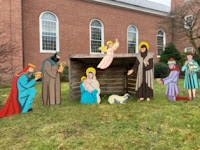
So it was yesterday, when I saw the one accompanying
this post, outside the Reformed Church of Oradell, several miles from where I
live in Bergen County, NJ.
All over the world, people continue to celebrate
births as miraculous signs of joy and hope. The birth of Jesus in Bethlehem 2,000 years ago
was even more so—an act of faith by Mary in bearing this child under unusual
and strained circumstances, and an act of faith by God that human beings,
despite their history and tendency towards sin, were worth such a dramatic
divine intervention in earthly affairs.
Sunday, November 7, 2021
Photo of the Day: First United Methodist Church, Westfield NJ

But it’s not just because it’s on a slight rise over
the traffic. This Greek Revival structure has, in its present form, stood on
this spot since 1968. It replaced another building for this faith community
that had lasted 92 years.
Sunday, March 7, 2021
Photo of the Day: St. Joseph's Church, Hackensack NJ

Befitting the parish’s origins as a house of worship
for Polish immigrants, Mass continues to be held in that language at 7 pm on Tuesday
and Friday and 11 am Sunday.
Saturday, January 30, 2021
Photo of the Day: Church of Jesus Christ of Latter-day Saints, Englewood NJ

The Church of Jesus Christ of Latter-day Saints—i.e.,
the Mormon Church—opened a facility elsewhere in Englewood in 2001, but this
faith community required a new location because of inadequate parking and an expanded
congregation. The site in this picture, on East Forest Avenue, was dedicated in
2012 and opened a couple of years later.
The meetinghouse is environmentally friendly,
including energy-efficient rooftop gardens, a recycling system that reduces
wastewater, and advanced control systems for lighting and thermal comfort. Its members
come not just from Englewood, but also Englewood Cliffs, Teaneck, Hackensack,
Fort Lee, Bogota, Leonia and Ridgefield Park.
Friday, January 1, 2021
Photo of the Day: Frank Lloyd Wright’s Unity Temple, Oak Park, IL

Visitors to the town can still see a number of homes
that Wright designed when he started his practice. But a structure of a
different kind is Unity Temple, which I visited—and photographed—while vacationing
in the Chicago area in October 2004.
This building was brought to my attention by Jim Stewart’s
“10 Sacred Sites in America Worth Seeing” post on “The Discoverer” blog.
I have my issues with his list (not a single Catholic church on it?), and he
lists Unity as being in Chicago rather than Oak Park, a suburb of the city. But
he did remind me of what a worthwhile building this is.
Readers of this blog know that I frequently include
pictures of religious institutions. Many, I found in researching their history,
were created by architects who specialized in such structures. But, out of the
approximately 1,000 buildings designed by Wright in his nearly 70-year career,
only 10 fit this description.
Wright, a member of this Unitarian congregation, offered
to design this church after its predecessor burned to the ground following a
lightning strike. Wright being Wright, his building costs doubled the original
projection of $45,000. But Wright being Wright, he also revolutionized how people
would experience such spaces.
What Wright had in mind to replace the traditional Gothic revival church building that had stood here was a structure with no steeple or front entrance, to be built entirely of poured-in-place, exposed concrete—a forerunner of 20th-century design.
Minus traditional
religious iconography, the sanctuary emphasizes light and space. It gives rise
to introspection and meditation, in keeping with the commission’s request for a
building that would embody the principles of “unity, truth, beauty, simplicity,
freedom and reason.”
When I visited, I understood perfectly how Paul
Hendrickson, in his 2019 biography of the architect, Plagued by Fire,
felt sitting in a pew in the church, “with all its light and silence and seeming
saving grace pouring down.”
When the temple was formally dedicated in 1909, Wright
was not on hand for the ceremony, having departed Oak Park in scandal because
of an affair with the wife of a client. But, if so much of his life was profane
with its ego, arrogance and deceptions, Unity Temple represented his belief in
the sacred.
Saturday, December 5, 2020
Photo of the Day: Grace Episcopal Church, Providence, RI

When the crisis clears, this institution in downtown
Providence will be well worth a visit. Though the community sustaining the
church dates back to 1829, its current home was built in 1846, according to
specifications by Richard Upjohn.
Upjohn, an immigrant from Britain, was the go-to
architect for the Episcopal Church when the denomination was in the midst of a
building expansion in the U.S. (Trinity Church in New York may be his most
famous project.)
Grace Episcopal has its own distinction as the first asymmetrical
Gothic Revival Church in America. Its beauty was enhanced in 1912 with the
addition of a chancel by architect Ralph Adams Cram.
Saturday, October 17, 2020
Photo of the Day: Our Lady of Victories, Harrington Park NJ

Saturday, October 10, 2020
Photo of the Day: St. Anthony Orthodox Church, Bergenfield NJ

I took this photo in the middle of last month, while
walking along the crossroads of Bergenfield, Englewood and Tenafly.
Sunday, September 13, 2020
Photo of the Day: Old Stone Church, Upper Nyack NY

This structure on North Broadway in this village was
begun in 1813 and dedicated the following year. The oldest church in Rockland
County, it first housed the Methodist-Episcopal Church of Nyack. Later it
served as a Unitarian Sunday school, then a non-denominational church. Now,
after restoration several years ago, it is listed on the NY State and National
Registers of Historic Places.
Tuesday, September 1, 2020
Photo of the Day: Steeple of ‘Old North Church,’ Boston MA

Even without knowing it at first, I knew there was
something important about this steeple when I saw it from a distance while I
was in Boston 12 years ago this October.
Technically speaking, this is now the Episcopal Church’s
Christ Church. But it is known to history as “Old North Church,” and if
there’s a more famous steeple in American history or literature, I can’t think
of one right now. I had to take this picture as soon as I became aware of it.
You know about it from Henry Wadsworth Longfellow’s poem
“Paul Revere’s Ride,” with the memorable lines:
He said to his friend,
“If the British march
By land or sea from the
town to-night,
Hang a lantern aloft in
the belfry-arch
Of the
North-Church-tower, as a signal-light,–
One if by land, and two
if by sea;
And I on the opposite
shore will be,
Ready to ride and spread
the alarm
Through every Middlesex
village and farm,
For the country-folk to
be up and to arm.”
A plaque downstairs
commemorates Revere and William Dawes, the other rider who alerted the
countryside that, per the steeple signal, the British were marching to
Lexington and Concord by sea across the Charles River and not by land.
The two men, unnamed in
Longfellow’s poem, who actually climbed the steeple and held high the two
lanterns were Old North Church’s sexton, Robert Newman, and vestryman, Capt.
John Pulling, Jr.—men whose courage was all the more conspicuous because, as
Patriots, they went against the prevailing Loyalist sentiment in the
congregation.
Here I am, using the
phrase “technically speaking” again—this was not the original steeple glimpsed
by Revere. This is actually the third on this spot. The first, the one
seen by Revere, was destroyed in the 1804 “Great Gale of Boston.” The second,
built two years later, fell down into Hull Street in 1954 as a result of Hurricane
Carol. (Luckily, the steeple was swaying so long that the neighborhood had
enough time to be evacuated.)
The steeple you see now
was rebuilt a year later, and made to look more like the one that Revere saw—only
this time, with added steel reinforcements to safeguard against future storms.
So far—God willing—it has held.
Sunday, March 22, 2020
Photo of the Day: St. John the Evangelist Roman Catholic Church, Leonia, NJ

I believe that at least some of my readers from
Bergen County, NJ, grew up attending Masses in St. John the Evangelist.
They in particular are likely to feel sad that an institution so much a part of
their memories has temporarily closed, like others in the Archdiocese of
Newark, because of the coronavirus.
At just the moment when we need a source of consolation amid stress and tragedy, one of our chief lifelong sources of it is unavailable to us.
Decades before this, the Roman Catholic Church
looked to other communication channels to spread the faith, such as radio and
television. But the resort to live streaming is less a proactive than a
defensive measure. It supplements the physical experience of the Mass, but does
not replace it. I was grateful to participate this morning via St. John’s
live-streaming, but longed for the real thing.
The creators of the Church instinctively grasped
that, like love for another person, love of God is best transmitted tactilely—through
the swelling of the organ, the lifting of voices toward the vaulted ceilings,
the clasp of hands in the sign of peace, and the odor of incense. And, as the
very name “Mass” indicates, the individual is anchored in a large, mass faith
community.
In the end, a live streaming service is a poor but
necessary substitute for the Mass. Although I understand and respect First Things editor R.R. Reno’s argument that canceling services is “utterly unnecessary,” incidents of
exposure to the coronavirus that have occurred in other faiths confirm the need
for caution.
Even now, so many of us long for God as we long for
each other. For now, we will have to find him inescapably where we always
should have: in the deepest parts of our souls.
Saturday, October 19, 2019
Photo of the Day: Heinz Memorial Chapel, Pittsburgh, PA

I visited Heinz Memorial Chapel, the
non-sectarian religious facility of the University of Pittsburgh, while in town
this past week. Like the buildings next to it—the Cathedral of Learning and the
Stephen Foster Memorial—it was designed by Philadelphia architect Charles
Klauder.
Each of the three is distinct, but Heinz possesses
an interior and exterior beauty all its own. In an American city of 20th-century
bustling industrial smoke and noise, it harked back to a 700-year-old Western
European tradition of purity and silence: the neo-Gothic style of architecture. I think you’ll understand perfectly
why I photographed the site.
The building is the result of a bequest by the
Pittsburgh industrialist Henry J. Heinz to honor his mother, Anna
Margaretta Heinz. Ground was broken in August 1933 with the dedication
ceremonies occurring five years later.
Open daily throughout the year except
for university holidays, the chapel hosts approximately 1,000 events annually--
religious services, weddings, concerts, lectures, memorial services and guided
tours.
The building inspires a sense of quiet awe of the
creative humans who brought it to fruition in the darkest days of the Great
Depression and of the supreme being who inspired their efforts and continues to
infuse those who behold this space.
Did I say “quiet”? Well, maybe only some of the time
in the chapel. Aside from services, you might hear the sounds coming through
the pipe organ—the third instrument of this kind in the history of the chapel.
But cast your eyes around at the Indiana limestone
walls, stone vaults, high ceilings, and arches—not to mention stained glass
pieces, each with their own story—and you can easily imagine yourself far, far
away.
Saturday, December 15, 2018
Photo of the Day: St. Thomas Episcopal Church, Fifth Avenue, NYC

When my company was located at the Rolex Building, I
used to pass by the house of worship located catty-corner from it on Fifth
Avenue and 53rd Street, St. Thomas Episcopal Church. The fourth church for the parish, it replaced a prior structure destroyed
in a 1905 fire.
Many other congregations might not have recovered
from a blaze that consumed interiors by John LaFarge and sculptures by Augustus
St. Gaudens. But architect Ralph Adams Cram announced that the new structure
would probably be “the most expensive church per square foot built thus far in
the United States.” St. Thomas rebuilt rapidly, with the first service in its new home being held Oct. 4, 1913.
Like St. Patrick’s Cathedral a few blocks to the
south, St. Thomas, with its French High Gothic architectural style, stands out
from the modernist, glass-and-steel cathedrals of commerce that now populate
Fifth Avenue. From its triple-arched entrance way to its stone quarried from
Kentucky, it awes even from the outside—an impression only enhanced by a
preservation project completed a year ago that saw restoration of its stained
glass windows and the cleaning of its facade.
Subscribe to:
Posts (Atom)


