Showing posts with label Bette Davis. Show all posts

Monday, October 7, 2024

Quote of the Day (George Meredith, on The Plight of Those ‘Hot for Certainties’)

"Ah, what a dusty answer gets the soul
When hot for certainties in this our life!—
In tragic hints here see what evermore
Moves dark as yonder midnight ocean's force,
Thundering like ramping hosts of warrior horse,
To throw that faint thin line upon the shore!"—English poet-novelist George Meredith (1828-1909), Modern Love (1862)

The image accompanying this post shows Bette Davis and Olivia DeHavilland in the 1942 film adaptation of Ellen Glasgow’s Pulitzer Prize-winning novel, In This Our Life—a title taken, as seen in the passage above, from this George Meredith poem.

Saturday, December 18, 2021

This Day in Film History (‘Pocketful of Miracles,’ Capra’s Lesser Yule Tale, Opens)

Dec. 18, 1961—Pocketful of Miracles opened in American theaters almost 15 years to the day that It’s a Wonderful Life premiered, and likewise failed to meet expectations at the box office. But, while veteran director Frank Capra’s earlier film went on, through countless repeat TV showings, to become a holiday classic, his later production—also containing Yuletide elements—has never gained similar popular traction.

It’s not that Pocketful of Miracles is completely unknown: The comedy has, after all, been shown numerous times over the years on TCM, and its stars included the very recognizable Bette Davis, Glenn Ford, and, in her big-screen debut, Ann-Margret.

But even many fans of older movies don’t recognize it, as was borne out for me a few days ago, when another fan of such fare could not bring it to mind when I spoke to her. And lines from the film have not entered popular memory, as they have with It’s a Wonderful Life or a much more recent movie, A Christmas Story.

Making the movie, Capra admitted a decade later in his autobiography, The Name Above the Title, was a “miserable” experience. It soured him so much on how the industry had changed since his heyday at Columbia Pictures in the 1930s that it turned out to be his swan song.

Part of the reason why the production turned out to be so joyless and disappointing was that Capra had begun it with such high hopes. It was, after all, a remake of Lady for a Day, which had earned him the first of six Oscar nominations for Best Director back in 1934.

Among Capra’s generation of older directors, the idea of remaking their own black-and-white films of more than 20 years before had a certain appeal, as evidenced by Alfred Hitchcock’s The Man Who Knew Too Much (1934 and 1956), and Leo McCarey’s Love Affair (released first in 1939, then redone as An Affair to Remember).

The logic behind their reasoning seemed overpowering, even inescapable: If Hollywood was going to remake these (and it would), who better to do so than the original creative force who knew not only what aspects of it were worth preserving but also what could be corrected and what could be added that wasn’t around a generation before (notably, color and bigger screens)?

There were only a couple of problems with this in Capra’s case, but they were significant. First, although he was eager to adapt Damon Runyon’s Prohibition Era tale “Madame Le Gimp” for a later generation, Hollywood executives did not feel similarly, believing audiences would find it dated.

Second, Hitchcock and McCarey had, in James Stewart and Cary Grant, stars not only well-cast but also uninterested in throwing their weight around. But Capra had as his male lead Glenn Ford, who, as associate producer, had helped finance the film and was not shy about determining its direction.

In particular, Ford insisted that, as gangster moll Queenie Martin, his girlfriend Hope Lange should replace Shirley Jones, a recent Oscar winner for Elmer Gantry whom Capra had already promised the role. The reluctant director acceded to his star’s cast-her-or-I-quit threat, but it rankled.

One of the few fundamental deviations that Pocketful of Miracles made from Robert Riskin’s script for Lady for a Day was a larger presence for Queenie  (whom 1930s audiences would have recognized as a fictionalized stand-in for nightclub hostess Texas Guinan). It is hard not to see the hand of Ford in that decision.

Lange was hardly a disaster in her role. But her presence represented a mounting list of initial casting choices that weren’t turning out as Capra had wished.

Ford himself was not his preference for superstitious gangster “Dave the Dude.” But his desired choices—Steve McQueen, Jackie Gleason, Kirk Douglas, Dean Martin and Frank Sinatra—didn’t work out, for one reason or another. (Sinatra’s association with the production would, in the end, be limited to turning its theme song into a hit.)

Likewise, Bette Davis was not whom Capra had in mind for street peddler Apple Annie. But Shirley Booth felt she couldn’t improve on May Robson’s Oscar-nominated performance in Lady for a Day; Helen Hayes couldn’t find space in her schedule; and Katharine Hepburn and Jean Arthur (so memorable in Capra’s Mr. Deeds Goes to Town and Mr. Smith Goes to Washington) both turned down the role.

Davis, with increasingly lower-profile roles since her triumph a decade before in All About Eve, was eager for the work and the $100,000 salary, and agreed to take on the part when Capra offered it.

As great an actress as she was, Davis was, at 53, younger and less believable as woebegone Annie than the two-decades-older Robson. But Capra had a more immediate problem with her, caused by—yes, Ford.

The trouble began a week after Davis came to the set, when Lange requested a dressing room next to Ford. That room belonged to Davis, who was miffed about yielding her position to a younger, less-established actress. 

In a well-intended but clumsy attempt to smooth things over, Ford only made matters worse by saying in an interview that he was repaying Davis for giving him his start in films by putting her in this movie, hoping it would be a comeback vehicle for her.

“Who is that son of a bitch that he should say he helped me have a comeback!” Davis stormed. “That shitheel wouldn’t have helped me out of a sewer!”

From then on, the production was “shaped in the fires of discord and filmed in an atmosphere of pain, strain, and loathing," Capra wrote in The Name Above the Title.

Years later, he regretted that with Davis, he “didn’t see that needed consolation and reassurance after so long away.” But on set, he was not inclined to mediate the noticeable tension between her and Ford, and he developed increasing headaches.

It’s hard not to read Capra’s memoir without the sense that, over and above everything else, he resented Ford for undercutting his authority and creative freedom as the director: “My ‘one man, one film’ Hollywood had ceased to exist. Actors had sliced it up into capital gains.”

The results showed on the screen. It wasn’t so much in the performances of the supporting players. (Particularly wonderful are “It’s a Wonderful Life”’s Uncle Billy, Thomas Mitchell, here in his last movie role; Mickey Shaughnessy, given perhaps the funniest line of the film, “She's like a cockroach what turned into a butterfly!”; and Peter Falk, nominated for a Best Supporting Actor Oscar as Dave the Dude’s cranky right-hand man “Joy Boy”).

Rather, the trouble is apparent in the film’s pace—which, uncharacteristically for Capra, is uneven, even slack at points. Lady for a Day had a running time of an hour and 34 minutes—plenty of time to tell its story and be on its way. In contrast, Pocketful of Miracles clocks in at two hours and 16 minutes but feels like it could use a good half hour cut.

Capra received a Directors Guild of America nomination for this film. But overall, he agreed with reviewers like The New York Times’ A.H. Weiler, who noted, “Mr. Capra and his energetic troupe manage to get a fair share of laughs from Mr. Runyon’s oddball guys and dolls, but their lampoon is dated and sometimes uneven and lifeless.” 

A couple of years later, Capra expressed interest in directing an adaptation of the Broadway satire The Best Man, but creative differences with playwright Gore Vidal kept him from taking on that project, probably for the best.

Pocketful of Miracles was an exercise in nostalgia for a world that had passed. So had the studio system in which Capra had once flourished.

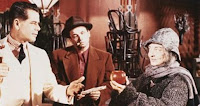
(The image accompanying this post shows Ford, Falk and Davis. Though it seemed imperative to have the two feuding co-stars in a still for my commentary, I couldn't resist including Falk, whose performances gives viewers as much pleasure as it did Capra.)

Wednesday, July 12, 2017

Quote of the Day (Bette Davis, on Why She Was ‘Doomed to an Eternity of Compulsive Work’)


“I am doomed to an eternity of compulsive work. No set goal achieved satisfies. Success only breeds a new goal. The golden apple devoured has seeds. It is endless.”—Two-time Oscar-winning actress Bette Davis (1908-1989), The Lonely Life (1962)

Saturday, February 16, 2013

Quote of the Day (Bette Davis, on Acting With ‘Wonder and Insight’)


"Without wonder and insight, acting is just a trade. With it, it becomes creation."—Bette Davis (1908-1989), The Lonely Life: An Autobiography (1962).

The two-time Oscar-winning actress is shown, in the image accompanying this post, in the trail for a film that did not net her an Academy Award, but which remains among the most vivid in her entire career: All About Eve (1950).

Monday, December 19, 2011

Movie Quote of the Day (‘Pocketful of Miracles,’ on Its ‘Lady for a Day’)

Junior (played by Mickey Shaughnessy), seeing boozy beggar Apple Annie (played by Bette Davis) transformed into a duchess: “She's like a cockroach what turned into a butterfly!”—Pocketful of Miracles (1961), written by Hal Kanter and Harry Tugend, based on an earlier screenplay by Robert Riskin and the Damon Runyon short story “Madame La Gimp,” directed by Frank Capra

Fifty years ago today, Frank Capra’s remake of his 1933 Gotham fairy tale, Lady for a Day, premiered, with a bigger budget, bigger stars, and longer running time, in New York City. Its failure this time around led the great director to decide that the thrill was gone out of moviemaking in an age when a star (to his aggravation, only a middling one like Glenn Ford) could force him into a compromised product. Partly as a result, this would be his last completed feature film: three years later, he pulled out of Marooned when he tired of incessant studio demands for script approval and budgets.

Capra was right in this respect: among his quartet of holiday movies (the others: Lady for a Day, Meet John Doe, and, of course, It’s a Wonderful Life), this one ranked last. I’m afraid that, like another holiday film, Love, Actually four decades later, the final product of Pocketful of Miracles failed to deliver on its tremendous promise. Miscast are Bette Davis and Ford, as, respectively, the street woman desperate that the daughter who has lived abroad for years not realize how far she has fallen, and the unexpectedly tenderhearted racketeer who decides to turn her into a duchess (or, at least, appear like one). Moreover, the extra 40 minutes gained since Lady for a Day puffed up what at heart is a comic fairy tale.

Not to say that there aren’t moments, even whole stretches, of pure enjoyment. When he wasn’t coping with cluster headaches over his feuding co-stars, Capra delighted in his terrific group of supporting players— not just Shaughnessy but also Sheldon Leonard, Edward Everett Horton, Thomas Mitchell (Uncle Billy of It’s a Wonderful Life), and especially Peter Falk, who was nominated for a Best Supporting Actor Oscar for his turn as Dave the Dude’s underling, the ironically named Joy Boy.

And then there is the dialogue. Much of the best of it sprang from unaccredited Jimmy Cannon (“superb slinger of Broadway’s argot,” Capra called him in his autobiography, The Name Above the Title). The sportswriter managed to blend seamlessly Runyon’s original lingo with his own, so it’s hard to tell the source of such lines as the above, or Joy Boy's exclamation upon seeing a room after a quarrel between Dave and girlfriend Queenie: “Look at this place, like the inside of a goat's stomach!"

For another Runyon Yuletide take, in undiluted form, you might want to turn to the short story “Dancing Dan’s Christmas,” in the Everyman Library anthology Christmas Stories. It now only features the colorful characters and hilarious dialogue that Hollywood and Broadway (Guys and Dolls) have long loved about Runyon, but also an O.Henry-style ending and a distinct undercurrent of danger downplayed on film and the stage (we are, after all, reading about people engaged in criminal enterprises).

Saturday, April 5, 2008

This Day in Film History (Birth of Bette Davis)


April 5, 1908—Those “Bette Davis eyes” first stared out at the world on this date in Lowell, Mass.

Her birth name was actually Ruth Davis, but she took the first name “Bette” in tribute to the French novel Cousin Bette by Balzac. Had her career not fallen into the abyss in her mid-to-late 40s, that role—a vengeful poor relation out to destroy her richer Parisian cousins—might have made a wonderful vehicle as she made the transition from leading lady to character actress. It would have afforded plenty of opportunity to display the intelligence—and seething amusement and anger at what suckers men are—behind those famous eyes.

Shortly before her 10th birthday, her father left the family—the first of a lifelong series of men who would never stay around, including four husbands.

Lack of money didn’t prevent her mother from sending her and her sister to boarding school, however. After that, acting beckoned.

People had her pegged from the start as a star in the making at John Murray Anderson's Dramatic School in Manhattan. Davis, her (initially) less successful classmate Lucille Ball remembered in her autobiography, Love, Lucy, “earned raves for everything she did. A short, dynamic blonde, she projected with great verve.”

Battles With the Studio
After a short Broadway stint, she made her way to Hollywood. Universal Studios couldn’t figure out what to do with her, and for awhile it appeared that Warner Bros. couldn’t either. Even after her star-making role (made on loan to RKO) in Of Human Bondage as a ferociously unsympathetic prostitute and a compensatory Oscar for Dangerous a year later, she was so annoyed with Warner Bros. for the parts they offered her that she left for England. A threatened lawsuit by Jack Warner brought her to heel, but she had made her point, and from then on the quality of the roles improved.

Critic Terrence Rafferty, whose judgment I have come to trust over the years, labeled Davis “the greatest actress of the American cinema” in a
fine career summation in The New York Times last weekend. I’m not sure I would go that far: Katharine Hepburn and Meryl Streep, for instance, have displayed a flair for comedy that Davis rarely if ever showed, and Streep in particular has displayed an extraordinary capacity to make herself over into virtually anybody. But there is little if any doubt of the tremendous impact that Davis at her best could make.

Whenever people think of Davis, several films come immediately to mind: Dark Victory, Now, Voyager, All About Eve, Whatever Happened to Baby Jane?, Jezebel, The Letter, and The Little Foxes. (The last three were made in collaboration with director
William Wyler. According to interviews with Charlotte Chandler done not long before the actress died, Davis aborted the child she conceived with Wyler while making Jezebel. Later, when he proposed marriage, she took too long to think about it and Wyler married someone else. For the rest of her life, she mourned him as the man who got away—though the director, predictably, thought that life with her would have been impossible, given her tempestuousness.)

Three Davis Favorites
All of these films deserve their acclaim, but I would suggest three others not as well known: Mr. Skeffington, The Old Maid, and Old Acquaintance.

Her last Oscar-nominated role while under contract to Warner Bros., Davis’ Fanny Skeffington is a vain beauty who marries her Jewish husband to save her brother from a stock-market scandal. The self-sacrificing decision by loving and long-suffering Job Skeffington (played by Claude Rains) to let her go leads her to embark on a string of empty affairs—and to end up lonely when a bout of diphtheria ruins her looks.

The plot is surely melodramatic and the film bears all the marks of the ‘40s “woman’s movie” (the more mature version of today’s “chick flick” we know today). But Davis negotiates her character’s passage from flirtatiousness to heartbreak well. (Kudos also to cinematographer Ernest Haller, whose black-and-white photography made Davis appear at the height of her allure--though even here, Davis needs to be given her due, since --characteristically--she never allowed anyone else to do her makeup for her.)

The Old Maid and Old Acquaintance became battlegrounds with a star whose tempestuousness may have exceeded Davis’:
Miriam Hopkins. In The Old Maid, an adaptation of the Edith Wharton novella, the actresses’ on-screen rivalry for the affection of the daughter that Davis’s Charlotte bore out of wedlock and Hopkins’ Cousin Delia adopted as her own was played out off-screen. Every bit of that intensity shows onscreen in the faceoffs between Davis and Hopkins. (Not long before her death, Davis paid a tribute of sorts to Hopkins, calling her “a wonderful actress but a bitch,” even – perhaps the ultimate compliment from Davis, given the run-ins she’d have through the rest of her career with other co-stars– “the most thoroughgoing bitch I have ever worked with.”)
.
Last summer, I saw the Roundabout Theatre Company’s revival of John Van Druten’s Old Acquaintance. Though Margaret Colin and Harriet Harris gave their all, the play felt curiously flat—as did, I might add, the more explicit film remake Rich and Famous starring Jacqueline Bisset and Candice Bergen in the Davis-Hopkins roles. But then, it was hard not for these two to measure up to my memory—the 1943 film featured a battle for the ages.

With Davis’ first choice for her frenemy in the film, Norma Shearer, turning down the role, the stage was set for a rematch between Davis and Hopkins. The script, like the play, featured a scene in which Davis’ midlist novelist, level-headed Kit Marlowe, was supposed to slap her longtime friend, Hopkins’ successful trashy novelist Millie Drake, for her jealousy and general all-around idiocy. The day the scene was shot, everybody on scene gathered to watch the most eagerly awaited rematch since Joe Louis and Max Schmeling’s shot but epic encounter at Yankee Stadium five years before.

Davis didn’t disappoint, letting Hopkins have it in a scene that makes the short list of any great Davis moment.

In her speech accepting her Best Actress Oscar for Terms of Endearment, Shirley MacLaine referred to the “turbulent brilliance” of co-star Debra Winger. That ferocious commitment to excellence was also the hallmark of Davis—who, in fact, in
a late-career interview, offered Winger up as one of two young actresses she particularly admired (Sissy Spacek was the other).

The tragedy of Winger’s career—now in abeyance for who knows how long?—is that she made her mark in relatively few films. For all of Davis’ clashes with moguls, directors and co-stars, the genius of the studio system was that it offered her repeated opportunities to practice her craft—and, in the case of Mr. Skeffington, elevate what seems at first glance to be hopelessly humdrum material.

A Little-Known Late-Career Treat
How might Davis’s career have turned out had she been born later? One tantalizing glimpse can be found in this 1963 guest appearance Davis made on Perry Mason, when CBS called on several stars to fill in for Raymond Burr as he recovered from surgery. (Given the lack of decent roles Davis was getting at that point, even after Whatever Happened to Baby Jane?, she probably jumped at the chance to play something.)

The show’s formula didn’t allow Davis a lot of room, but watch this clip as her defense attorney listens to her client—eyes flitting around the room, fingers clutching and unclutching her pencil--and you’ll learn all you need to know about her character’s restless intelligence. “The Case of Constant Doyle” is like watching Michelangelo doing a pencil drawing—not an ideal medium, but enough to reveal an outsized talent. It's easy to imagine Davis on Law and Order or its progeny.

For a long time, Hollywood discussed making an American version of Helen Mirren’s detective Jane Tennison in Prime Suspect. I think Davis would have performed marvels with the flinty but troubled middle-aged detective superintendent.